Object of the Month: December 2025
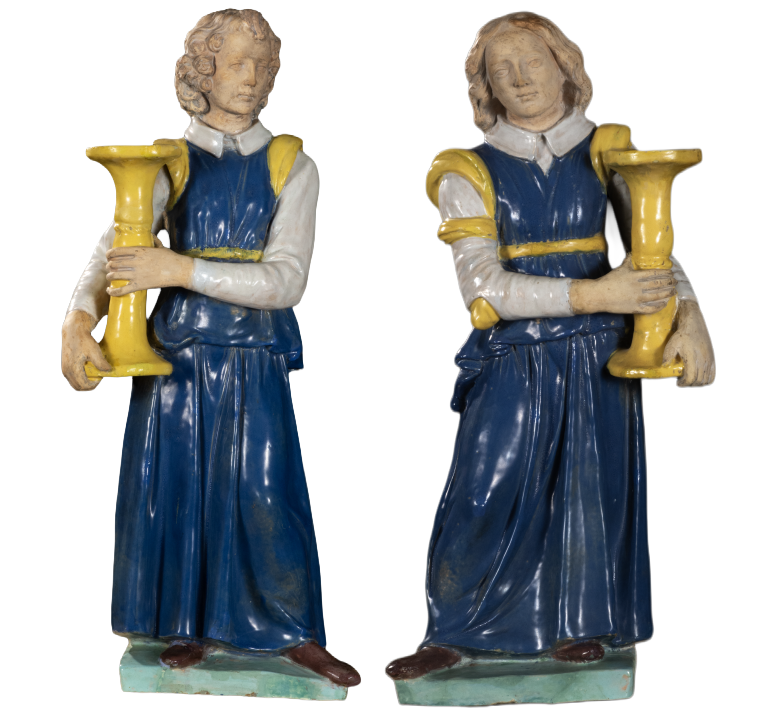
Pair of Angels with Candlesticks
Glazed terracotta, c. 1500
Benedetto Buglioni (attributed to)
Florence, 1459/60 – 1521
 Italian Renaissance masters like Donatello, Cellini, and Michaelangelo created magnificent sculptures chiseled from stone, carved from wood, or cast in metal. These methods were time-consuming and costly. In the early 1440s, Luca della Robbia, a stone sculptor in Florence, was able to cut the time and cost of sculpture production by developing techniques for tin-glazed terracotta. In addition to achieving the magnificent detail found in the expensive materials, he produced vibrant, permanent colors in his sculptures which other media could not duplicate. Also, he designed multiple modified pieces from molds, which greatly reduced production time and cost.
As a businessman, Luca della Robbia managed a large workshop, where he produced high quality, tin-glazed terracotta pieces and preserved the secrecy of his formulas and techniques. His nephew, Andrea della Robbia inherited both Luca’s workshop and secrets. He became an outstanding sculptor, creating pieces beyond his uncle’s capabilities. (Andrea’s sons, Giovanni and Girolamo, also became sculptors and practiced the family’s secrets. Girolamo accepted the king of France’s invitation to Paris in 1517, where he made M&G’s terracotta busts of French nobility.)
Benedetto Buglioni
The son of a sculptor, Benedetto Buglioni was born in Florence in 1459/60. He probably studied under Andrea del Verrocchio (Leonardo da Vinci’s teacher) and learned terracotta sculpting as a pupil in the della Robbia workshop of Luca and later Andrea. According to Giorgio Vasari, a contemporary artist and historian, Benedetto learned the “secret of glazed earthenware” from a female servant “who came out of the house of Andrea della Robbia.”
In his early 20s, Benedetto opened his own terracotta workshop in Florence. For unknown reasons, from 1487 to 1490, he and his brother produced terracotta works in Perugia, a city about 100 miles from Florence. Returning to Florence, the Buglioni brothers opened their own workshop and became della Robbia’s chief competitors. High quality, tin-glazed terracotta was extremely popular, and there were plenty of commissions for both workshops.
In time Benedetto was recognized as a master artist. His clients included major churches, important civic groups, and wealthy patrons, including the Medici family. His standing in the artistic community is recognized by the fact that he served on the committee which determined the placement of Michelangelo’s monumental David.
Terracotta Angel Candlesticks
The Eucharist or Communion is a Christian sacrament instituted by Jesus Christ at the final supper before His crucifixion. He shared bread and wine with His disciples and told them the bread represented His body and the wine, His blood. His followers were to partake of the bread and wine as a reminder of His sacrifice and its eternal significance.
In Roman Catholic churches, the elements of the Eucharist are kept in a tabernacle, a locked and decorative box, built into the wall or placed on the altar. As part of the Catholic Mass, candles on either side of the tabernacle are lit. Traditionally, the candles are reminders that Christ is the light of the world and the church.
M&G’s angels probably held candles on either side of a tabernacle. These angels may have been part of a matching tabernacle and angel set, or they may have been used with a tabernacle made of other materials. There are few Renaissance terracotta tabernacles still in existence, and very few of those still have their original angel candlesticks. Of the existing Renaissance terracotta angel candlesticks, most lack tabernacles and some even lack their partner angel.
M&G’s terracotta candlesticks are a typical height—roughly 22 inches; however, their design details vary greatly. Some Renaissance angel candlesticks stand, others kneel. Some wear robes, stoles, surpluses, sashes, jewelry, or belts; others have intricate collars, cuffs or hems. Some are barefoot, some wear sandals, and others wear shoes. Many have wings, and some, like M&G’s, were designed wingless.
M&G’s Pair of Angels with Candlesticks began as a piece of wood wrapped in wet cloths. A molded clay body was formed around the cloths. The body then received a head, arms, hands, feet, clothing details, and candle holder. Some of these additions were based on standard clay molds, and others were hand-sculpted from raw clay. When the sculpture was complete and the clay set, the wood and cloths were removed, leaving a hollow center, necessary for proper drying and firing.
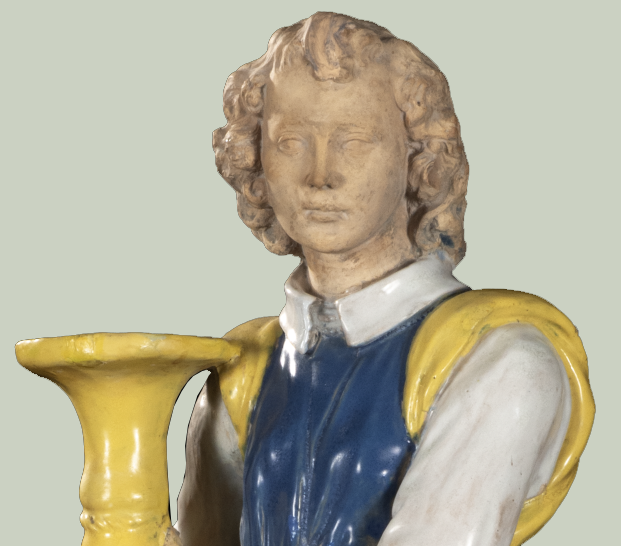 The head and hands of M&G’s angels are not glazed; these areas are the color of baked clay. A tin oxide glaze was painted over all the areas to be glazed and then fired, leaving a beautiful white as seen in the angels’ collars and sleeves. Next, a blue cobalt and a yellow lead glaze were painted over the white. When fired again, the glazes fused with the terracotta, became enameled, and their colors permanent.
Renaissance sculptors rarely signed their works. If found, contracts and payment records can establish who created larger objects; however, smaller works are most often associated with a particular workshop based on style, quality, and the figure’s individual details. Experts agree that M&G’s angels can be attributed to Benedetto Buglioni and his workshop.
Although these angels no longer serve during church services, they do speak to us of the craftmanship of Renaissance tin-glazed terracotta masters. They may also cause us to think of those who saw them in the warm glow of their candles more than 500 years ago.
William Pinkston, retired educator and M&G volunteer
Suggested Reference
Della Robbia: Sculpting with Color in Renaissance Florence by Marietta Cambareri, with contributions by Abigall Hykin and Cortney Harris
Published 2025
