This depiction of St. John the Evangelist by the Master of Cueza provides an intriguing look at various accoutrements used by medieval scribes.
Category Archives: M&G Collection Online
Hebrew Scroll of the Book of Esther
Gazelle skin and wood
Hebrew Scroll of the Book of Ruth
Parchment on olive wood with ivory crown
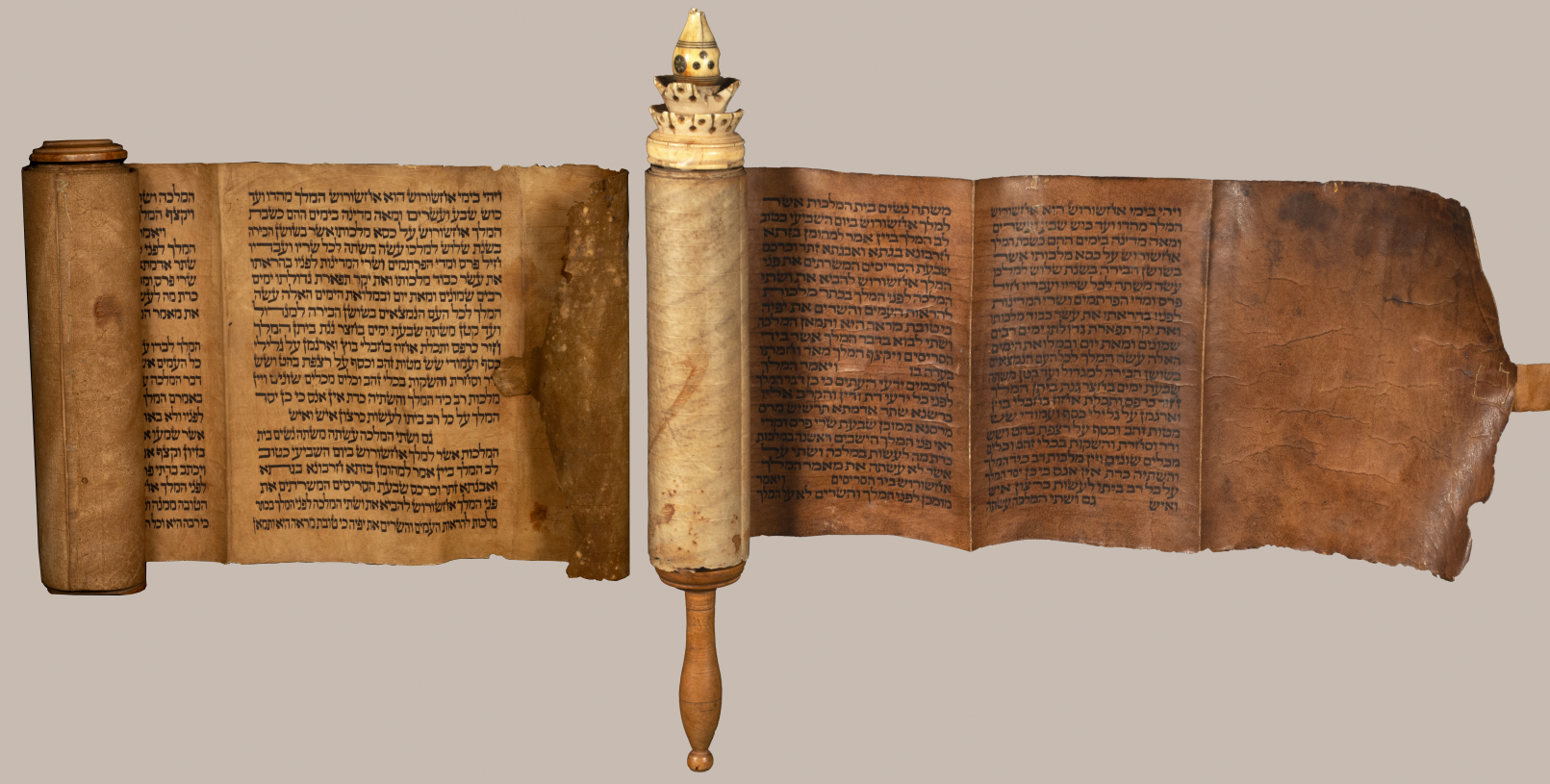
The Jewish Bible, known as the Tanakh, is divided into three parts: the Law (Torah), the Prophets, and the Writings. The Writings are also in three divisions: poetry, history, and the Megillot. Synagogue worship during the five annual Jewish holidays often include reading of one of the five, short Megillot scrolls. M&G’s collection of antiquities includes two Megillot scrolls: Esther and Ruth. They are the only biblical books named for females, and both tell dramatic narratives of their heroines.
Esther
Esther, a young Jewish woman, becomes the queen of Persia when King Xerxes (or Ahasuerus) chooses her as his bride. Mordecai, Esther’s cousin and guardian, has offended the king’s chief advisor, Haman, by not bowing to him. This public insult provokes Haman to plot the annihilation of the Jewish people in Persia. When Mordecai learns of Haman’s plan, he urges Esther to use her position to save her people.
Initially Esther is reluctant. By decree, anyone entering the king’s presence without being summoned is to be put to death. Her approaching Xerxes could be fatal. Eventually she is persuaded as Mordecai says: “Who knows but that you have come to the kingdom for such a time as this?” (Esther 4:14).
After three days of prayer and fasting, Esther approaches the King. He extends his golden scepter to her, sparing her life, and tells her that her petition will be granted. She invites the King and Haman to a series of banquets. At the second banquet the king repeats his offer to grant Esther’s petition. She reveals that she is a Jew and tells of Haman’s plan to kill all the Jews in Persia. The enraged king orders Haman’s execution, and it is carried out on the gallows he had prepared for Mordecai. The King then promotes Mordecai to Haman’s position.
The Book of Esther teaches that Divine intervention often occurs in unexpected ways. The story highlights the themes of courage, faith, justice, the reversal of evil, and the importance of standing up for one’s faith in God, even in times of peril.
After Mordecai’s promotion he writes to all the Persian Jews that they should annually “make them days of feasting and joy, and of sending portions one to another, and gifts to the poor” (Esther 9:22). Today the Jewish festival of Purim celebrates this deliverance of the Jews by chanting or reading aloud the Book of Esther as part of synagogue worship. M&G’s Esther scroll is just over 11 ft long, and depending on one’s pace, can take 60–90 minutes to read. During the reading many congregations participate by reciting certain verses and by using wooden noise makers (gragers) to blot out Haman’s name. Purim’s traditional celebratory meal, exchanging gifts of food, and contributions to the poor are based on Mordecai’s instructions.
Ruth
Famine causes Elimelech, his wife Naomi, and their two sons to leave Israel and live among idol-worshipers in the land of Moab. While there, the sons marry Moabite women. Eventually Elimelech and his sons die. Naomi, a grieving and bitter widow, decides to return to Bethlehem and instructs her daughters-in-law to return to their families. One does. Ruth, however, says “Intreat me not to leave thee, or to return from following after thee: for whither thou goest, I will go; and where thou lodgest, I will lodge: thy people shall be my people, and thy God my God” (Ruth 1:16).
In Bethlehem, Ruth gleans in the fields of Boaz, a wealthy relative of Naomi’s late husband. Impressed by Ruth’s kindness to Naomi, Boaz insures she is protected while gathering barley in his fields. Seeing an opportunity, Naomi encourages Ruth to ask Boaz to redeem her, a legal condition that would wed her to Boaz and restore Naomi’s family property. Moved by Ruth’s character, Boaz is inclined to accept but recognizes that a closer relative has the right of redemption. When that kinsman declines to redeem her, Boaz marries Ruth.
The theme of redemption and the virtues of loyalty and faithfulness permeate the Book of Ruth. The universality of God’s providence is also demonstrated. Ruth and Boaz’s son, Obed, is the grandfather of the Jewish King David, which places Ruth, a converted Moabite, in the lineage of the Messiah.
Today many Jewish communities read the Book of Ruth during Shavuot, the two-day holiday that commemorates God giving Moses the Ten Commandments. Shavuot is celebrated during the time of harvest, which parallels the time of Ruth’s gathering barley. Ruth’s acceptance of the Jewish faith parallels the Jewish people accepting the Law delivered to them on Mount Sinai.
M&G’s Megillot Scrolls
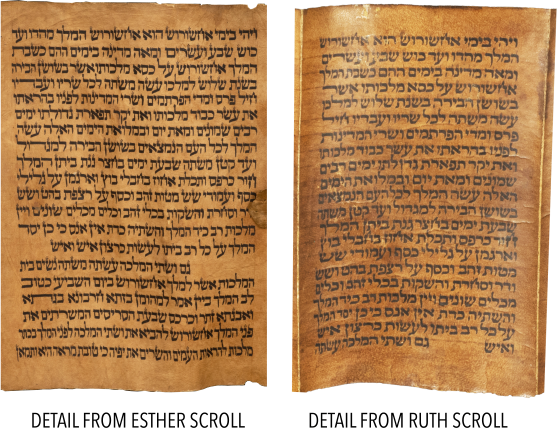
To be read in synagogue worship, a scroll must be sefer (ritually clean), meeting a lengthy list of conditions. It must be handwritten by a qualified sofer, using a quill of a kosher bird (or other permitted instrument) with kosher ink, on parchment made of a kosher animal hide. M&G’s Esther scroll, for example, is written on gazelle skin.
Sefer scrolls may not have calligraphic flourishes, illuminations or illustrations. Such additions could distract the reader from thinking about the message of the text. Some Jewish groups, however, permit Megillot scrolls to be embellished. Sefer Esther scrolls have been illuminated with decorative borders and portraits of its characters for centuries. In some Jewish communities a modern scroll of Esther may have colorful, printed scenes of the story between handwritten panels of the Hebrew text. Both M&G’s Esther and Ruth scrolls lack calligraphic or other embellishments. They were probably commissioned for use in strict Jewish congregations.

While groups may differ regarding embellishments of the scroll, its protective coverings (a cloth mantle or a cylindrical box) and the wood dowel on which the scroll is rolled can be ornate. Costly embellishment of the non-textual parts of a scroll reflects a desire to recognize the scroll’s significance and the means of the individual or group commissioning the scroll. M&G’s Ruth scroll is mounted on an olive wood shaft with a carved ivory crown. The scroll is 8.5 ft long and could be read or chanted in about 30 minutes.
William Pinkston, Retired Educator and M&G Volunteer
Published 2025
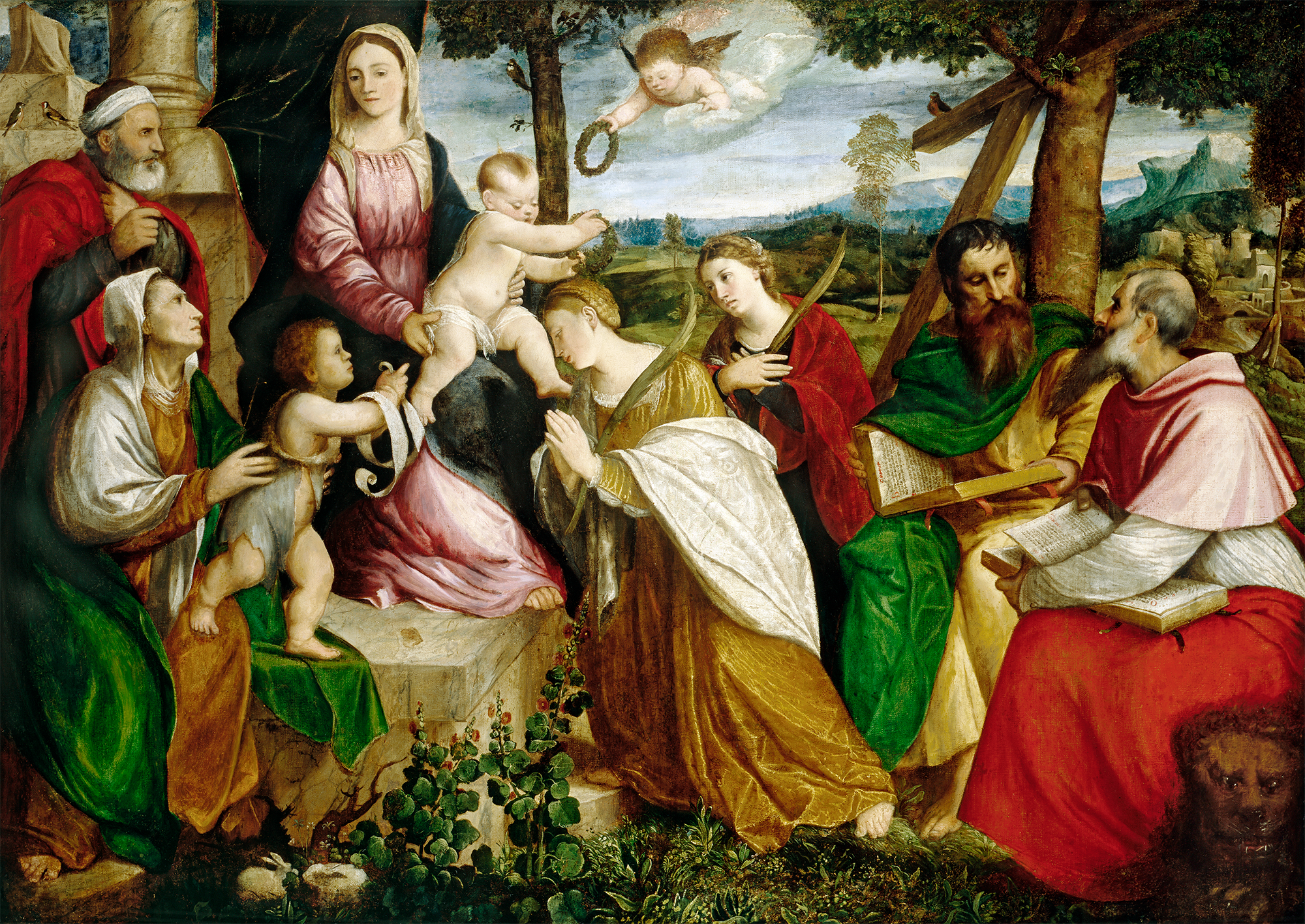
Sacred Conversation
Bonifazio de’ Pitati, called Bonifazio Veronese
Below the image, click play to listen.
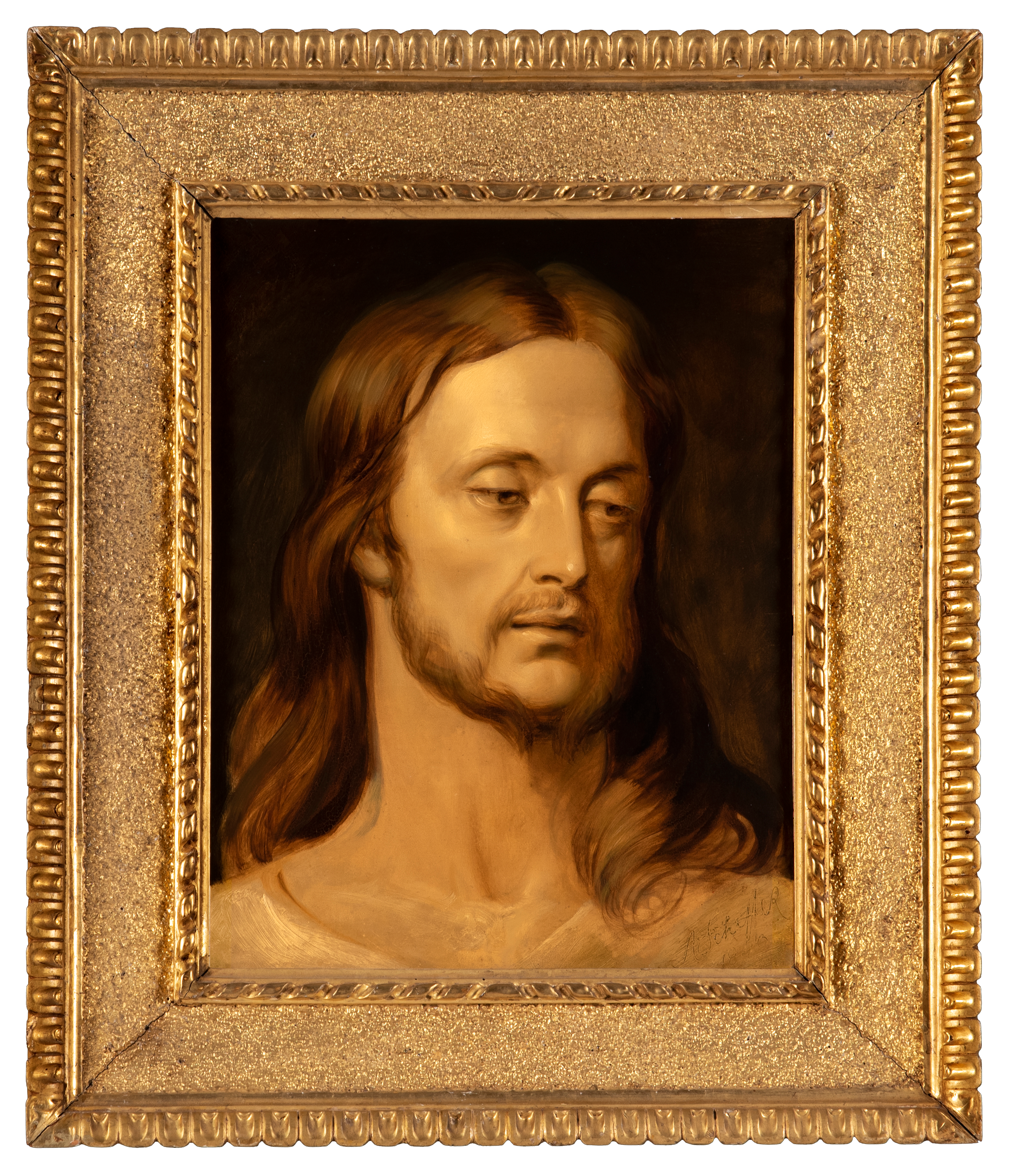
Head of Christ
Oil on panel, signed and dated lower right: A Scheffer 1849
Ary Scheffer
Dutch, active in France, 1795-1858
Ary Scheffer first studied art with his parents, later studying at the Amsterdam Drawing Academy. When his father died, Scheffer moved with his family to study in Paris with the neoclassical painter Pierre Guerin which set Scheffer on the road to Romanticism. A year later, he debuted at the Royal Academy’s Salon Exhibition. Five years after the move, he won his first medal which garnered him patronage by a supporter of the royal family.
The French would call this work an étude—a study made of a model to reference and work out details for a later painting. As such, collectors consider them valuable works. A glance at his oeuvre (body of work) reveals that Scheffer uses this model repeatedly for the Christ figure in several of his works largely during his religious period at the end of his career. Dated 1849, M&G’s study likely influenced later works, such as The Temptation of Christ (1854) in the National Gallery of Victoria and perhaps Christ Weeping over Jerusalem (1849) in the Victoria & Albert Museum (which he repeated in an 1851 version at the Walters Art Museum).
Scheffer’s popularity did extend to England but with a marked division in how the British received his works. The members of the Pre-Raphaelite Brotherhood, just at the start of their own movement (1848), varied in their reactions: William Holman Hunt did not approve, unlike Thomas Woolner. In fact, Hunt convinced D.G. Rossetti that Scheffer’s works were “worthless” (Morris 180).
The Royal Academy in London criticized nearly all the technical aspects of his work, especially his coloring, possibly feeling vulnerable from the acclaim that he was receiving in the industrial North. The growth in the middle class through textile factories in cities such as Manchester and Liverpool made art collecting a mark of affluence and social status. These “barons” were already comfortable with Europe due to product exportation; the importation of ideas from there was a natural consequence. Scheffer was championed by the author Elizabeth Gaskell and collected by the “intensely pious John Heugh” (Morris 186). John Ruskin called him “one of the heads of the mud sentiment school,” but admitted that Scheffer “does draw and feel very beautifully and deeply” (Morris 180).
So if technical excellence was not the draw, what was? Edward Morris states that “it was above all spiritual and emotional exaltation particularly in expression that Scheffer’s English friends admired in his art” (176). This Head of Christ evidences the coloring that drew criticism: the palette is limited to creams and browns with little distinction between Christ’s clothing and His skin. But Christ’s face is what draws attention. Kindness, introspection, firmness of purpose, along with a far-seeing gaze, create the impression that the God-man is on an eternal mission. “Emotional idealism” can easily cross the line into sentimentality, especially in religious works. However, the appeal to sentiment often leads to contemplation, a result that all artists desire. And anything more than a passing glance at Scheffer’s Head of Christ compels the viewer to ponder the Savior of the world.
Dr. Karen Rowe Jones, M&G board member
Work Cited:
Morris, Edward. French Art in Nineteenth-Century Britain. Yale UP, New Haven. 2005
Roughly the same size, these beautifully rendered panels painted by Pietro Negroni most likely came from an altarpiece in a convent church in the Calabrian city of Cosenza.
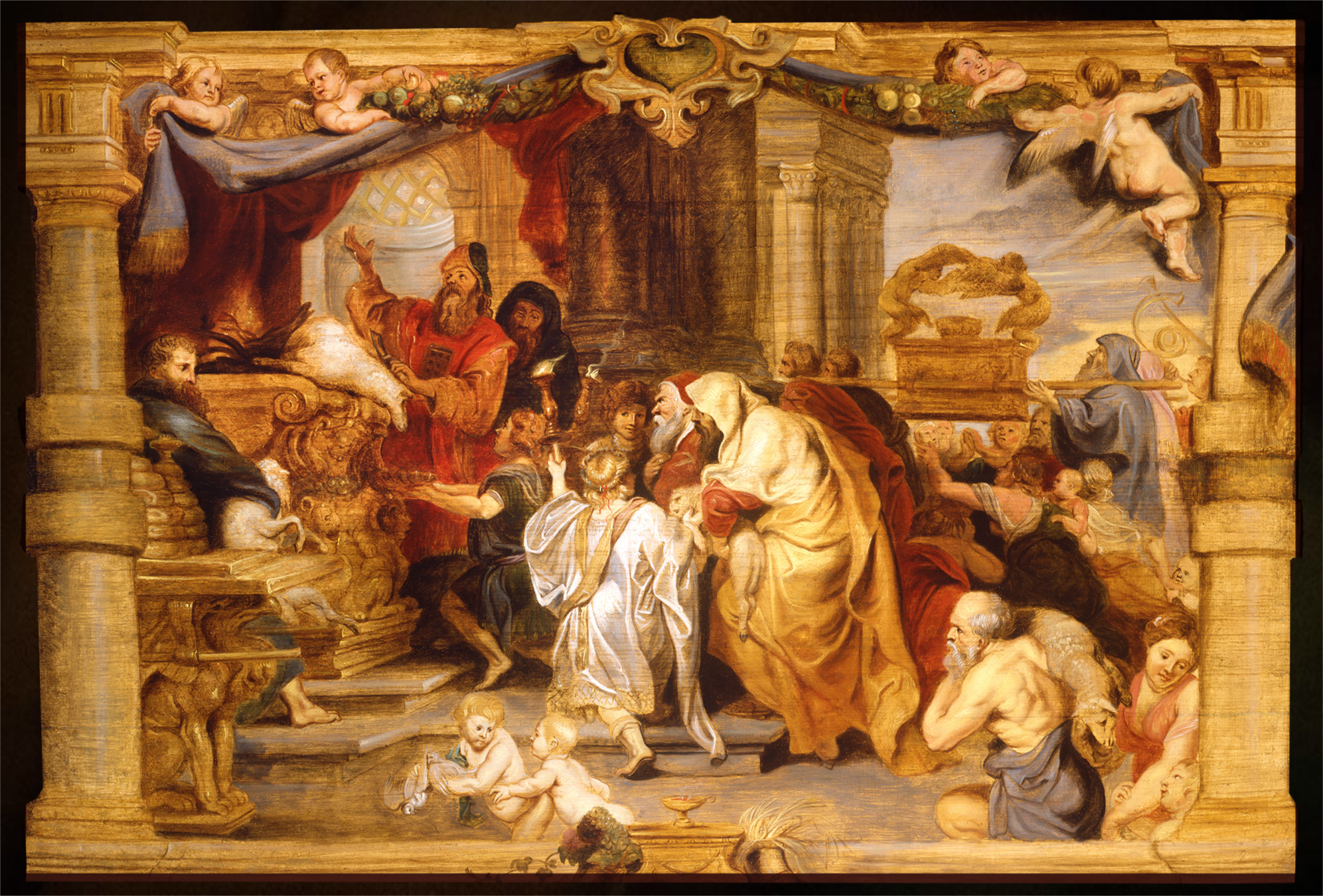
Bringing the Ark to Jerusalem
Peter Paul Rubens (and studio)
Below the image, click play to listen.
This vibrant painting depicting Abraham and his family’s departure for Canaan features many of the details that the Bassano family were skilled in painting.
Esau and Jacob Presented to Isaac
Benjamin West, P.R.A.
Below the image, click play to listen.
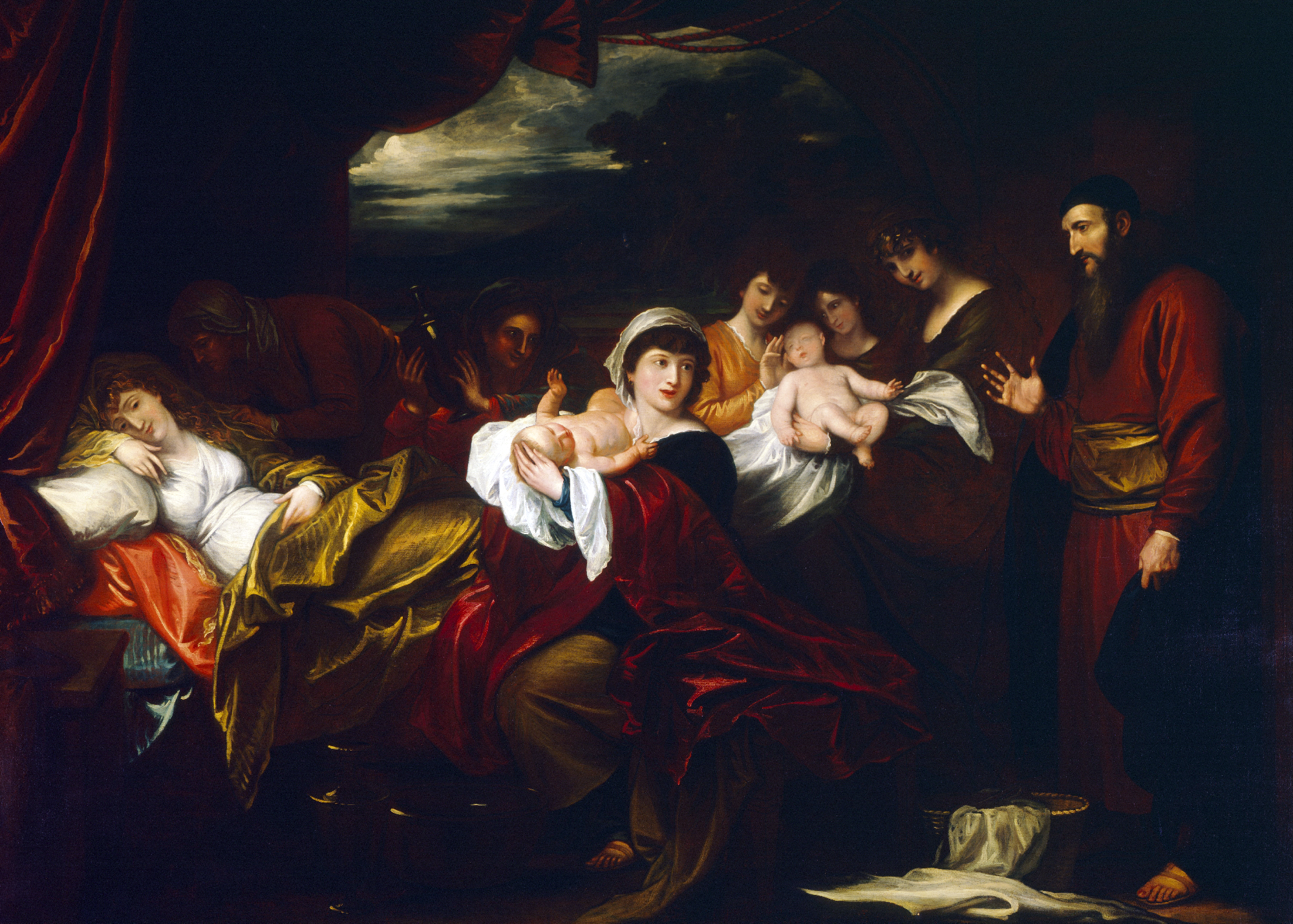
You can learn more about the entire series by West and M&G’s significant collection from the series HERE.
Madonna and Child with Angels
Tempera and oil on panel
Master of the Greenville Tondo
Umbrian, active late 15th century
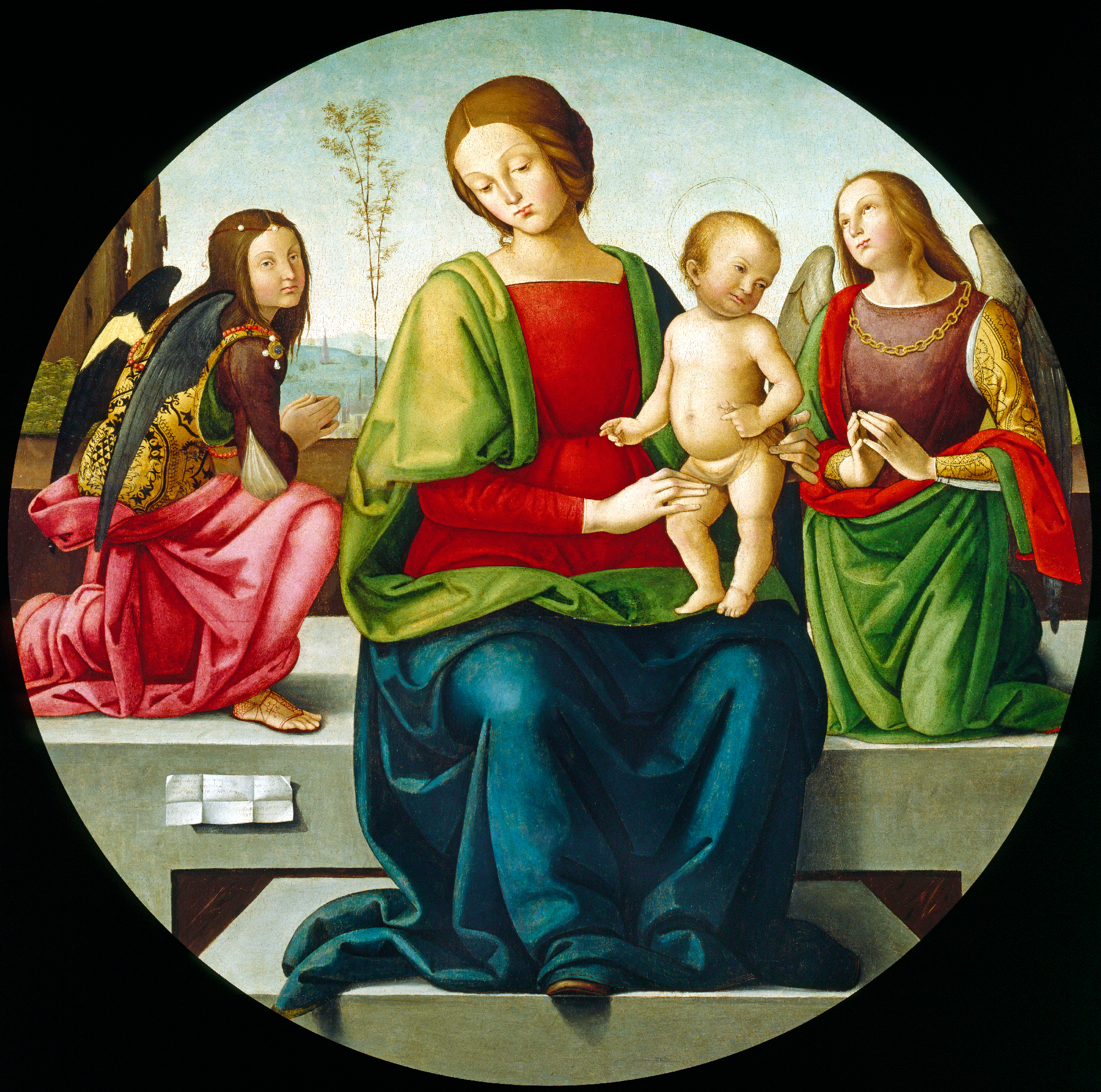
This mystery painting was once attributed to the young Umbrian, Raphael as possibly one of his early works (Giuseppe Fiocco, 1937), which could “aid in the studies of the formation of Raphael’s personality” (Mario Salmi). Then, it was suggested as characteristic of Raphael’s teacher in Umbria, Pietro Vannucci, called Perugino (William Suida, 1941 and Wilhelm von Bode, 1921). But it was the great historian Federico Zeri in 1959 and later followed by Everett Fahy, former Metropolitan Museum of Art curator and Director of the Frick, who suggested a different old master entirely.
This tondo (Italian for “round”) is puzzling, but understanding the cultural context of patronage, traditional artistic training, and the workshop setting can help explain some of the mystery.
In the Middle Ages through the early Renaissance, workshop practice was the only common form of artistic instruction in Italy beginning with the religious orders, monasteries, and convents. The Trades (sculptor, mason, architect) were taught from father to son or from an older family member to a younger. Formal apprenticeships emerged in the 13th century in the context of the craft guild system when workshop or bound apprenticeship became a fully regulated system for lay artists. Then, during the 15th century, the dislike for the guild system’s restrictions and process led to an adapted concept of artistic training, called the Academy. The specific training process for artists is further developed in the article about M&G’s painting, A Sibyl by female Old Master, Ginevra Cantofoli.
Throughout all of these training methods to become a master of one’s own workshop, imitation was the most important component of artistic training. Master painters employed a workshop of assistants to copy or paint in his style and to help meet the incoming demand of commissions by patrons. These points are critical to understanding why it is difficult to attribute a specific artistic personality to today’s enduring Old Master paintings. Besides, most painters well into the late 1400s and early 1500s did not autograph their finished works, and finding the original documents commissioning paintings can be challenging.
However, when the artist is unknown, yet there is an entire group of works that look to be by the same master’s hand, the experts (as in this case) will suggest a pseudonym—create a name for the artist after the place or location where his best or most representative work resides. Zeri and Fahy chose M&G’s painting as the namesake for the painter, “The Master of the Greenville Tondo,” meaning this tondo in Greenville, SC.
According to historian Carrie Baker, this painter, subject, and style reflect the “prevailing visual tastes of the period.” Workshop practice utilized multiple assistants and collaborative work to fill commissions that looked like the master’s hand. The assistants were all skilled artisans but working for the key master. Not knowing the assistants’ names isn’t an issue as this was their occupation: to reproduce works at the request of clients in the consistent style of the master to meet customer expectations. Today, we can photograph and print our favorite originals, but then artists could only copy and repeat. Works like M&G’s Madonna and Child with Angels reflect a popular subject and shape of the period, and providing paintings like M&G’s at a client’s request was the master’s way of “positioning . . . his workshop at an economic advantage.”
Many of the masters and their assistants were truly “Renaissance” men—able to tackle the design of many things, not just paintings but manuscripts, reliquary, sculpture, fabrics, architectural features, etc. The anonymous artist as Baker notes, “was probably an active participant of a working-class system of many trades.” The artist is unknown, but by comparing similar characteristics, experts have connected at least 32 works as having come from this same artist’s hand found in places including Pancole, Italy, the Museum of Fine Arts, St. Petersburg in Florida, Princeton University Art Museum in New Jersey, the Walters Art Museum in Baltimore, and the Estensi Gallery in Modena, Italy.
Regardless of this painting and many others not being attributed to a specific, known personality—such as a respected influencer like Perugino or a major name of the Renaissance like Raphael, this master’s work was just as valuable in shaping Umbria’s artistic identity. And, more than that, our painting is shaping the estimation of our own community through the designation “Master of the Greenville Tondo”—bringing honor and recognition to the city of Greenville throughout the world where other works by this unknown master are displayed.
Erin R. Jones, Executive Director
Published 2025
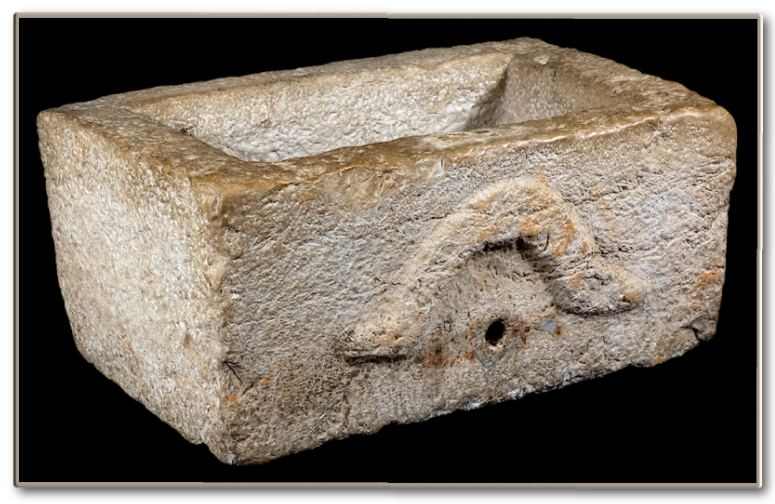
Bethlehem Manger
Hebrew, 1st century
Below the image, click play to listen.