Object of the Month: January 2026
The Resurrection with Feasts
Tempera on panel
Unknown Russian
18th century
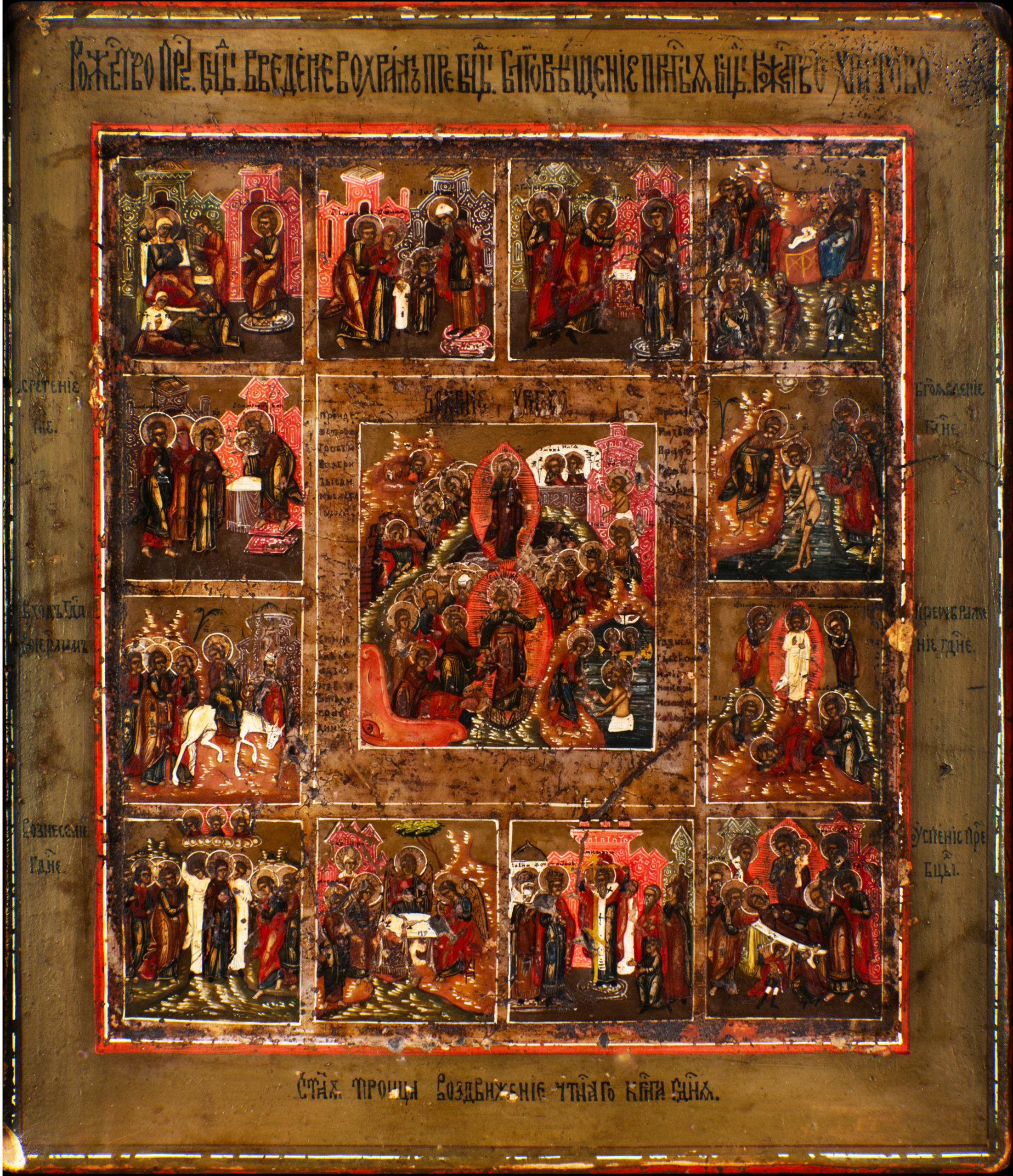
Russian icons have been part of M&G’s collection since our inaugural opening in 1951. Our founder, Dr. Bob Jones Jr., collected these uniquely symbolic works along with the Old Masters throughout the decades, including this interesting panel acquired in 1996—the year before his passing.
The central scene is surrounded by twelve smaller scenes identified by inscriptions and portraying the twelve major ecclesiastical feasts of the Eastern Orthodox Church, which are celebrated throughout the year. This type of icon is referred to as a calendar icon—a suitable focus as we turn the page on the New Year and a year in which M&G celebrates our 75th anniversary.
An image like this is read from left to right. Beginning with the top row (left corner), the illustrated events are:
- The Nativity of the Virgin: observed September 8
- The Presentation of Mary in the Temple: observed November 21
- The Annunciation: celebrated March 25
- The Nativity of Christ: celebrated Christmas Day, December 25
- The Presentation of Christ in the Temple: celebrated February 2
- The Baptism of Jesus: celebrated January 6
- Entry into Jerusalem: celebrated on Palm Sunday
- The Transfiguration: celebrated August 6
- The Ascension: celebrated 40 days after Easter
- The Holy Trinity (for Trinity Sunday, known as Pentecost): celebrated 50 days after Easter
- The Exaltation of the Cross: observed September 14
- The Dormition of Mary: observed August 15
Finally, the centerpiece features the victorious, resurrected Christ, which is celebrated on Easter Sunday. All of the other feasts lead up to or follow this great event. Additionally, the central image includes a number of elements from the Harrowing of Hell as described in the apocryphal book of Nicodemus (part II).
Observe the incredible amount of detail crowded into this central scene! Just below the risen Christ, He is shown again as standing triumphant over Hell (represented here as the realm of the dead) with the broken gates underfoot. On the left, He welcomes Adam and Eve and other Old Testament saints in a procession of people exiting the red mouth of Hell (lower left with a few visible teeth) toward the entrance of Paradise on the top right. To the right of Christ are Abel (murdered by Cain), Kings David and Solomon, and John the Baptist led by the good thief crucified with Christ, who is showing his cross to Enoch and Elijah as justification for his entrance into Paradise.
The lower right corner pictures the Biblical narrative of Jesus walking on the water to the disciples in the boat and Peter sinking after his failed attempt to stride the waves. On the top left, Peter peers into the empty tomb discovering the burial garments. Just below him are the angels led by Michael the archangel helping protect the procession of saints to Paradise.
Like the Western European audiences who viewed Old Master paintings, so the Byzantine and later Greeks and Russians were largely illiterate, relying on the pictures at church for scriptural understanding and church teachings. An icon like this one would have been made personally for the home of the devout. In a traditional Russian home, families would place their icons on a special shelf in a corner, known as the “beautiful corner.” By including an icon of the annual feasts in the display, every day would be lived in light of Christ’s victory over sin, Satan, and death.
Erin R. Jones, M&G Executive Director
Published 2026
