Object of the Month: July 2026
St. Paul and a Deacon
St. Jude Thaddeus and St. John the Evangelist
Tempera on panel, c. 1390-95
Tommaso del Mazza, called the Master of St. Verdiana
Florentine, active 1377-1392
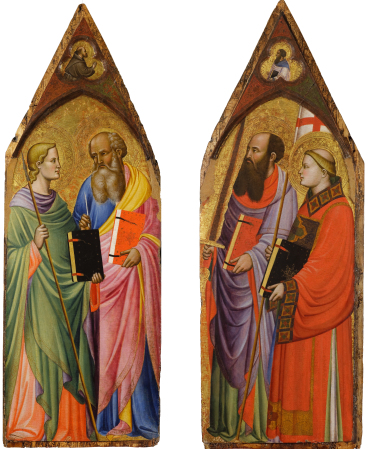
Among the Museum & Gallery’s large collection, there are many altarpieces. Some are complete and some are sections of an altarpiece such as a predella or a removable wing. While considered “incomplete,” these panels stand alone as magnificent examples of art history.
One such is a pair of altarpiece wings titled St. Jude Thaddeus and St. John the Evangelist and St. Paul and a Deacon. Painted c. 1390-95 or the late Trecento, they show six figures from church history and link earthly worshippers with the divine. The details of the paintings—their rounded figures, the precise punchwork in gold, as well as the fluid and monumental fabrics—show a stylistic veneration of Giotto and the early Trecento. Compared to other paintings in the collection, they are not immediately eye-catching. However, their intricate details provide questions that are still being answered.
One resolved question surrounding the wings is the identity of the artist. The earliest collection records attributed them to the late-Trecento painter Giovanni del Biondo, then to the Master of St. Verdiana. The name comes from a rare depiction of Saint Verdiana in Atlanta’s The High Museum of Art, Madonna and Child with Six Saints. St. Verdiana is depicted with two snakes as her distinguishing attribute. Barbara Deimling was one of the first to connect the name Tommaso del Mazza to the Master of St. Verdiana in Tradition & Innovation in Florentine Trecento Painting: Corpus of Florentine Painting. Del Mazza (active 1377-1392) was trained in Florence and was influenced by the work of Agnolo Gaddi and Jacopo di Cione. Although del Mazza is considered a minor painter in the late-Italian Gothic style, he had a busy workshop in Florence, and his oeuvre consists of about fifty paintings.
One unanswered question continues to plague scholars: If these wings were part of a larger triptych and if so, where are the other panels? While there is speculation of other sections, Deimling and a few others believe the center panel to be The Annunciation from the J. Paul Getty Museum collection. It depicts the moment Gabriel appears to Mary and informs her that she will be the mother of Jesus.
M&G’s two wing panels were sent to the Getty where the conservation department examined and restored them. Up to that point, the union had been based on separate photographs and had never been seen together by modern historians. After extensive analysis, Yvonne Szafran, paintings conservator at the Getty at the time, concluded there is no way of being certain all the panels belong together. However, when the three works were brought together at M&G for an exhibition (and subsequent symposium) entitled Twilight of a Tradition, opinions were still divided about the panels originally being a united triptych.
More research will be needed to reach conclusive results on this particular altarpiece and more can be read about these two wings and the exhibition in the catalog Discovering a Pre-Renaissance Master: Tommaso del Mazza. Like the artwork, the catalog does an excellent job in conveying the technical skill of a moderately overlooked artist. Perhaps it is the small details and the small things which lead us to some of the largest discoveries.
KC Christmas Beach, artist and M&G volunteer
Published 2026
