Give Now


Tag Archives: Dutch art

Object of the Month: April 2013

Joseph Interpreting the Dreams of Pharaoh’s Butler and Baker

Oil on canvas, signed and dated, 1643

Gerbrand van den Eeckhout

Dutch, 1621–1674
Gerbrand van den Eeckhout, the son of a goldsmith, studied with Rembrandt for five years (age 15-20) and was a “great friend” of the famous artist, according to his biographer. He also continued to imitate his teacher’s style throughout his career, especially in his religious paintings. His first signed painting is dated 1641 (age 20), which probably indicates the time he advanced from student to independent artist. Therefore the Museum & Gallery’s painting, dated 1643, was one of his earliest works. In addition to painting, he worked as an etcher and draughtsman. He never lost interest in his father’s work of goldsmithing, often including precisely painted metal objects in his paintings, as well as producing a book of patterns for ornamental designs for metalworkers. His family’s Mennonite faith influenced his preference for religious subject matter, although he was also known for portraiture and landscape painting.

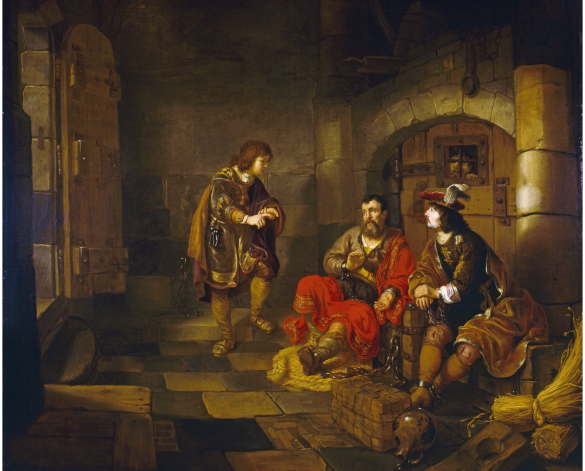
The biblical story of Joseph is an inspiring one. After being sold into slavery by his jealous brothers and being falsely accused of attempted rape in Egypt, the depicted scene shows him in prison. Because of his trustworthiness, he has been placed in a position of leadership within the prison (notice the keys hanging from his waist) and is interpreting the dreams of two of Pharaoh’s servants. The butler (or person who tasted the king’s wine to make sure it was not poisoned) is shown to the right in fancier clothes with a jug at his feet; he would be pardoned in three days. The baker, however, would be killed in three days. We can see the look of despondency on his face as he learns his fate. Although the butler promised to remember Joseph to Pharaoh, it wasn’t until two years later that a circumstance caused him to remember. After all of Joseph’s trials, he praised God and told his brothers, “you meant evil against me, but God meant it for good” (Genesis 50:20).

The provenance, or ownership history, of the painting begins with a sale in Amsterdam in 1762, just a little over 100 years after its creation. The Dundas family of Scotland purchased it, where it remained by family descent until 1953; it became part of the Collection in 1963.


Published in 2013
Object of the Month: March 2013

The Holy Family in the Carpenter Shop

Oil on canvas

Gerrit van Honthorst

Dutch, 1592–1656


All museums have at least one or two works that visitors love to see again and again. First-time visitors often comment on their preferences after a tour through the galleries, and regular patrons tell us that they enjoy returning to see their favorite works. M&G’s Holy Family in the Carpenter Shop by Gerrit van Honthorst is one such crowd pleaser.

Honthorst’s mastery of lighting effects was inspired by the works of Caravaggio during a sojourn to Italy around 1612 or 1620. Even though Caravaggio only produced two known night paintings which depict artificial lighting such as a candle or a torch, Honthorst and a group of other Dutch artists from Utrecht followed this genre’s techniques and became known as the “Candlelight Painters.” In fact, the Italians gave Gerrit van Honthorst the nickname, Gherardo delle Notti, meaning “Gerard of the Night Scenes.”

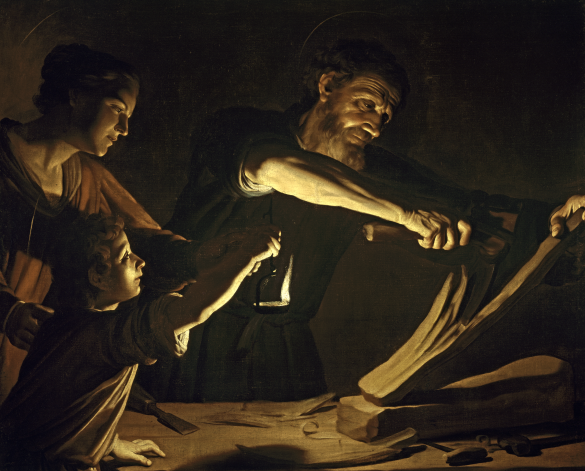
For the viewer the primary, gripping element is the effect of light in the painting. Mary, Joseph, and Christ are gathered in a plain, dark room with a soft, warm light illuminating their forms from out of the darkness. Honthorst’s proficiency and sensitivity are noted in his ability first to concentrate the most intense light on the arms of Christ and Joseph and then subtly diffuse the beam as it stretches away from the light source. The emotional effect of the soft lighting is heightened by the characters’ gentle, loving facial expressions as well as the simple, natural portrayal of their manner. Christ holds the oil lamp while Mary carefully steadies His hand in order to position the flame for Joseph to see his work and to prevent Jesus from burning Himself.

In this favored work of M&G patrons, the meaning evoked by the light is as equally compelling as the painterly technique. Although Christ is but a child in the scene, the lamp which He grasps metaphorically alludes to the declaration of an adult Christ, “I am the light of the world: he that followeth me shall not walk in darkness, but shall have the light of life” (John 8:12). Scripture further describes Christ in these words: “In him was life; and the life was the light of men. And the light shineth in darkness; and the darkness comprehended it not” (John 1:4-5). Perhaps another layer of Biblical significance is present in the work; as the youth eagerly looks to His father to please him and help him, the act faintly implies not only a family value or work ethic of Honthorst’s time, but also a Biblical injunction to children to obey and honor their parents (Ephesians 6:1, 2).

In order to fully appreciate the impression and effect of this remarkable work, come and view the painting for yourself. You will surely come to understand why this painting has become the favorite of so many.


Published in 2013

Object of the Month: February 2013

Madonna of the Fireplace

Oil on panel, ca. 1500

Attributed to Jan Gossaert, called Mabuse

Flemish, b. Maubeuge?, ca. 1478, worked in Antwerp, d. Antwerp 1532


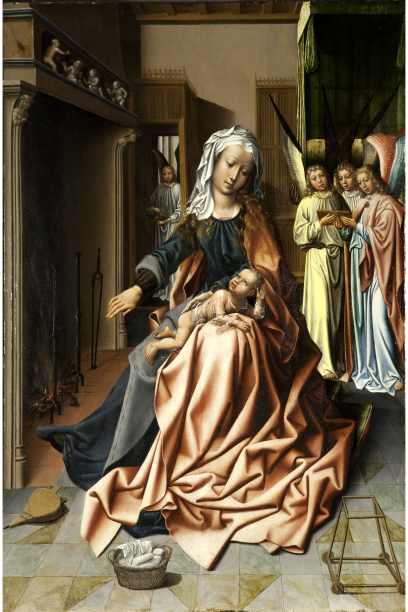
Though the Madonna of the Fireplace is a painting that continues to lack a firm attribution to a known painter; nonetheless, it is one of the “star” paintings in the collection. One of the primary considerations of Dr. Bob Jones Jr. in assembling the collection during the 1950s and 60s, was the importance of the painting’s quality, even if the work lacked sure authorship by a known artist.

The characteristics of this painting epitomize late fifteenth-century painting in the area of the Low Countries generically referred to as Flanders. The highly angled and stylized folds of the drapery are typical of paintings in the 1400s and even occur in carved sculpture from this period. The slightly awkward proportions and elongated facial features are stylistic hallmarks of the era as well as the very accomplished and detailed surface treatment. Even the setting for Mary and Christ strongly betrays its Northern origins. Though the fireplace carvings and treatment reveal the artist’s knowledge of Italian models, the tile floor patterns and the carved linen-fold wooden paneling would have been found in many well-to-do homes throughout Flanders. It is also the same kind of carved, period paneling on the very gallery wall on which this painting hangs in the museum.

One of the turning points in the history of Northern Renaissance art began when painters started depicting the Virgin in domestic interiors. Artists of the 1300s and early 1400s typically placed the Virgin within a church interior as part of an Annunciation scene or other narratives. However, this setting changed with innovations in the 1420s by Robert Campin, whose famous Merode Altarpiece (Metropolitan Museum of Art, New York) broke with tradition and pictured the Virgin in a domestic interior typical of a fifteenth-century home. M&G’s painter continues Campin’s vision later in the century with this remarkable panel—one of the most beautiful and well preserved paintings in the entire Museum & Gallery Collection.


Published in 2013