Give Now


Tag Archives: Florentine

Object of the Month: December 2025

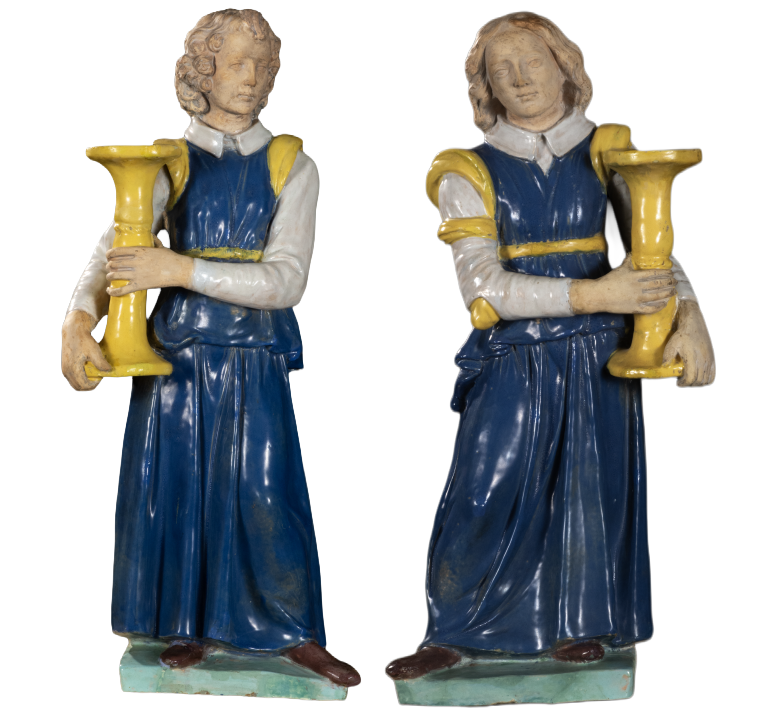
Pair of Angels with Candlesticks

Glazed terracotta, c. 1500

Benedetto Buglioni (attributed to)

Florence, 1459/60 – 1521
Italian Renaissance masters like Donatello, Cellini, and Michaelangelo created magnificent sculptures chiseled from stone, carved from wood, or cast in metal. These methods were time-consuming and costly. In the early 1440s, Luca della Robbia, a stone sculptor in Florence, was able to cut the time and cost of sculpture production by developing techniques for tin-glazed terracotta. In addition to achieving the magnificent detail found in the expensive materials, he produced vibrant, permanent colors in his sculptures which other media could not duplicate. Also, he designed multiple modified pieces from molds, which greatly reduced production time and cost.

As a businessman, Luca della Robbia managed a large workshop, where he produced high quality, tin-glazed terracotta pieces and preserved the secrecy of his formulas and techniques. His nephew, Andrea della Robbia inherited both Luca’s workshop and secrets. He became an outstanding sculptor, creating pieces beyond his uncle’s capabilities. (Andrea’s sons, Giovanni and Girolamo, also became sculptors and practiced the family’s secrets. Girolamo accepted the king of France’s invitation to Paris in 1517, where he made M&G’s terracotta busts of French nobility.)

Benedetto Buglioni

The son of a sculptor, Benedetto Buglioni was born in Florence in 1459/60. He probably studied under Andrea del Verrocchio (Leonardo da Vinci’s teacher) and learned terracotta sculpting as a pupil in the della Robbia workshop of Luca and later Andrea. According to Giorgio Vasari, a contemporary artist and historian, Benedetto learned the “secret of glazed earthenware” from a female servant “who came out of the house of Andrea della Robbia.”

In his early 20s, Benedetto opened his own terracotta workshop in Florence. For unknown reasons, from 1487 to 1490, he and his brother produced terracotta works in Perugia, a city about 100 miles from Florence.  Returning to Florence, the Buglioni brothers opened their own workshop and became della Robbia’s chief competitors. High quality, tin-glazed terracotta was extremely popular, and there were plenty of commissions for both workshops.

In time Benedetto was recognized as a master artist. His clients included major churches, important civic groups, and wealthy patrons, including the Medici family. His standing in the artistic community is recognized by the fact that he served on the committee which determined the placement of Michelangelo’s monumental David.

Terracotta Angel Candlesticks

The Eucharist or Communion is a Christian sacrament instituted by Jesus Christ at the final supper before His crucifixion. He shared bread and wine with His disciples and told them the bread represented His body and the wine, His blood. His followers were to partake of the bread and wine as a reminder of His sacrifice and its eternal significance.

In Roman Catholic churches, the elements of the Eucharist are kept in a tabernacle, a locked and decorative box, built into the wall or placed on the altar. As part of the Catholic Mass, candles on either side of the tabernacle are lit. Traditionally, the candles are reminders that Christ is the light of the world and the church.

M&G’s angels probably held candles on either side of a tabernacle. These angels may have been part of a matching tabernacle and angel set, or they may have been used with a tabernacle made of other materials. There are few Renaissance terracotta tabernacles still in existence, and very few of those still have their original angel candlesticks. Of the existing Renaissance terracotta angel candlesticks, most lack tabernacles and some even lack their partner angel.

M&G’s terracotta candlesticks are a typical height—roughly 22 inches; however, their design details vary greatly. Some Renaissance angel candlesticks stand, others kneel. Some wear robes, stoles, surpluses, sashes, jewelry, or belts; others have intricate collars, cuffs or hems. Some are barefoot, some wear sandals, and others wear shoes. Many have wings, and some, like M&G’s, were designed wingless.

M&G’s Pair of Angels with Candlesticks began as a piece of wood wrapped in wet cloths. A molded clay body was formed around the cloths. The body then received a head, arms, hands, feet, clothing details, and candle holder. Some of these additions were based on standard clay molds, and others were hand-sculpted from raw clay. When the sculpture was complete and the clay set, the wood and cloths were removed, leaving a hollow center, necessary for proper drying and firing.
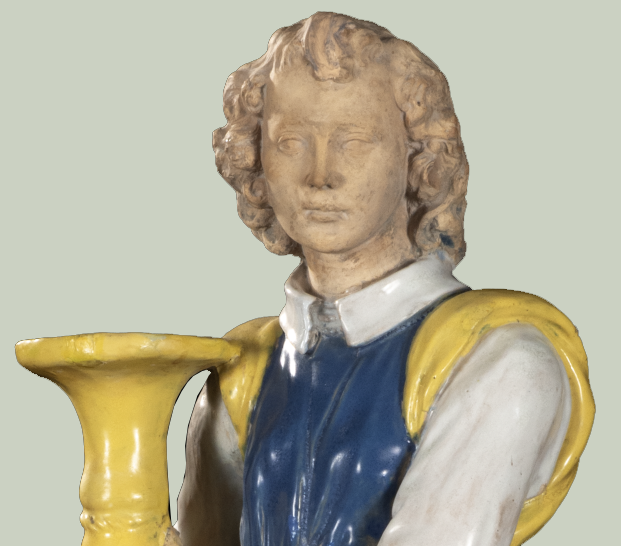
The head and hands of M&G’s angels are not glazed; these areas are the color of baked clay. A tin oxide glaze was painted over all the areas to be glazed and then fired, leaving a beautiful white as seen in the angels’ collars and sleeves. Next, a blue cobalt and a yellow lead glaze were painted over the white. When fired again, the glazes fused with the terracotta, became enameled, and their colors permanent.

Renaissance sculptors rarely signed their works. If found, contracts and payment records can establish who created larger objects; however, smaller works are most often associated with a particular workshop based on style, quality, and the figure’s individual details. Experts agree that M&G’s angels can be attributed to Benedetto Buglioni and his workshop.

Although these angels no longer serve during church services, they do speak to us of the craftmanship of Renaissance tin-glazed terracotta masters. They may also cause us to think of those who saw them in the warm glow of their candles more than 500 years ago.


William Pinkston, retired educator and M&G volunteer


Suggested Reference

Della Robbia: Sculpting with Color in Renaissance Florence by Marietta Cambareri, with contributions by Abigall Hykin and Cortney Harris


Published 2025
 

Object of the Month: November 2022

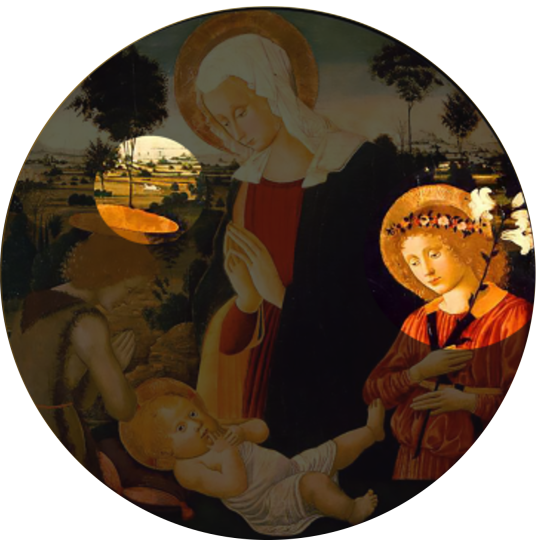
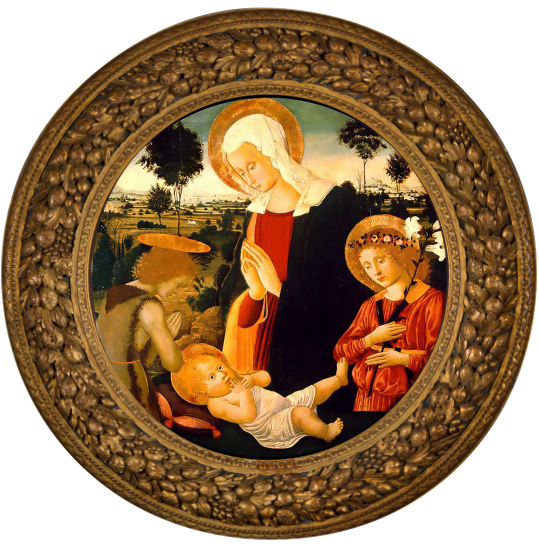
Madonna and Child with St. John the Baptist and an Angel

Tempera on panel

Pseudo Pier Francesco Fiorentino

Florentine, active late 15th century

In the 15th century, Florence enjoyed a robust cultural and economic environment. One prominent idea of the era was the rediscovery of the circle and the variety of ways it was used. It may be somewhat humorous in our current culture to recognize that a simple shape could dominate life, but the circle did.

The Renaissance was about advancement—an era full of discoveries. Dias, da Gama, Columbus, and Vespucci found places previously unknown through geographical exploration of our planet, understood then to be round instead of flat. Rediscovery of Greek and Roman mathematical perfections included the circle. The shape was incorporated into architecture in a variety of public and private buildings in Florence. The circle became a symbol of God, the universe, and heaven. Between late 1430 to early 1450, artists began using the circle as part of their painting design in a format called tondo, the Italian word for round.

As a spiritual symbol, the circle became a means of representing the patron saint of Florence, John the Baptist. He was often depicted as a youth, an example to the young people of Florence. Before the Renaissance, paintings focused on individual depictions of saints and biblical characters; however, artist Fra Filippo Lippi is credited with being one of the first to paint John the Baptist together with Mary and the infant Christ in the 1450s. Additionally, Lippi was the first to paint the figures worshipping the Christ Child in adoration as seen in his work, the Annalena Adoration in the Uffizi, Florence. This new subject was the beginning of a popular focus in the late 1400s and well suited to the tondo format.

Filippo Lippi had a bustling workshop with many apprentices including Pesellino and Botticelli. As a favorite of the Medici, Lippi fulfilled numerous private and public commissions, including a Medici tondo now in the National Gallery. While Botticelli is credited with making the round format popular in the late 1400s, Lippi’s studio and apprentices created tondi and essentially mass-produced paintings depicting Mary and John the Baptist adoring the Christ Child to satisfy the public demand.

The Medici family was partly responsible for the popularity of tondi because these round paintings became not only a status symbol of wealth, but also were of spiritual significance in private, devotional settings. To have an object of art that the Medici possessed was a means of connection to them. Tondi existed in the homes of wealthy Florentines and public spaces and soon became popular in other Italian cities. They were not commonly used in churches since they were smaller.

The creator of M&G’s tondo, Madonna and Child with St. John the Baptist and an Angel, is enigmatic. Scholars have been unable to attribute a specific artist, but the work seemed influenced by Pier Francesco Fiorentino yet not painted by him. Hence, the designation of “Pseudo.” However, careful study of the work indicates that its construction predates the surge in popularity of tondi in the 1480s. M&G’s painting is one of the earliest surviving tondi produced after Fra Filippo Lippi’s initial exploration of the adoration subject—a strong representative of the Florentine tondo tradition.

The painting’s details include a unicorn in the background, which is a symbol of Mary’s purity along with the white lily. Her adoring the Christ Child in a country landscape setting may be based on St. Bridget’s Revelations. The halos reveal the influence of naturalism prevalent in the Renaissance style. While the halos of Mary and the angel are typical of the flat Gothic style, the foreshortened, elliptical halo of John the Baptist is shown from a three-dimensional perspective.

As a “window into heaven,” M&G’s tondo has delighted viewers since entering the collection in 1951—the museum’s inaugural year.


John Good, M&G volunteer


Published 2022

Object of the Month: November 2018

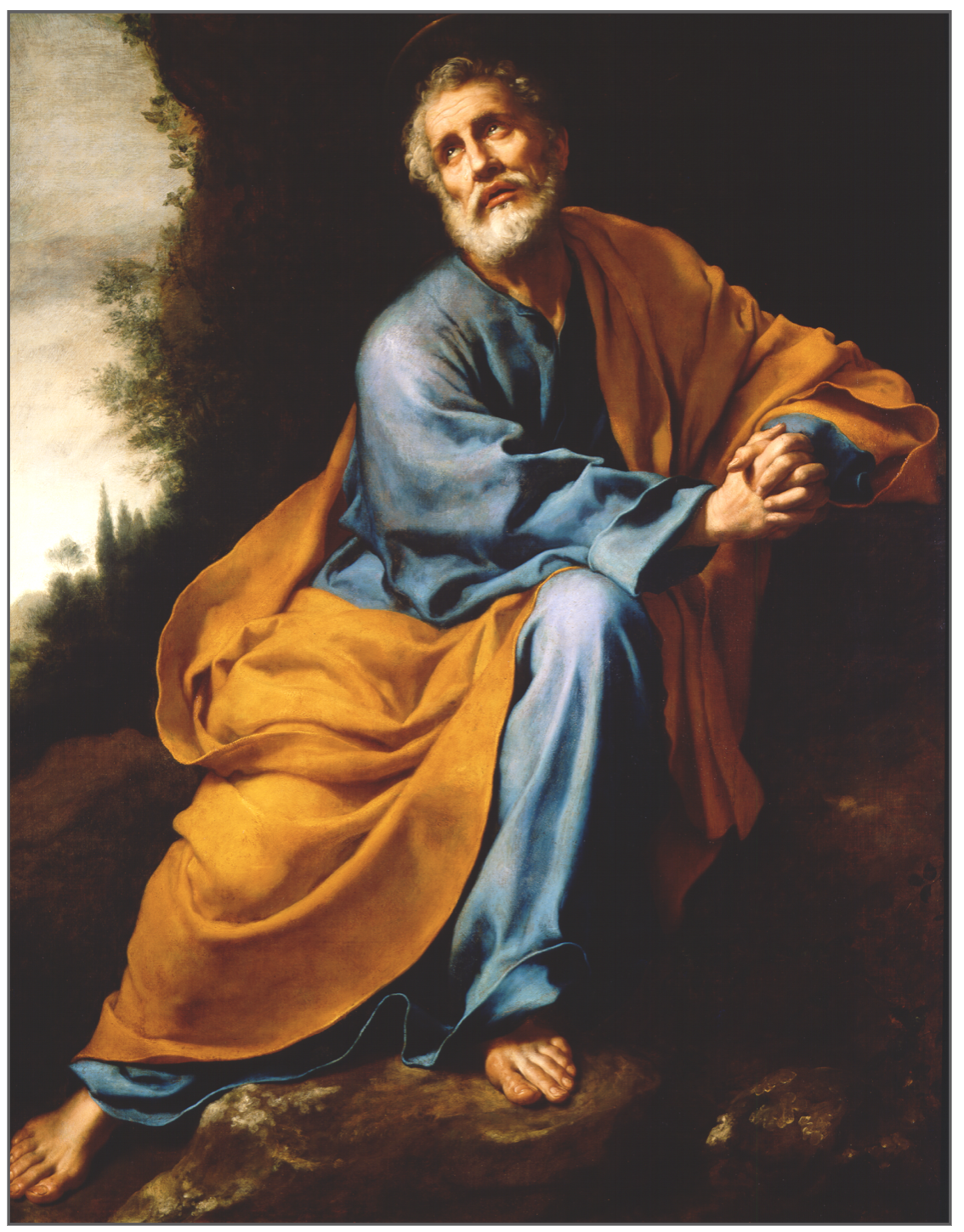
The Repentant St. Peter

Oil on canvas, circa 1664

Carlo Dolci

Florentine, 1616-1686

This powerful portrait of the penitent Peter is by seventeenth-century Florentine artist Carlo Dolci. A child prodigy, Carlo entered Jacopo Vignali’s studio as an apprentice at the age of 9 and by 13 was independently completing noteworthy commissions. Throughout his lifetime Dolci’s paintings would continue to garner praise and to attract the patronage of luminaries like the Grand Duchess of Tuscany Vittoria della Rovere and her son Cosimo III.  

However, Dolci’s aspirations went beyond a desire for fame. His lifelong friend and biographer Filippo Baldinucci wrote: “From early childhood, Dolci frequented the Benedictine Order, and his devotion ever increasing, he made a firm vow never in all his life to wish to paint anything other than sacred images or religious stories, and to represent them in such a manner that they would inspire Christian piety in those who saw them.”  It is not surprising, therefore, that aside from a few portraits, Dolci’s entire oeuvre is comprised of devotional works. 

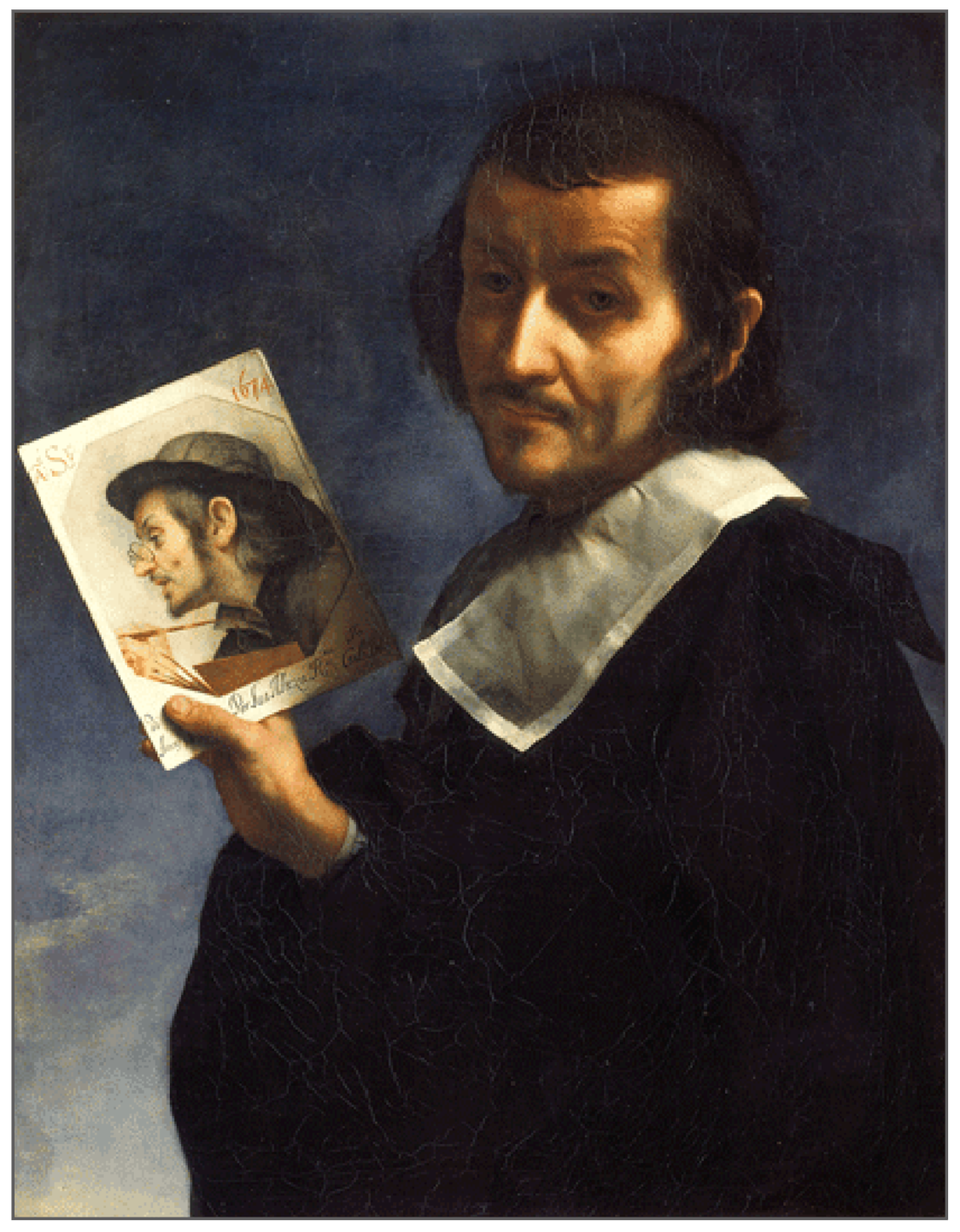
One of those rare portraits is this 1674 Double Self-Portrait.  This work not only highlights the artist’s technical skill but also insinuates his temperament.  Dolci was a meticulous artist. Baldinucci commented: “It may seem strange to hear that he completed so many works, having worked so slowly, or more accurately having taken so long to complete them, since sometimes a single foot occupied him for weeks.” We see that obsessive attention to detail in this work—both in its execution and in the handling of the subject. In a sense it is a visual pun. In the miniature portrait we see the bespectacled Dolci leaning in to delicately apply brush to canvas while the larger, central figure holds this miniature up for viewer examination. Notice the wistful expression of the dominant Dolci. It’s as if he is inquiring of the viewer, “I’m not sure I’m satisfied with my ‘image.’ Are you?” Numerous sources site that throughout his life Dolci suffered from melancholia, an archaic term describing (among other things) bouts of extreme depression. Perhaps this malady contributed to his ability to render powerful emotion convincingly. Regardless, it is this quality that evokes the pathos readily apparent in the Museum & Gallery’s portrait.  

Although the subject of this work is derived from the gospels, it’s popularity during Dolci’s time was due in part to Counter-Reformation dogma.  For example, one of the many objectives of the Council of Trent was to urge Catholic painters to reaffirm through art the salvatory function of those sacraments dismissed by the Reformers—including the sacrament of penance (the private confession of sins to a priest).  Art historian and curator David Steel notes that as a result “the repentance of Peter became an especially popular subject since it depicted the Prince of Apostles, and the first pope, in the sacramental act of doing penance; Peter’s tears became a symbol for that sacrament.”  

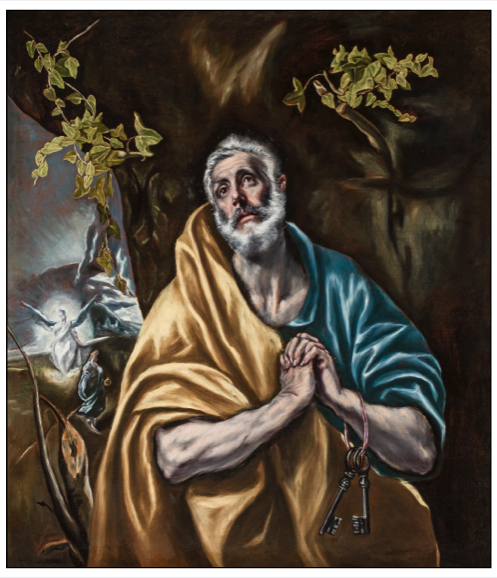
The compositional details mirrored in Dolci’s work were first codified by the Mannerist painter Domenikos Theotokopoulos, called El Greco. El Greco completed numerous variants and at least five autograph versions of this subject, including the one pictured here from the San Diego Museum of Art.  His dark background, grotto-like setting, and figural pose became standard, and we see these elements mirrored in Dolci’s rendering.  Both artists also clothe the figure in his traditional yellow-gold mantel of faith.  However, Dolci’s elegant brushwork and jewel-like coloration add what one historian describes as a “fresh, objective approach.”  

Although naturalistic in the handling of light and the depiction of Peter’s weathered face, red-rimmed eyes, and tousled hair and beard, there is none of the severity characteristic of such Baroque naturalists as Caravaggio. Dolci’s vital realism seems free of despair. As art historian Michael Bryan observed, “Nothing is harsh or obtrusive, all is modest and harmonious.” This seamless integration of the natural and the sublime creates a wonderfully moving image. 

To learn how Protestant painters sought to affirm their faith read about Lucas Cranach, the Younger’s Allegory of the Fall and Redemption of Man. 

Donnalynn Hess, Director of Education


Published in 2018

Niccolò di Pietro Gerini

Madonna and Child with Saints
Niccolò di Pietro Gerini

Object of the Month: July 2018

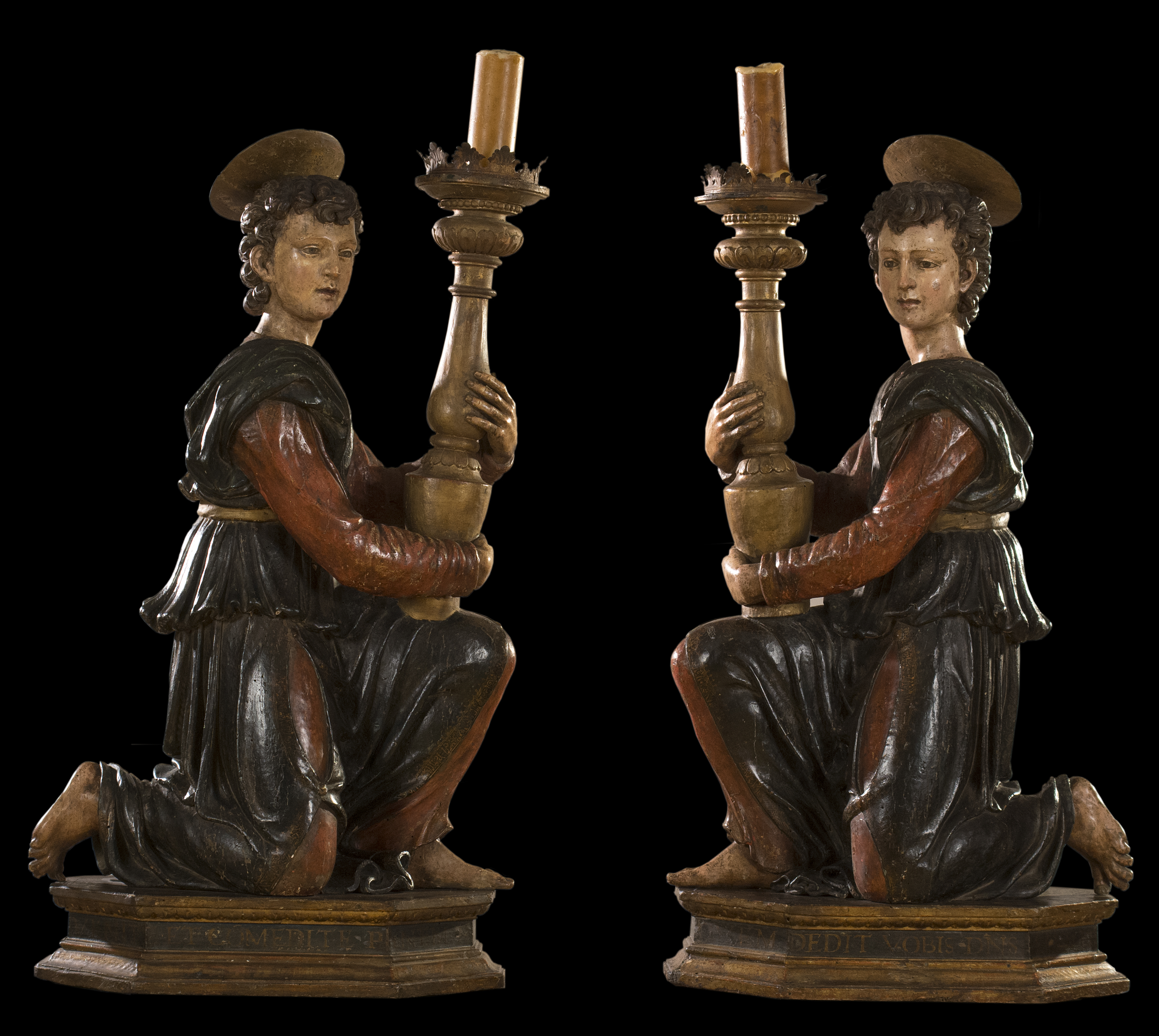
Angel with Candlestick (pair)

Polychrome and parcel-gilt

Unknown

Florentine, c. late 15th century


Since paintings in an exhibit often take “center stage,” ecclesiastical pieces like these Angels with Candlestick can be overlooked by museum viewers. During the Renaissance, however, a polychrome sculptural grouping would often be the centerpiece of an altar’s decorative scheme while the painted narrative scenes or figures functioned as the “wings” of the altar. Although by the end of the sixteenth century, paintings became the central focus of Italian altarpieces, while sculpture continued to be used extensively in other countries like Spain. 

The term polychrome (meaning “many colored”) refers to the application of colored materials to sculpture in order to present a more life-like quality. This technique dates back to the Greeks and Romans and was particularly popular during the Renaissance. Because these pigments fade over time such coloring is rarely discernable today.  The good condition of these statues is due to the porous wood used which retains color well. 

We know that the figures shown here were meant to be angels from the metal pins that remain on the back of each figure—a clear indication of the wings’ placement. Sadly, it is not uncommon for such appendages to be broken off or lost over centuries of movement from place to place. Fortunately, the carved wooden haloes have remained intact, as has the original base with its Latin inscriptions.

Since several of the words are Latin abbreviations, the precise translation of the inscriptions is unclear. However, a loose reading would be: 

OVEM DEDIT VOBIS DNS ADVES CENTVIM 

Dedicated to the Lord’s Advent

VENITE ET COMEDITE PANEM

Come and eat bread 

ANGE ORVM

Angels


Donnalynn Hess, Director of Education


Published in 2018