Give Now


Tag Archives: French Baroque

The Resurrection, Frère Jean André

Many of the surviving monumental paintings of Dominican friar Frère Jean André may be seen in churches in Lyon, Bordeaux, and Paris.


Object of the Month: March 2026

St. Veronica

Oil on canvas

Claude Vignon

French, 1593-1670

The legend of St. Veronica is a tangled one. Whether she is based on a woman named Berenice, the woman with the issue of blood, or merely a weeping woman of Jerusalem, the important thing is that there is no Biblical foundation to her story. Veronica is said to be a widow who pitied the Savior and offered Him her veil to wipe His sweaty, bloodstained face. He accepted, and when He returned the veil, it bore His likeness.

In the world of art, her iconography includes the face-imprinted cloth, as in M&G’s painting by Claude Vignon. The religious have long sought relics of biblical personages. This veil with its miracle-produced image is considered the vera icon or “true image” to distinguish it from all other images of Christ. Over time the cloth became known as a veronica (also a sudarium) and the woman as “Veronica.”

Luke 23:28 states that Christ tells the mourning women following Him to Calvary, “Daughters of Jerusalem, weep not for me, but weep for yourselves, and for your children.” These are not the devoted Galilean women; these are women of Jerusalem who doubtless heard of or even participated in the mob cry, “Let his blood be upon us and our children” outside Pilate’s palace. Christ denies their pity for Himself; His death is a permanent payment for sin, but He will rise again. Instead, He confronts them with the consequences of their nation’s rejection of the Son of God (Luke 23:29-30). Whether He foretells the cruel Roman destruction of Jerusalem (A.D. 70) or the ultimate judgment of the earth when the Jews recognize fully their sin in rejecting Him (Revelation 6:16) or both destructions, Jesus’ words point up the irony that their sympathy should lie with the living, not the soon-dead, innocent One (the “green tree” in Luke 23:31).

Vignon painted another work with a veronica, this time with angels holding the cloth. It is intriguing to consider the variations of the face of Christ. M&G’s St. Veronica depicts a corpse-like appearance similar to a death mask with a face drained of color, eyes closed, and a marked lack of blood from both the crown of thorns and the soldiers’ abuse. It is clearly not a true image of Christ on His way to Calvary, though His blood loss must have been severe. However, the visage on the cloth that the two angels display is much more like the face the women saw—a man abused, yet fully aware. Why Vignon painted such different versions of the vera icon, aside from being ironic, is a mystery.

Two Angels Presenting the Holy Face, Claude Vignon
Musee des Beaux-Arts, Rouen, France

The vibrant colors and use of chiaroscuro suggest the influence of the Caravaggisti that Vignon encountered in Rome during his travels. The different coloring between these two works highlights the variety that is found in Vignon’s style in general and causes the viewer to understand the validity of one critic’s comment that “a wealth of hues plays a large part in the poetry of the work of Claude Vignon.”

He was employed by King Louis XIII as well as Cardinal Richelieu, commissions that speak to his skill and popularity. A man of varied talents (painter, etcher, and art salesman), Vignon drew together the influences of Mannerism, Colorism, Caravaggism, and even of Rembrandt and produced works that mark him as “one of the most important and most distinctive French painters of his generation.”


Dr. Karen Rowe Jones, M&G Board Member


Published 2026

The Holy Family with St. John the Baptist: Michel Corneille, the Younger

In this beautifully tranquil scene, Michel Corneille includes a variety of traditional symbols highlighting Christ’s sacrifice for our sin.

Object of the Month: August 2024

The Visitation

Oil on canvas, signed and dated lower left: L. Boulogne le J.f. 1688 

Louis de Boullogne, the Younger

French, 1654-1733
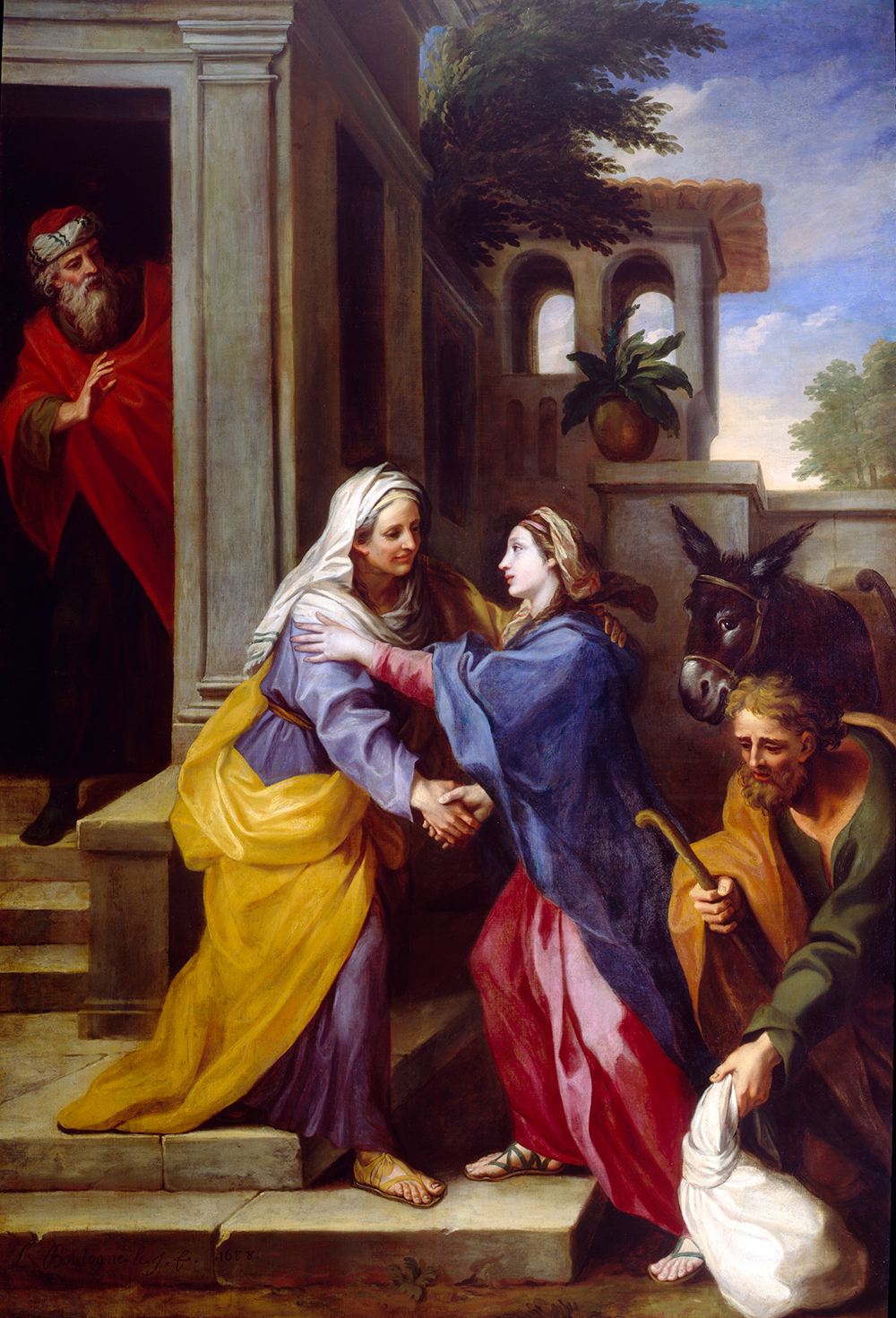
Louis de Boullogne, the Younger is a second-generation French painter who with his brother studied at the French Academy and also in Rome. Unlike most other students, however, Boullogne later taught at the Paris Academy and then became its director. He went on to become First Painter to King Louis XIV. His work is known throughout France, especially at Versailles.

When one encounters a work of art, one often has a visceral reaction to some aspect of the work. No doubt the vibrant colors in The Visitation by Louis de Boullogne are a lovely invitation into an appreciation of the painting. In the mid-1800s, Charles George, the Commissaire-Expert of the Louvre, complimented the choice of color and even the “fresh and graceful” brushstrokes. But to really understand a work, one must know the subject matter; after all, the work is but a vehicle for the meaning.

The title refers to the visit of the Virgin Mary to her cousin Elizabeth shortly after Gabriel announced that God had chosen Mary to bear the Messiah (Luke 1). Elizabeth herself had also been the recipient of God’s grace. Mirroring Sarah and Abraham, Elizabeth and Zechariah (also Zacharias) were old and childless. But God sent Gabriel to meet Zechariah with a message of miraculous birth three months before the angel appeared to Mary.

To visit the one who can best sympathize with her situation, Mary travels nearly one hundred miles “in haste,” needing encouragement, for the public ordeal that will doubtless come from her pregnancy. Nazareth was a small town, and “bad” news always travels fast. As Mary greets Elizabeth, now openly six-months pregnant, the baby (John as he will be called) leaps “in her womb for joy.” This first meeting of the cousins—John the Baptist, the Way-Preparer and Christ the Messiah—foreshadows the joy of their partnership in turning the hearts of Israel toward God.

Both mothers have crucial roles to play in the redemption story. Though Elizabeth is the elder and Mary the visitor, Boullogne places the characters on the same step of the house. Their mirrored poses—clasped right hands and left hands placed on one another’s shoulders—show their equality as well. Both mothers are handmaidens of the Lord, being the fulfillment of Isaiah’s prophecies. This certainty of God’s hand upon them gives both women the strength they need to endure the whispers and stares of their community.

Elizabeth’s response to Mary’s unrecorded greeting, wondering that “the mother of my Lord” would come to visit her and blessing Mary and the “fruit of her womb” prompts Mary’s own praise of “God [her] Savior.” Both Mary and Elizabeth know their place in the redemption story—recipients of the Messiah’s saving work.

Possibly influenced by the school of Carlo Maratta, Boullogne chose colors and brushstrokes to make this a winsome and charming portrayal of two godly women. Zechariah as the elder forerunner is thus placed superior to Christ on the steps, yet his son John’s fame and ministry will decrease as the Messiah Himself rises in prominence. Joseph’s presence is not noted in the biblical text, which is an appropriate omission for this first-recorded recognition of the Son of God by those He came to save.


Dr. Karen Rowe Jones, M&G board member


Published 2024