One of the most important pieces of furniture during the Italian Renaissance was the cassone—the Italian word for a chest.
Tag Archives: Italian furniture
Credenza
Walnut
Italian, 15th or 16th century
Gift of Paul W. Doll
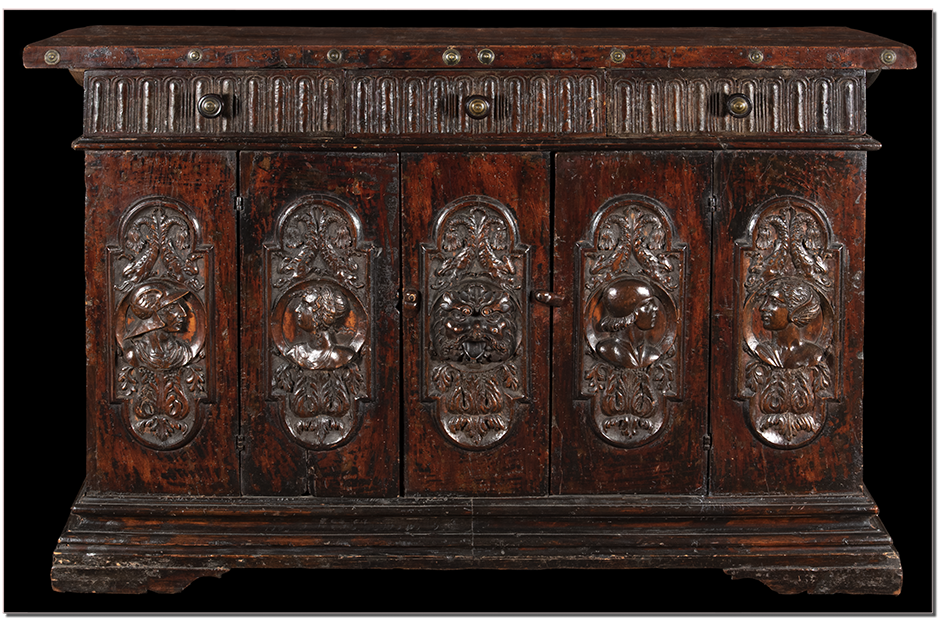
In 1970, one of the Museum & Gallery’s primary early donors contributed this piece—a 15th-16th century carved walnut Credenza. As a furnishing, credenzas began as functioning sideboards, the top of which were meant for preparation and presentation of food. Long, low cabinets, often featuring drawers or doors for storing dishes and glasses, credenzas were often draped with expensive fabrics in wealthier homes.
Taken from medieval Latin, credenza means “belief” or “confidence” (sharing its derivation with our English word, “credence”). In our modern mindset, it is somewhat difficult to comprehend how the idea of “confidence” might have been wedded to a piece of wooden furniture, but it likely began as an association of the act of testing a noble’s food for poison.
Lest we discount such a probability, it’s helpful to understand the historical context. As far back as A.D. 1198, the Jewish doctor and philosopher Maimonides wrote a treatise on the subject for his employer, Sultan Saladin of Egypt and Syria. Maimonides gave detailed instruction, urging Saladin to insist his server or host eat a large portion of each dish before beginning to eat his own.
It seems unlikely to us that the need to test food could be so great, but historical examples may aid here. During the reign of Henry VIII in 16th-century England (the era in which M&G’s Credenza was constructed in Italy), the king employed some 200 persons in Hampton Court’s kitchens alone. While other European royalty and nobility may have employed smaller staffs, there was still ample opportunity for poisoning a ruler’s food. As servants delivered dishes to the dining room, they placed the dishes on the piece of furniture where credence tests for poisons were conducted, a literal credenza.
The face of M&G’s 16th-century walnut credenza was crafted of five solid boards, with overlay panels applied over each. Each of these panels is ornamented with detailed carving—four of these featuring profile busts of Renaissance figures (a technique called romayne). Each pair of these panels form doors, and the doors flank a fixed central panel carved with a grotesque mask. Hovering above the five front panels are three drawers, largely camouflaged by detailed fluted carving. The two end panels are simpler, each contain a distinctively Italian carved rosette and each lack the fluted frieze at the top. Along the front of the top plank are periodic dowel caps, indicating that the top is formed of smaller individual planks.
This style of carved Renaissance credenza is typical of both France and Italy, but individual elements indicate that this piece is most likely from Northern Italy, while still reflecting influences from the surrounding countries. Construction, materials, and ornamentation help to date the Credenza to the end of the 15th century to the middle of the 16th. Specifically, the detailed clothing of the men and women carved on the face of this credenza is like a Renaissance time capsule. The winged helmet worn by the first male (far left), for instance, depicts a sallet, a combat helmet which replaced the bascinet (helmet) in the mid-15th century. Later sallets dispensed with face protection and featured gracefully curved surfaces. These were preferred by more lightly armed troops and suggest that this credenza was built no earlier than about A.D. 1460.
Fascinating historic pieces such as M&G’s Credenza provide windows through which we understand the lives and culture of those who came before us and, in this case, an era upon which much of our modern Western civilization is built.
Dr. Stephen B. Jones, M&G volunteer
Cassone
Walnut
Italian, 16th century
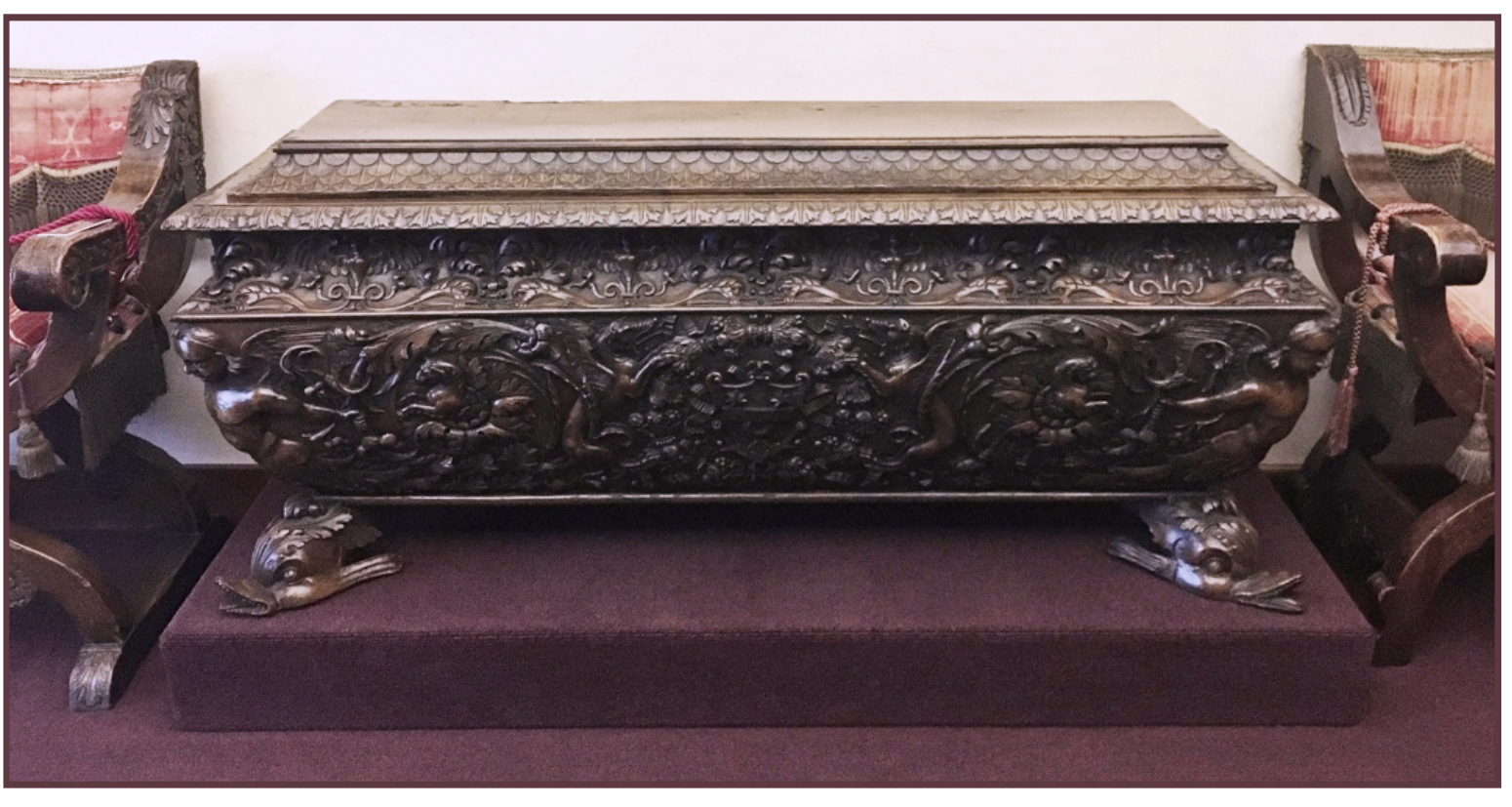
Years ago a television series aired featuring a dolphin named “Flipper.” He exhibited the usual amount of dolphin intelligence and often saved the day. One of M&G’s pieces of furniture includes carved dolphins and takes a person to a time and place where dolphins symbolized various aspects of life.
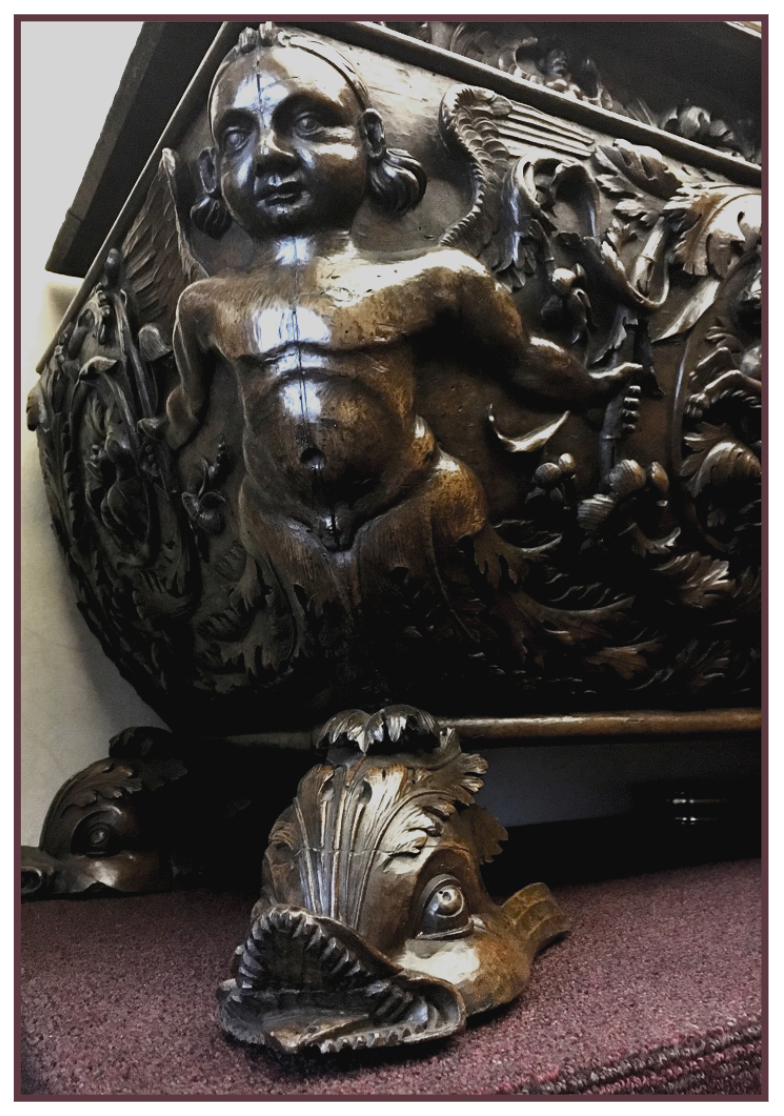 During the 15th and 16th centuries, Italy specialized in the production of a special piece of furniture called, cassone, the Italian word meaning chest. Of the eighteen cassoni (plural for cassone) in M&G’s collection, one is beautifully and elaborately carved; rather than a lion’s claw for feet or some other standard furniture base, this cassone rests on four carved dolphins. In his catalog for M&G’s furniture collection, furniture connoisseur Joseph Aaronson described the chest this way, “the dynamic carving of swirling plant and grotesque animal forms, framed at the corners by winged putti figures. . . is based on Roman patterns and is unmistakably Italian in its playful freedom.”
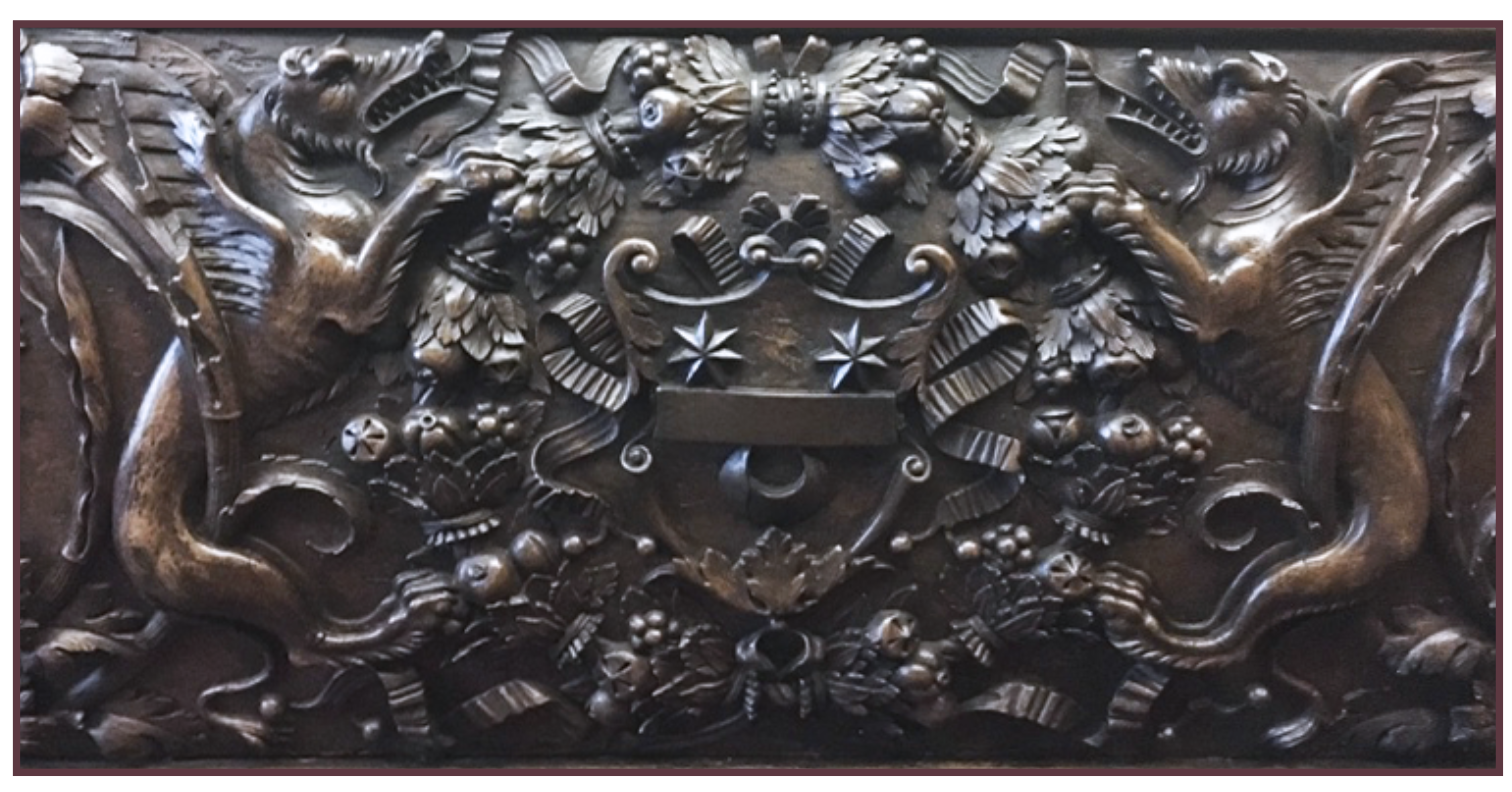
Rome became the center of cassone production in the mid to late sixteenth century. According to the Encyclopedia of Interior Design, by this time society’s taste had shifted from the chests with painted panel scenes and portraits to a more sculptural form of decoratively carved dark walnut with little to no paint or gilding. M&G’s cassone represents the era’s preferred choice with its dark wood and ornate carvings.
However, why would dolphins be carved for the feet? Most people at this time were familiar with the mammal due to the fact that Italy is surrounded by water. Greek mythology presents dolphins as companions to Dionysius, a seafaring god; and they are also connected with Venus the goddess of love. Dolphins symbolized long life and safety in travel. Since cassoni were often given in pairs as a wedding gift by a bride’s parents, it was one way to express their support and desire that a marriage would be safe, long, and produce a healthy family. In its context, a cassone was both a practical and necessary piece of furniture, but also a status symbol in society for newlyweds.
M&G’s cassone was a gift from Carl Hamilton in 1956, and remains somewhat mysterious. Its shape may indicate when it was made and its possible origin in the seaport of Genoa. On the front is a crest, yet no further information has been found to connect it to a specific family. As cassone production is further studied, perhaps more will be learned about M&G’s cassone in the future.
John Good, Security Manager
Published in 2017
Stipo Bambocci, walnut Stipo Bambocci, walnut
Italian, 16th century Italian, late 16th to early 17th century
Click on links for additional reference information.
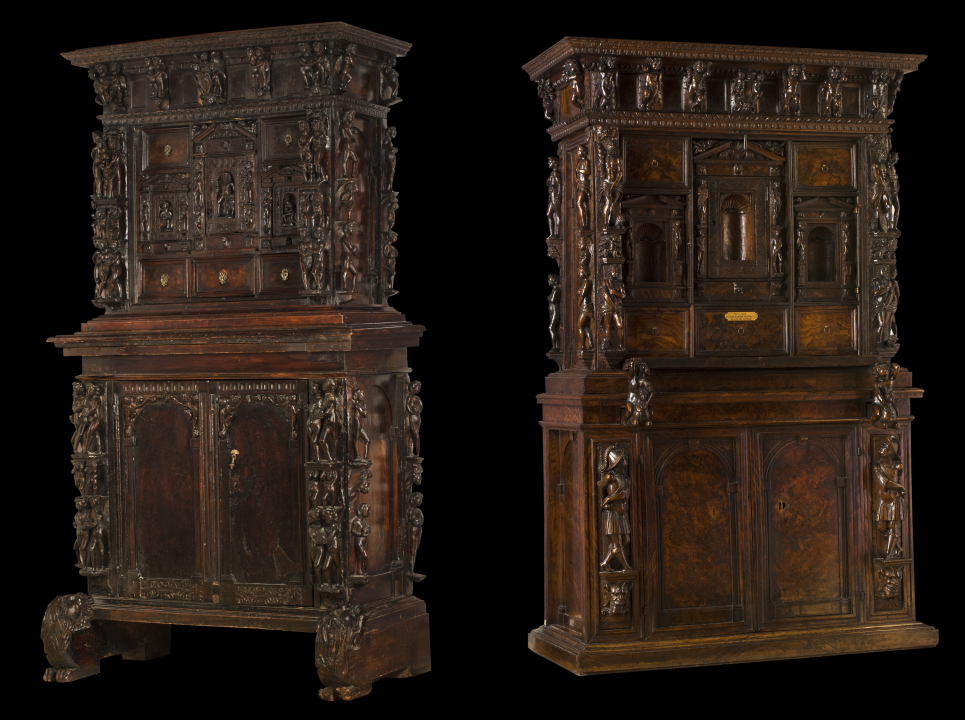
Most of us at one time or another have treasured and tucked away some poem, theme paper, or letter. Your paper valuables may have been stashed in a simple cardboard box, but if you were living in Italy between 1560 and the early 1600s in the thriving cities of Genoa or Florence, your written mementos may have been stored in a tall, desk-like piece of furniture called a Stipo a Bambocci, loosely translated “a cabinet with carved babies.” As the style became popular, more iconographic carvings embellished the desk’s exterior, which is typical of the emerging Baroque period. Yet, the name’s association with “babies” persisted.
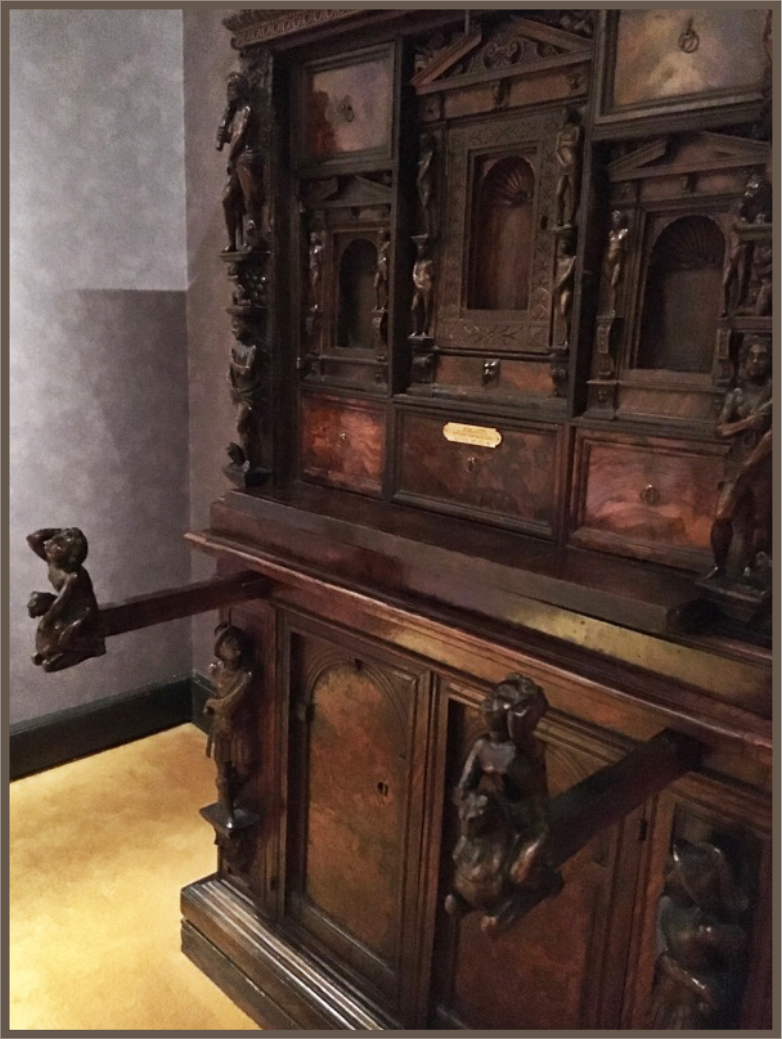 Beautifully fashioned out of two kinds of wood—burled-walnut and Caucasian walnut, the upper portions of the desks (not usually created at the same time as the lower cabinets) are completely removable, allowing a nobleman to tote just the top portion of his desk on his travels. The interiors, laden with multiple drawers and hidden caverns, beckon the imagination as to what might have been secretly stored within! Most often, a stipo a bambocci was secured with a lockable, fall front writing surface. Supported by lopers when lowered, the false front becomes positioned at a comfortable height for writing.
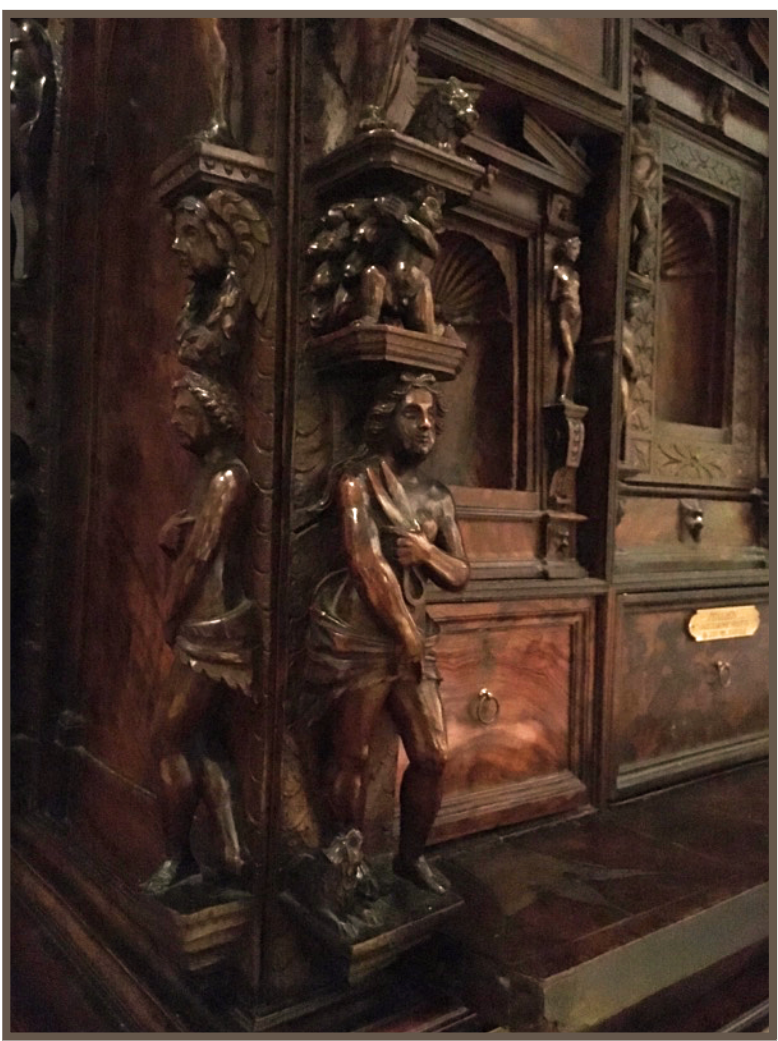
Mimicking the design of an Iberian desk called a bargueño, the production of stipi (plural for stipo) was short lived, a mere 60 to 70 years. Yet their substantial influence can be seen in a more common piece of furniture today known today as an escritoire or secretary.
Little is known about these early furniture makers; however art historian, Dr. Thomas Meyer, discovered in 2008 that Riccardo Taurini and his workshop were craftsmen of a specific stipo. Meyer notes that the family of Taurini is considered to be the “fathers” of the stipi, blending their designs with inspiration from famous artists, architects and sculptors such as Rosso Fiorentino, Jacques I Androuet du Cerceau, Hugues Sambin, Leon Battista Alberti, Giacomo Barozzi da Vignola, and Andrea Palladio.
Almost as interesting as the desks’ construction are the various personages who formerly owned M&G’s unique pieces—the Royal Family of Savoy; an Austrian Archduke living in Lichtenstein Palace, Vienna; Myron C. Taylor, President Roosevelt’s personal representative to Pope Pius XII during World War II; and the industrialist and avid collector, Carl W. Hamilton of Philippine Refining Corporation. It is intriguing to consider what documents might have once been composed upon or stored within these beautiful pieces of furniture!
Though stipi are most often found today in house museums such as Museo Poldi-Pezzoli, Bagatti-Valsecchi and in the Castello Sforzesco, it is no surprise that M&G has two such unusual desks. M&G’s furniture collection (which includes approximately 100 pieces predominately from the 1400s and 1500s) is almost as renowned as its collection of Old Masters. Joseph Aronson (1898-1976), an international European furniture authority, once remarked that “it is one of the finest collections of Renaissance furniture in America.” Aronson’s work, Furniture in the Bob Jones University Collection, as well as other significant volumes such as A Concise History of Interior Decoration by George Savage and A History of Italian Furniture by William M. Odom, both review these two stipi, and qualify M&G’s collection as a must-see for furniture lovers and historians everywhere.
Bonnie Merkle, Collection Database Manager and Docent
Published in 2017
Cassone
Polychrome and giltwood
Italian, 16th century
Click on the links throughout the article to view additional artists’ works and reference material.
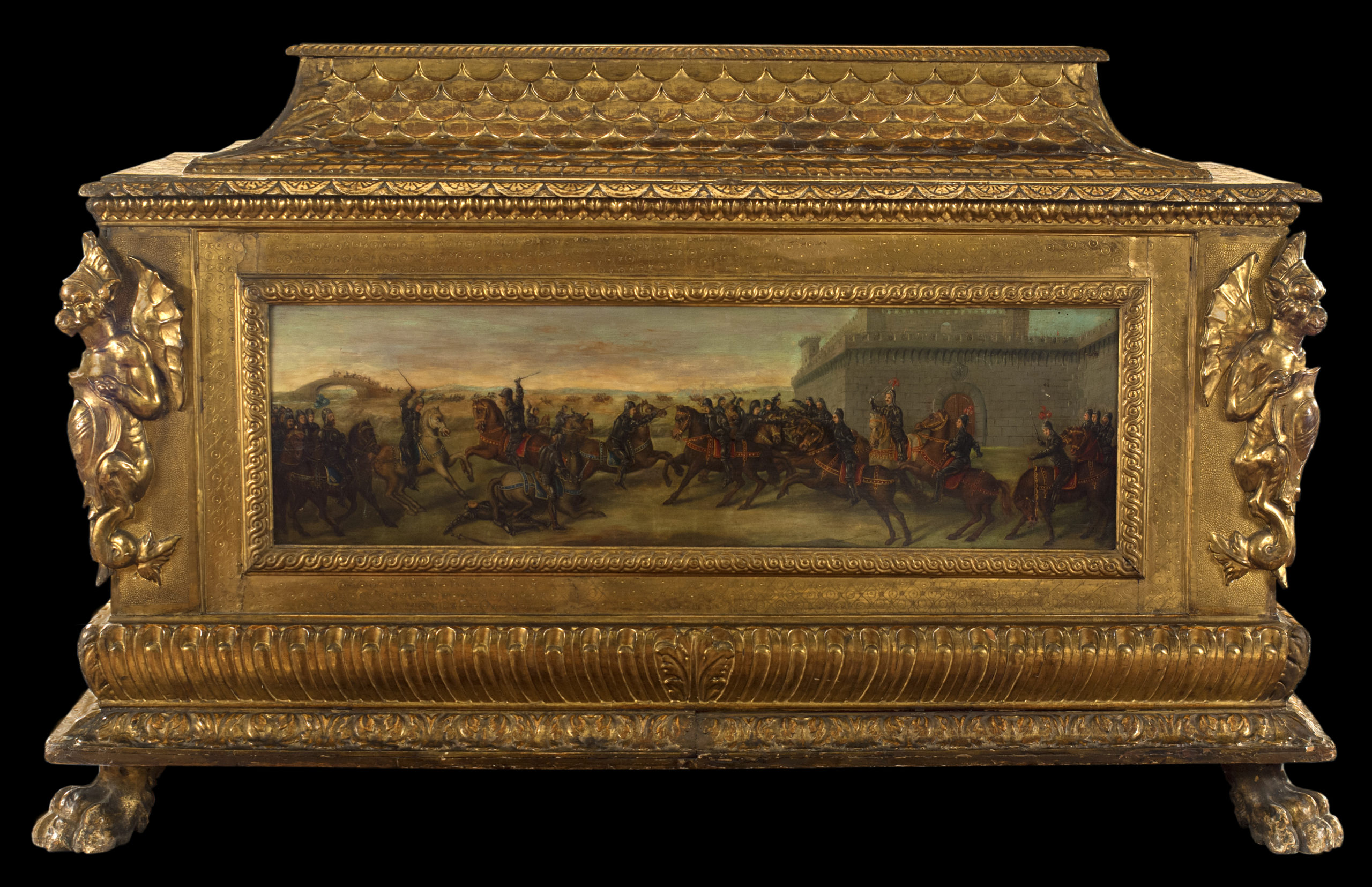
In the not-too-distant-past, young women acquired hope chests to hold clothing, linens, and other items needed to set up housekeeping after marriage. In medieval and Renaissance Italy, similar chests, called cassoni (singular, cassone) served the same purpose. The ornate chests reflected the wealth and status of the families; even the size and grandeur of the cassoni conveyed the importance of the bride’s family, which in this case must have been substantial. Part of the wedding celebrations included the parading of cassoni through the streets from the bride’s home to her new home.
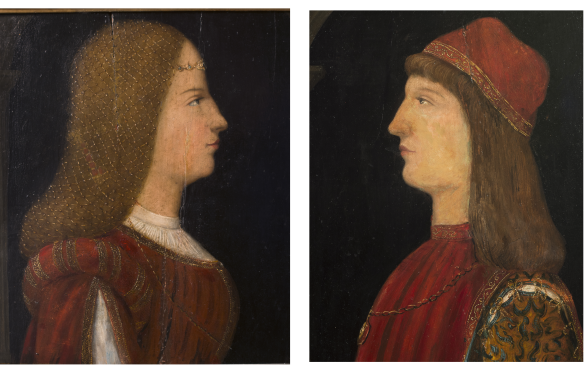
Portraits of the bride and groom are painted at each end of the Cassone.
To complete a cassone, the project required a variety of artisans—woodworkers, ironworkers, artists working in gesso for the ornate pastiglia and gilding, and painters for the inlaid painted panels. It is probable that this cassone once had a decorative back called a spalliera, which is now missing. All of these components combined to make the cassone more impressive and expensive. The portraits of the bride and groom on each end of the cassone provide a beautiful, personal touch.
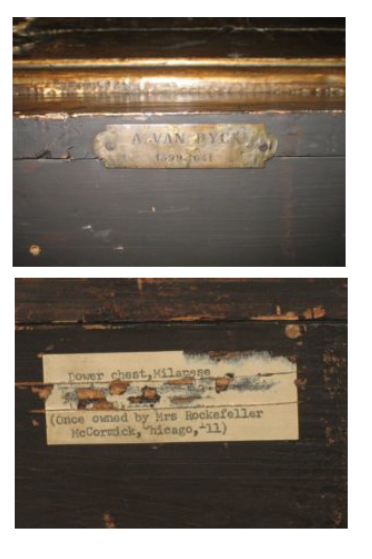 Sometimes an object of art contains clues on the back as to the history of its ownership, known as provenance. For example, a brass plate on the back of this cassone gives the information of “A. van Dyke 1599-1641.” Obviously added at a later date, there must have been some evidence to support the claim. It is known that Anthony van Dyke lived in Italy for six years (1621–1627). It seems especially appropriate that he would have owned this object which beautifully exhibits Renaissance portraiture since he became one of the best known portraitists who ever lived.
Another clue bears the name “Mrs. Rockefeller McCormick.” Edith Rockefeller McCormick was at one time one of the wealthiest women in America. She built an Italian-inspired villa on Lake Michigan and filled it with antiques. A chest such as this one would have fit in perfectly with the décor of the villa.
Anne Short, Volunteer Collection Researcher & Retired Docent
Published in 2016
