Wounded Christ Between Angels
Tempera on panel, mid-1480s
Bartolommeo Vivarini
Venetian, c. 1432–c. 1499
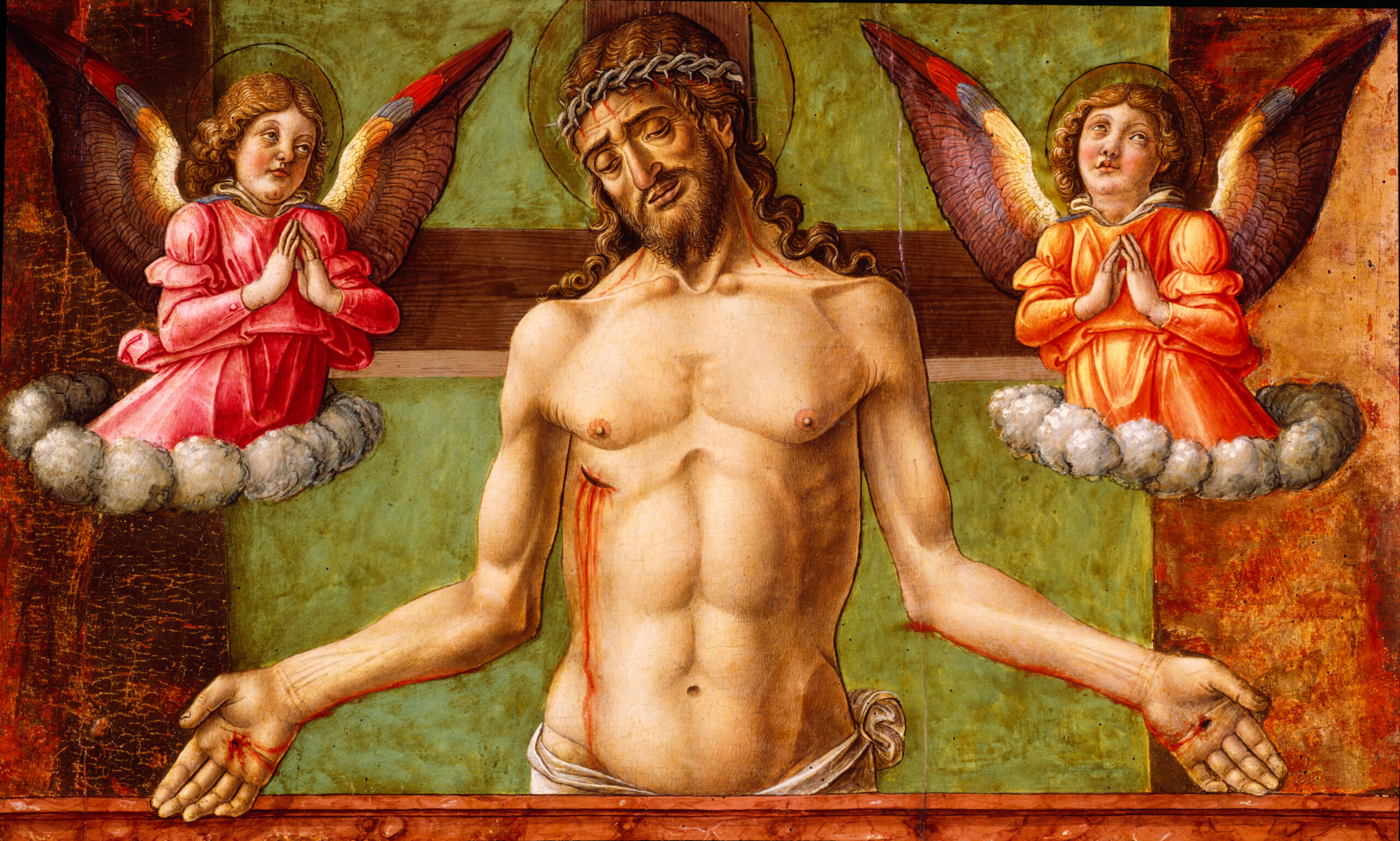
Born in Venice on the island of Murano, Bartolommeo followed his older brother Antonio in becoming an artist and collaborating together on projects as early as 1450. In addition to his sibling’s teaching, he may have studied under Antonello da Messina, the first artist to use oil paint in Italy. However, Bartolommeo’s artistic style with its strong linear quality and hard, sculptural forms suggests possible instruction by Francesco Squarcione of Padua or the influence of one of Squarcione’s greatest students, Andrea Mantegna known for his linear perspective and foreshortening. Although Vivarini’s later works show some influence of Venetian master, Giovanni Bellini.
He, his brother, and nephew Alvise were talented painters. He spent much of his artistic career working in Venice and was quite successful creating large altarpieces in the 1460s and 1470s following the standard Gothic features of gold ground and flattened figures. As the new Renaissance ideals took form in more natural beauty and landscaped backgrounds, Vivarini’s outmoded painting style led him to find work outside the city for more provincial churches, where the artistic innovations were slower to replace his traditional approach.
M&G’s Wounded Christ Between Angels is more than likely a cymatium, the highest decorative panel in the architecture of a polyptych for a church altarpiece. Historians have suggested that M&G’s panel was originally part of one of two large Bartolommeo Vivarini altarpieces that have since been dismembered: the Almenno Polyptych with a focus on St. Bartholmew or possibly the Torre Boldone triptych now in Bergamo’s Galleria dell’ Accademia Carrara.
In looking at the panel, one notices before recognizing Vivarini’s linear style, the bright gold and vivid color choices—both signature elements of the artist’s style. At one point, the work was titled, Pieta, referencing the Byzantine term of Imago Pietatis, meaning Christ of Pity, which developed into the imagery later identified as the Man of Sorrows as seen in M&G’s work.
Vivarini’s thorn-crowned Christ seems to stand in an open sepulcher with His hands resting on a ledge of red marble stone. He presents His wounds to the viewer as He looks down, His face winced in pain. The cross with clearly rendered wood grain is placed behind Him as a reminder of His sacrifice. Two angels hover in mourning beside Him while one looks heavenward and the other watches Christ. Similar to Bergamo’s Trinity with Angels, the background behind the emaciated body of Christ is a vibrant green—a symbolic choice representing the new life that His innocent death and victorious resurrection made possible for mankind.
Erin R. Jones, M&G Executive Director
Published 2026