Give Now


Tag Archives: Italian sculpture

Object of the Month: February 2026

Sorrowing Virgin

Glazed Terracotta, c. 1500

Andrea della Robbia

Florence, 1435-1525

Andrea della Robbia was born into a family known for artistic innovation. His uncle, Luca della Robbia pioneered glazed terracotta as a durable and expressive sculptural medium. As Luca’s primary heir, Andrea learned not only sculptural principles of form and proportion from his uncle, but also the closely guarded technical procedures of glazed terracotta that made the family’s works exceptional in Renaissance Florence.

Throughout his long and prolific career, Andrea expanded and perfected the aesthetic, technical, and practical uses of tin-glazed clay sculpture. His terracotta works are recognizable for their highly refined modeling of serene faces and graceful drapery, their luminous surfaces, and their brilliant colors.

Although Luca and Andrea both carefully guarded their tin-glazing techniques, an early form of corporate espionage resulted in these methods being leaked, allowing competitors—such as Benedetto Buglioni, who crafted M&G’s Pair of Angels with Candlesticks—to share the profitability of glazed terracotta. Others, like Andrea’s son, Girolamo della Robbia, built on the families’ advances and developed firing processes needed for extremely large pieces, like M&G’s terracotta busts of French royalty.

Savonarola, a contemporary of Andrea, was a fiery preacher calling for reform within the Roman Catholic Church. He was not anti-art, but was critical of excessive ornamentation and sensuous beauty in religious art.  He fostered art that reflected humility, repentance, and Christian devotion. There is documented evidence that contemporary Florentine artists such as Botticelli, were followers of Savonarola. Their works show dramatic stylistic shifts as Savonarola rose to prominence, as illustrated by M&G’s Botticelli tondo.

Art historians, including Sir John Pope-Hennessy and Franco Gentilini, have noted that Andrea’s later works resonate with what Savonarola described as “semplicità devota” (devout simplicity). Andrea increasingly favored simpler compositions and less exuberant ornamentation. His later images of the Virgin portray a quiet gravity rather than the courtly sweetness seen in both Luca’s works and Andrea’s earlier productions. There is no documentary evidence of a personal or ideological connection between Andrea and Savonarola; however, Andrea’s later works reflect the tone and purpose of the religious reform Savonarola advocated. One expert noted that M&G’s Sorrowing Virgin aligns not with Andrea’s early works, created under his uncle’s tutelage, but with those from his later period, “when he, himself was in control” of the studio.

The Same Molds

Andrea della Robbia’s wall-mounted glazed terracotta reliefs of the Virgin and Child were highly popular. The graceful, serene expression of the Virgin and the strong, confident appearance of the infant Christ reflect a devotional mood suitable for chapels, hospitals, orphanages, and private homes. These works also embody the “devout simplicity” endorsed by Savonarola.

While the background and frames vary considerably, the figures themselves were likely produced from the same molds. Minor variations can be as seen in details such as the Virgin’s head covering or placement of her right hand. Occasionally more significant variations occur, such as a swaddled Christ seated on His mother’s lap. These and other works that appear to derive from the same molds, can be found in situ in Italy, and in museums and private collections worldwide. Some have direct provenance to Andrea and his studio. A repeated detail also seen in M&G’s piece, is the decorative, single slipped reef knot on Mary’s belt, an Italian Renaissance symbol for purity.

M&G’s Sorrowing Virgin is unsigned; few Italian Renaissance terracotta pieces are, but some of the molds used to make Andrea’s wall-mounted reliefs of the Virgin and Child, as well as other works from his studio, appear to have been used in forming M&G’s piece. Experts agree that these and other similarities justify attributing M&G’s Sorrowing Virgin to Andrea and his studio.

M&G’s Sorrowing Virgin

The first known reference to M&G’s piece is in Allan Marquand’s 1922 Andrea Della Robbia and His AtelierMarquand describes the sculpture, stating, “This much injured half figure of the Virgin is only partially glazed,” that in 1920 it was owned by the New York art dealership French & Co., and that it had received some conservation treatment.

It is possible that the piece experienced a kiln disaster during the firing to affix the glazes. Its extensive damage and conservation are in keeping with this scenario.

  • The right side of the sculpture is glazed in standard colors for Renaissance terracotta. However, during conservation, areas not usually damaged by normal wear, received in-painting.
  • The left side required extensive repair and was painted brown. It is unknown if any glazing survives beneath the paint.
  • During the Renaissance, a permanent red glaze was impossible; artists often glazed areas brown and painted them red after firing. The Virgin’s dress is finished in a brown glaze, but the color intended for it is unknown.
  • A firing problem could explain the very dark, unglazed terracotta of Mary’s face, neck, and hands.

The della Robbia studio developed skin-tone glazes, which Andrea used on works intended to be viewed from a distance. For more intimate sculptures, leaving the skin unglazed resulted in a pale brown, matte surface. Set against the high gloss of their glazed surroundings, these matte areas appeared as soft flesh. Unglazed clay also allowed for detailed modeling and subtle facial expressions, which would have been obscured by thick glaze. The expressions of the figures became the focal point of the sculpture. In keeping with Savonarola’s message, unglazed terracotta would convey the Virgin’s suffering more powerfully than a polished surface would.

The Virgin Mary knew her Son, Jesus Christ, was the Messiah, the God-sent Redeemer. Her sorrow at His crucifixion stemmed from His unjust treatment and excruciating suffering. That sorrow would have been tempered by what the angel Gabriel had told her as His miraculous birth was described. He, the Son of God, would not only be her Redeemer, but He would also be an Everlasting King. Believing God, she had both hope and peace with her sorrow. All of which can be seen in the face of Andrea della Robbia’s Sorrowing Virgin.


William Pinkston, retired educator and M&G volunteer


Suggested References

Cambareri, Marietta. Della Robbia: Sculpting with Color in Renaissance Florence (Boston: MFA Publications, Museum of Fine Arts. Boston, MA. 2016)

Marquand, Allan. Andrea Della Robbia and His Atelier (Princeton University Press. Princeton, NJ. 1922)


Published 2026

Object of the Month: December 2025

Pair of Angels with Candlesticks

Glazed terracotta, c. 1500

Benedetto Buglioni (attributed to)

Florence, 1459/60 – 1521

Italian Renaissance masters like Donatello, Cellini, and Michaelangelo created magnificent sculptures chiseled from stone, carved from wood, or cast in metal. These methods were time-consuming and costly. In the early 1440s, Luca della Robbia, a stone sculptor in Florence, was able to cut the time and cost of sculpture production by developing techniques for tin-glazed terracotta. In addition to achieving the magnificent detail found in the expensive materials, he produced vibrant, permanent colors in his sculptures which other media could not duplicate. Also, he designed multiple modified pieces from molds, which greatly reduced production time and cost.

As a businessman, Luca della Robbia managed a large workshop, where he produced high quality, tin-glazed terracotta pieces and preserved the secrecy of his formulas and techniques. His nephew, Andrea della Robbia inherited both Luca’s workshop and secrets. He became an outstanding sculptor, creating pieces beyond his uncle’s capabilities. (Andrea’s sons, Giovanni and Girolamo, also became sculptors and practiced the family’s secrets. Girolamo accepted the king of France’s invitation to Paris in 1517, where he made M&G’s terracotta busts of French nobility.)

Benedetto Buglioni

The son of a sculptor, Benedetto Buglioni was born in Florence in 1459/60. He probably studied under Andrea del Verrocchio (Leonardo da Vinci’s teacher) and learned terracotta sculpting as a pupil in the della Robbia workshop of Luca and later Andrea. According to Giorgio Vasari, a contemporary artist and historian, Benedetto learned the “secret of glazed earthenware” from a female servant “who came out of the house of Andrea della Robbia.”

In his early 20s, Benedetto opened his own terracotta workshop in Florence. For unknown reasons, from 1487 to 1490, he and his brother produced terracotta works in Perugia, a city about 100 miles from Florence.  Returning to Florence, the Buglioni brothers opened their own workshop and became della Robbia’s chief competitors. High quality, tin-glazed terracotta was extremely popular, and there were plenty of commissions for both workshops.

In time Benedetto was recognized as a master artist. His clients included major churches, important civic groups, and wealthy patrons, including the Medici family. His standing in the artistic community is recognized by the fact that he served on the committee which determined the placement of Michelangelo’s monumental David.

Terracotta Angel Candlesticks

The Eucharist or Communion is a Christian sacrament instituted by Jesus Christ at the final supper before His crucifixion. He shared bread and wine with His disciples and told them the bread represented His body and the wine, His blood. His followers were to partake of the bread and wine as a reminder of His sacrifice and its eternal significance.

In Roman Catholic churches, the elements of the Eucharist are kept in a tabernacle, a locked and decorative box, built into the wall or placed on the altar. As part of the Catholic Mass, candles on either side of the tabernacle are lit. Traditionally, the candles are reminders that Christ is the light of the world and the church.

M&G’s angels probably held candles on either side of a tabernacle. These angels may have been part of a matching tabernacle and angel set, or they may have been used with a tabernacle made of other materials. There are few Renaissance terracotta tabernacles still in existence, and very few of those still have their original angel candlesticks. Of the existing Renaissance terracotta angel candlesticks, most lack tabernacles and some even lack their partner angel.

M&G’s terracotta candlesticks are a typical height—roughly 22 inches; however, their design details vary greatly. Some Renaissance angel candlesticks stand, others kneel. Some wear robes, stoles, surpluses, sashes, jewelry, or belts; others have intricate collars, cuffs or hems. Some are barefoot, some wear sandals, and others wear shoes. Many have wings, and some, like M&G’s, were designed wingless.

M&G’s Pair of Angels with Candlesticks began as a piece of wood wrapped in wet cloths. A molded clay body was formed around the cloths. The body then received a head, arms, hands, feet, clothing details, and candle holder. Some of these additions were based on standard clay molds, and others were hand-sculpted from raw clay. When the sculpture was complete and the clay set, the wood and cloths were removed, leaving a hollow center, necessary for proper drying and firing.

The head and hands of M&G’s angels are not glazed; these areas are the color of baked clay. A tin oxide glaze was painted over all the areas to be glazed and then fired, leaving a beautiful white as seen in the angels’ collars and sleeves. Next, a blue cobalt and a yellow lead glaze were painted over the white. When fired again, the glazes fused with the terracotta, became enameled, and their colors permanent.

Renaissance sculptors rarely signed their works. If found, contracts and payment records can establish who created larger objects; however, smaller works are most often associated with a particular workshop based on style, quality, and the figure’s individual details. Experts agree that M&G’s angels can be attributed to Benedetto Buglioni and his workshop.

Although these angels no longer serve during church services, they do speak to us of the craftmanship of Renaissance tin-glazed terracotta masters. They may also cause us to think of those who saw them in the warm glow of their candles more than 500 years ago.


William Pinkston, retired educator and M&G volunteer


Suggested Reference

Della Robbia: Sculpting with Color in Renaissance Florence by Marietta Cambareri, with contributions by Abigall Hykin and Cortney Harris


Published 2025


Object of the Month: December

Madonna and Child with St. John the Baptist

Polychrome terracotta

Italian, 17th century
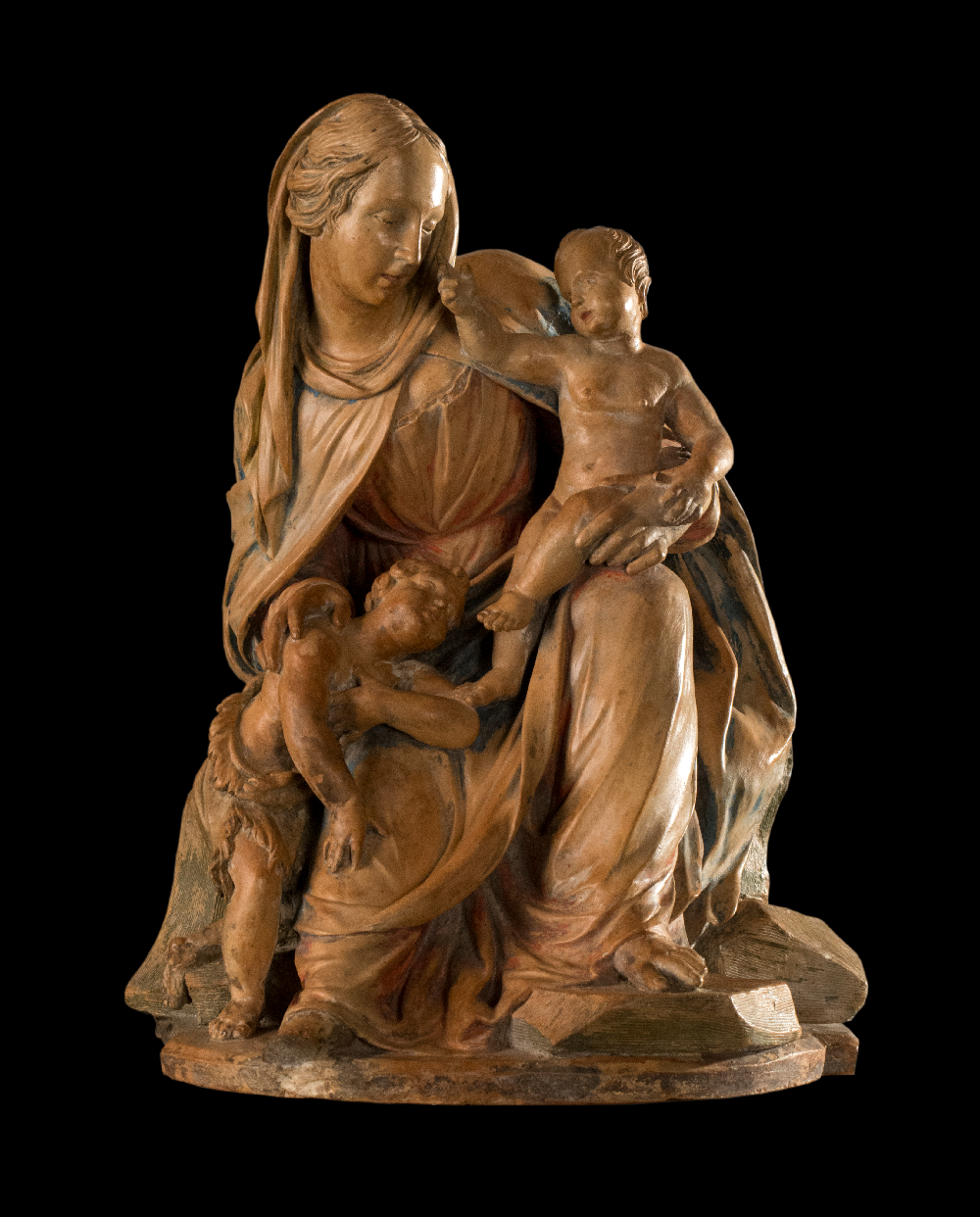
The vast collection at the Museum & Gallery contains many hidden treasures that are sometimes overlooked. In my years working for the museum, I don’t remember coming across this piece. Or if I had, I did not give it too much thought as it was one of many pictorial examples of a common theme—the Madonna and Child with the infant St. John the Baptist. While this sculpture may not be one of the biggest or most recognizable, it is a reminder of humility.

The terracotta sculpture was made towards the beginning of the Italian Baroque. The dramatic movement, and attention to anatomical detail is very typical of Baroque art. Mary is portrayed as a graceful, ideal beauty; and the two infants, Jesus and St. John the Baptist, look like active children. Their leaning bodies and outstretched arms lead the viewer through the piece. In fact, this similar pose can be found in another work in the museum’s collection from the Italian Renaissance, Granacci’s Rest on the Flight into Egypt.

It also relates back to another famous visual interpretation of these three individuals—Leonardo da Vinci’s Virgin of the Rocks. There are obvious similarities, such as Mary’s arm wrapped around an adoring St. John the Baptist and Jesus blessing his infant cousin. What may not be as noticeable at first glance is the setting. Of course, one is a painting, and one is a sculpture, but they both feature figures sitting on rocks. This iconography is referred to as the Madonna of Humility. In earlier art history and even during the Renaissance, Mary is sometimes shown as the Queen of Heaven, enthroned in gold beside Jesus. However, in contrast, da Vinci and this Italian sculptor position Mary seated on the ground, which is a possible reference to her resting during their flight to Egypt. By sitting on the ground or on rocks, Mary demonstrates her humility before her Savior.

The Bible records an example of Mary’s meekness before the Lord in Luke 1:46-55. It was after she had received the news that she would give birth to Jesus Christ, the Son of God. Called her Magnificat, she begins by saying, “My soul magnifies the Lord, and my spirit rejoices in God my Savior, for God has looked with favor on the humble estate of His servant. For behold, from now on all generations will call me blessed; for He who is mighty has done great things for me, and holy is His name…”

While not large or ostentatious, this 19-inch terracotta sculpture is as humble as its subject matter. During the holiday season, we celebrate Christ’s birth that was only made possible through the humility of a young woman and the ultimate humbling for the Savior of the world to become flesh and dwell among us.


KC Christmas Beach, M&G summer educator


Published 2023

Girolamo Della Robbia: Terracotta Busts

The Della Robbia family is famous—for their secret artistic recipe. Watch to learn more about a pair of sculpture and this family of artists represented in M&G’s collection.