Sarah Taken to Pharoah’s House
Oil on canvas
Guillaume Courtois, called Il Borgognone
French (active in Italy), 1628-1679
There is little definitive documentation on Guillaume Courtois, the French painter of this vibrant High Baroque painting. We do know that he came from a family of painters; thus, his earliest training may have been under his father Jean-Pierre Courtois. Around 1636, however, Guillaume and his teenage brother Jacques left France (which had been devastated by the Thirty Years’ War) for Italy. According to some sources they spent time in Bologna, Florence, and Siena before settling in Rome in 1638.
At this time, artists were “pouring in from all over Europe to settle in the city [of Rome]. They all came to learn. Few came with prestigious contracts or appointments in their pockets. Most of them relied for work on the support of the most firmly established national communities (the French, the Dutch, and the Flemish). It was a disconcertingly, rich human panorama that offered an unprecedented opportunity for meetings, exchanges of opinion, and parallel developments of styles” (Zuffi, p. 64). In this eclectic environment both brothers flourished. Jacques went on to become a popular battle-scene painter, Guillaume a painter of religious and mythological scenes.
During his first few years in Rome, Guillaume devoted himself to studying and copying the works of prominent Roman artists like Giovanni Lanfranco and Andrea Sacchi. There is no record of his ever being trained by a specific master; though several historians suggest that he may have been a pupil of Pietro da Cortona in the 1650s. Others reject that claim. Regardless, in this work we do see the brilliant coloration, exaggerated movement, and theatrical “staging” typical of Cortona’s mythological scenes.
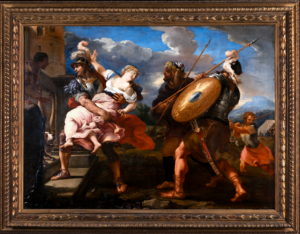
Notice how the saturated colors of the soldiers’ accoutrement (brilliant gold shield, silvery cuirasses, red sword sheath, and cloak) provide a vivid contrast to the soft hues of Sarah’s costuming. She is obviously the focal point of the picture. Her strong diagonal body position, sweeping gestures, and backward glance toward her husband Abraham are all in opposition to the soldiers’ dynamic movement toward the “castle-like” structure on the left. This is indeed an unfolding drama, illustrating what art historians like John Canaday describe as the “swooning emotionalism” of the High Baroque style. Although Courtois’ stylistic technique certainly adds power and beauty to the visual narrative, the Biblical text on which the painting is based is far more nuanced in unfolding the narrative’s historical and spiritual context.
In Genesis 12:9-28, Abraham is not a “background figure” but the catalyst for the narrative’s action. While journeying toward Canaan, the patriarch and his entourage encounter a severe famine. Rather than trust God’s continued provision, Abraham decides to “go down to Egypt.” But before entering this potentially hostile territory, he instructs his wife Sarah to equivocate regarding their relationship, explaining to her his rationale: “You are a beautiful woman, and I fear that when the Egyptians see you, they will learn that you are my wife, kill me, and let you live. Say you are my sister, so that I will be treated well for your sake and my life will be spared.” As expected, Pharoah’s officials did indeed take note of Sarah and praise her beauty to Pharaoh who (believing she was Abraham’s sister) took her into his harem and treated Abraham well for her sake. However, God’s judgment on the unsuspecting Pharaoh and his household was swift, and he soon discerned that Abraham had lied. Summoning the patriarch he demanded, “What is this you have done unto me? Why did you not tell me that she was thy wife? I might have taken her to me to wife: now therefore, . . . take her, and go thy way.” His actions had not only failed to provide refuge during the famine but won him a powerful enemy further complicating his situation! It was a valuable lesson.
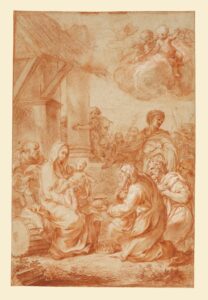
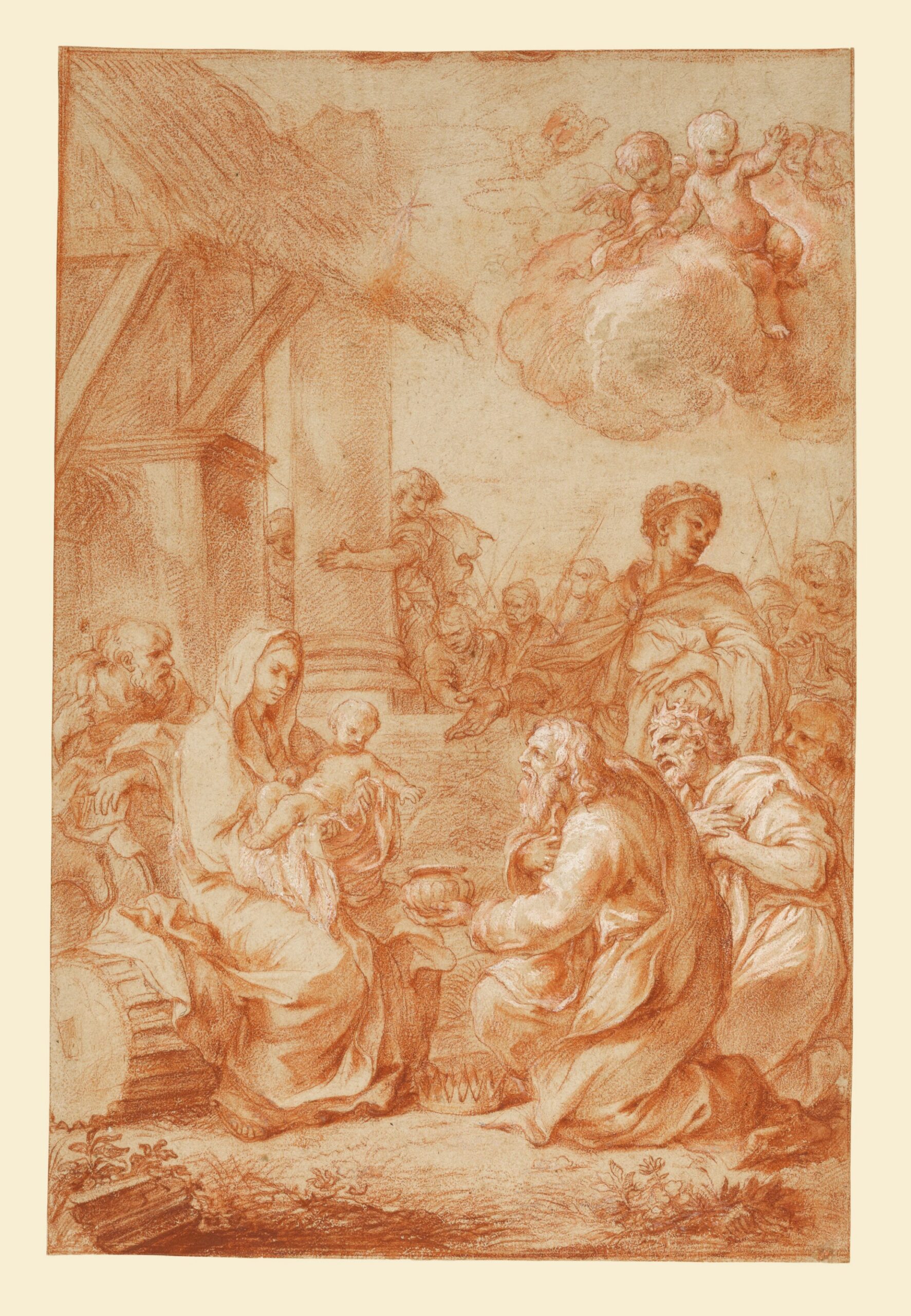
Fig. 1 Adoration of the Magi
In the 1660s Guillaume moved toward a more Classical style of painting. During this stage in his career, he produced numerous preparatory studies for each work, generally drawn in red or black chalk. The preparatory sketch for the Adoration of the Magi illustrates not only the artist’s stylistic shift but also his considerable skill as a draughtsman. This study was completed for an engraving reproduced in a missal book printed in Rome in 1662. Such books (many of which are now lost) often included engravings by leading Italian painters of the time. Peter Vergo notes that Guillaume Courtois “shows himself to be a draughtsman of great distinction. His style of drawing is much enriched in his final years through the use of several colored chalk drawings upon tinted paper. Thereby providing pastel-like effects. His development broke off at its climax. He died at the age of 51.”
Donnalynn Hess, Director of Education
Works Cited:
John Canaday. Metropolitan Seminars in Art: Great Periods in Painting. Metropolitan Museum of Art Publications. 1959.
Ian Chilvers. Concise Dictionary of Art and Artists, 3rd edition. Oxford University Press. 2003.
Hanno-Walter Kruft. “Drawings by Borgognone and Baciccia in the Dusseldorf Kupoferstichkabinett,” The Burlington Magazine, Vol. 119, No. 887 (Feb., 1977).
Stefano, Zuffi (Ed.). Baroque Painting: Twenty Centuries of Masterpieces from the Era Preceding the Dawn of Modern Art. Electa. 1999.
Published 2026