Give Now


Tag Archives: Renaissance

Object of the Month: May 2017

Allegory on the Fall and Redemption of Man

Oil on canvas

Lucas Cranach, the Younger

German, 1515-1586

Click on links for additional reference information.

Lucas Cranach the Younger and his father (also named Lucas) were prominent painters in the town of Wittenberg. The glory of Wittenberg was its university where Martin Luther taught and its village church where the great reformer posted his 95 Theses. At this time the printing press was still in its infancy and textual literacy still the purview of scholars. There was, however, a long tradition of using iconographic painting to educate the masses—most of whom were well-versed in “reading” images. It is not surprising, therefore, that the Cranachs, who were friends of Luther, would use their skill to instruct the populace in emerging Protestant theology. This painting which unfolds Luther’s tenet of justification by faith is a good example.

The tree in the center divides Cranach’s work into a two-chapter narrative that begins with the law (left side of the canvas). The tree overhanging the characters in these scenes is dead and bare—a signification of sin. Adam and Eve’s original transgression opens the story (upper left register). The continuity of sin throughout man’s history is then presented through the Israelites’ worship of the golden calf (toward the center in the upper left register). The high point of the chapter is “played out” in a final scene in the lower left register. Here we are introduced to a hooded prophet who joins Moses in drawing our (and the sinner’s) attention to the law. Condemned by these oracles, the unfortunate Everyman is hurried into hell by grotesque personifications of Death and Satan.

Chapter two opens in the lower right register under the tree’s green bough—a signification of life and resurrection. Here we see another prophet, but this one is facing John the Baptist who points this Everyman to the crucified Christ. At the foot of the cross is the risen Savior with Death and the Devil crushed under His feet. In the distant background is the Old Testament scene of the brazen serpent, referenced by Christ in John 3:14 and 15: “As Moses lifted up the serpent in the wilderness, even so must the Son of Man be lifted up. That whosoever believeth in Him should not perish but have eternal life.” Mary Magdalene, one who has inherited this life, stands with a Lamb (symbol of Christ) on the hillside. Above her in the clouds are the Savior’s feet, signifying both His ascension and His promise to return.

Cranach also inserts into this story one of his contemporaries, Phillip Melancthon (the figure in the hat in the lower right register). Melancthon, a colleague of Luther’s and writer of the Peace of Augsburg, was an important proponent of grace in his own right. One other interesting detail is the artist’s use of text from Romans and Galatians. These Latin verses are a nod to emerging literary forms, including the translations of Scripture that were becoming more accessible through Gutenberg’s press.

To see this work and learn more about the Cranachs and their relationship to the great reformer Martin Luther visit M&G’s exhibition Luther’s Journey:  Experience the History on the campus of Bob Jones University. For more information click here.

Donnalynn Hess, Director of Education


Published in 2017

Object of the Month: January 2017

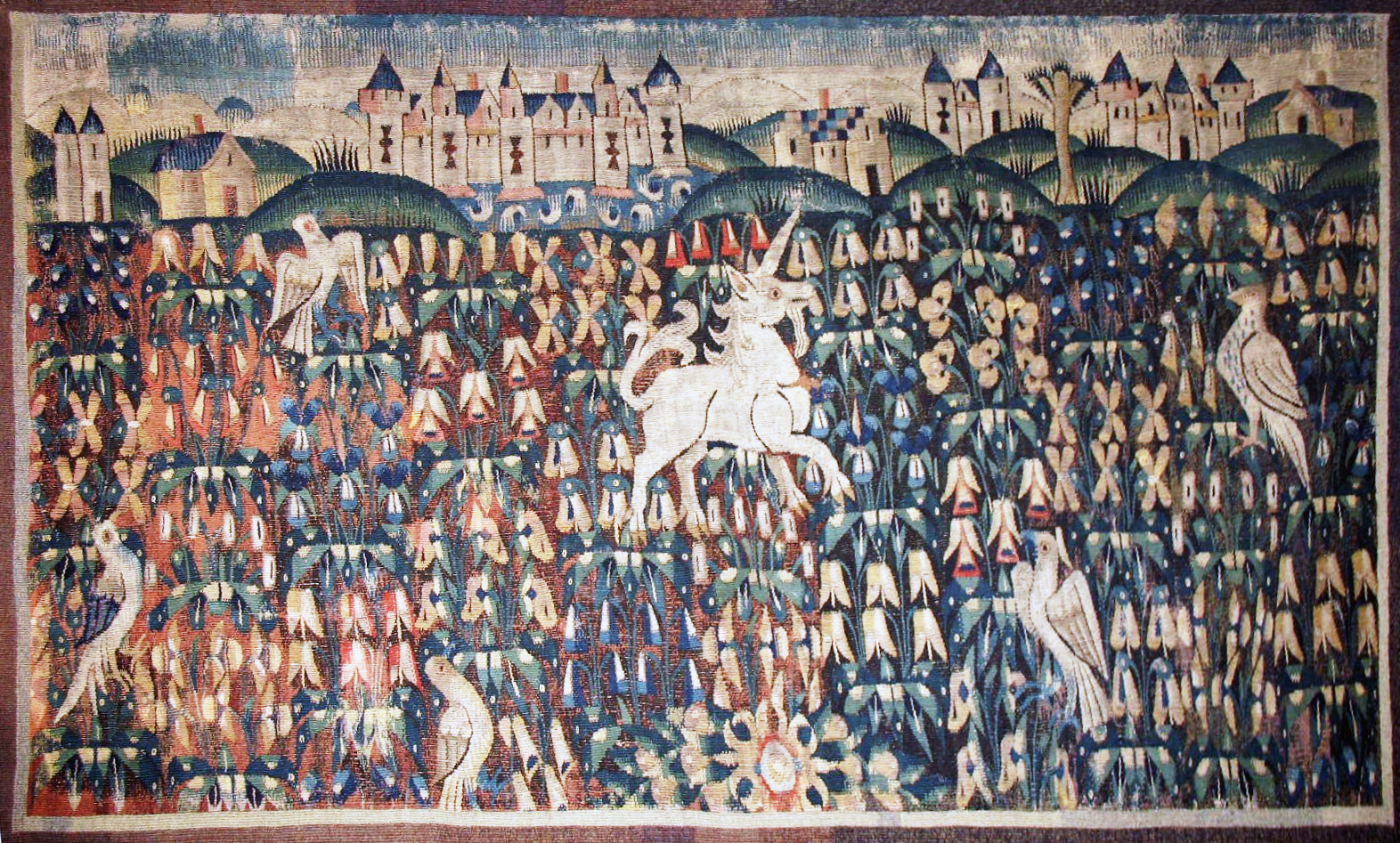
Mille-Fleurs Tapestry

Franco-Flemish, c. 1480

Gift of Z.E. Marguerite Pick in memory of Misty

Click on the links throughout the article to view additional artists’ works and reference material.

Mille fleurs tapestries are those with a myriad of small flowering plants sprinkled across a dark blue or red or sometimes dark brown background.  Mille-fleurs is French, literally translated “thousand flowers.”

Tapestries have been around for centuries, and their use was not merely decorative as we might assume in today’s culture. These incredible textiles are constructed from a considerable amount of wool threads with varying amounts of silk, silver, and gilt yarns for beauty and richness. Their size and material provided insulation in the drafty, cold interiors of medieval castles and homes, and they could easily be rolled or folded and transported, which was a great advantage to those living back then.

However, the subject matter of tapestries varied significantly focusing on scenes from history, allegory, mythology, Scripture, and romance with coats of arms and decorative elements included too.  The mille fleurs decoration, however, wasn’t necessarily linked to any specific subject, but sometimes might be; instead, as one writer describes, the flowering background is more of “an expression of the universal human love of fresh flowers and the wish to have bouquets of fields of them covering the walls”—especially in the barren winter months.

Although as symbols, mille fleurs particularly lend themselves to allegorical and romantic themes “furnishing a slight subject for tapestries entirely sprinkled over with sprightly growing plants” with the “now and then active dogs, strange beasts or an occasional human figure [who] claimed a space.”

M&G’s tapestry certainly meets this composition depicting the imaginary animal, the unicorn, with various birds (perhaps a falcon on the right) against the mille-fleurs background.  The upper portion reveals a landscape of mountains and hills with tall grasses, trees, various buildings, towers, and castles—including one with a moat full of wavy, active water.

The unicorn has quite a history—through second-hand accounts, of course. This mysterious animal is described in classical references as having goat-like features, hence the cloven hooves and beard; he hunts in the mountains and is a very strong, fast animal that no one could capture.  He is depicted on cylinder seals as far back as Babylon and Assyria and referenced in the fifth-century Greek writings by Artaxerxes’ physician, Ctesias.  Other references of the unicorn appear in the old bestiaries.

Philippe de Montebello, former director at the MET, explains the interest in animals both real and imagined, “During the Christian era, the expressive power of animals perhaps reached its height in the Latin bestiaries of the twelfth and thirteenth centuries. These books, labored over by the monks who copied them over and over again, combined factual, realistic observations of animal life with legend and served as allegorical texts for teaching clergy and laymen alike. Animals in their amazing diversity yielded illustrations and promulgations of desired behavior as well as warnings against misbehavior or evil.”

Of all the beasts, the unicorn (sometimes called the Monoceros) has become legendary. He symbolizes purity, and since the unicorn could only be captured by a virgin because of his attraction to her love of chastity, the hunt for the unicorn became an allegory of the incarnation of Christ as well as an allegory of romance and marriage.  Thus, the unicorn appears in both secular and religious art—even on some vestments worn by priests.

It is said that the horn of the unicorn possessed the virtue of detecting poison as well as the power to render the poison harmless. According to legend the animals of the forest would not drink from a pool until the unicorn had first purified it with his horn.  This story is depicted in one of the great unicorn tapestries in the collection at the Cloisters in New York.

The unicorn is often depicted in a place of colorful and abundant fauna, referencing Paradise—sometimes in connection with scenes of Creation and the Fall. He usually stands in the middle or off to the edge, alone or distant from the other animals, and sometimes near a body of water, perhaps immersing his horn.

For the gardeners and lovers of flowers, some of the plants possibly depicted include: foxglove, day lilies, rowan, and the daffodil.  Look closely to identify these symbolic plants:

  • Cuckoo Flower, which Pliny claims can repel snakes and “drive away melancholy and makes people happy in their hearts.”
  • Blue Bell blossoms, which supposedly when a bluebell is suspended above the threshold, “all evil things will flee therefrom.”
  • Wild Pansy, a symbol of remembrance and meditation
  • English Daisies, which signify the joy of Easter, and in medieval Germany these were called massliebe or “measure of love” suggesting that even then girls plucked the petals saying, “He loves me, he loves me not.”

Without knowing more about the designer, weavers and past owners, it’s difficult to know the intention of the tapestry; however, its symbolism provides insight for both the secular and spiritual just as it did in its original home.  The concept of appreciating nature and learning from our observation of it wasn’t new in the old bestiaries or even Aesop’s fables. King Solomon, the wisest man to ever live, exhorts the reader in his wisdom writings of Proverbs and Ecclesiastes to observe God’s creation and find its parallels for application and improvement in our own daily living—a good start for a New Year.

Erin R. Jones, Executive Director


Published in 2017

Object of the Month: December 2016

Casket

Bovine Bone

Flanders, 15th century

Acquired with funds from the Audrey Love Charitable Foundation

Click on the links throughout the article to view additional artists’ works and reference material.

Special boxes or caskets were once made to hold valuable items or at least the personal items of the wealthy. These containers, used for storage and transport, are often beautifully decorated and constructed of rich materials themselves—a practice that has existed for centuries as far back as Egyptian culture.

Many of the surviving caskets focus on romance—decorated with scenes from medieval literature including Tristan, Taking the Castle of Love, Aristotle’s infatuation with Phyllis, poems by Homer, and the concept of chivalry in the characters of Sir Gawain, Lancelot, Percival and others. Thomas T. Hoopes, former curator at the MET explained, “In nearly every case they are decorated with scenes from popular legend and romance, especially with such as would have an allegorical significance appropriate to the occasion for which they were designed.”

In the middle ages, France was the primary creator and market for the luxury items of carved ivory and bone, but by the fifteenth century the center of industry shifted.  The best known craftsmen were the and Florence. For four decades, this group of artisans created and satisfied the demands of fashion crafting beautiful objects in ivory, wood, bone, and horn. The workshop produced a variety of carvings including large and small altarpieces, but their principal output seemed to focus on special, personal items such as caskets, mirror cases, and small toilet articles—many of them bridal gifts or gift sets for the wealthy and noble of the court.

However, the Embriachi weren’t the only entrepreneurs in carving; the industrious and creative Dutch also continued the French tradition.  The workshops in both the southern and northern Netherlands innovated and developed commercial centers for a variety of products including textiles, metalwork, and oil painting. Specifically, the workshops in Flanders developed an export trade of bone boxes and ivory products that traversed the Rhine river routes to European cities and markets—bone boxes like the present Casket.

M&G displays a number of cassone and chests used by our European forbears to store their household items as well as a few smaller versions of storage containers in the form of coffers and now a casket for protecting one’s precious personal items: jewelry, documents, and sentimental objects.

At one time, it was the height of medieval fashion to own a casket, but with the delicate nature of the material it is unusual to have an intact box that has survived time, use, and past repairs.

The Casket is constructed of bovine bone mounted on a wood structure. The bottom of the box is a checkerboard pattern of wood and bone, and the sides and top are carved in low relief, which still retain some gilding and color.  The carved decoration is religious depicting Christ, apostles such as Peter holding the keys, and various saints including St. Catherine identified by her wheel. Perhaps the religious decoration on its exterior reveals that this Casket formerly sheltered a manuscript or religious text.

Since the background of the individual bone plaques is crosshatched, it may indicate that the workshop was influenced by religious prints and engravings from the time period, such as Biblia Pauperum (the Pauper’s Bible).

While the interior is lined by worn and repaired green fabric, interestingly, what was so valued to be safely stored inside is now lost. Once an expensive, beautiful container for holding something of great value, however, it is now the container itself that has become the treasure.

M&G is grateful for the generosity of the Audrey Love Charitable Foundation, without whom we could not have acquired this beautiful, mysterious medieval object.

Erin R. Jones, Executive Director


Published in 2016

Object of the Month: November 2016

Bust of Henri II, King of France 

Bust of Catherine de’ Medici, Queen of France

Glazed Terracotta

Girolamo della Robbia (attr. to)

Italian, 1488–1566

Click on the links throughout the article to view additional artists’ works and reference material.

Heading into the month of November, the themes of family and tradition are strongly emphasized. Throughout the Museum & Gallery, there are many examples of studio traditions passed down between family members such as father to son, uncle to nephew and even father to daughter.  Of these there are few families who have achieved such renowned fame as the Della Robbia family.  Founded in Florence by Luca Della Robbia, the family workshop produced sculpture for more than 100 years and was considered one of the most successful studios of the Renaissance.

What made the Della Robbia family so successful was their contemporary approach to sculpture and their luminescent glazing.  Sculpture began to take new forms in the Renaissance, especially in the use of a forgotten medium—clay, which was revived for many reasons.  It was easy to model and cast, which allowed delicate detail; and it was an inexpensive material.  Clay was considered a humble medium that encouraged piety and did not distract from the holiness of the subject it depicted.

Luca is credited with the invention of the glaze, the family studio’s distinctive trademark, which effectively combined painting and sculpture.  Many reasons are given why he developed the new glazing technique ranging from aesthetic to economical or both.  The glaze was a ceramic treatment of the clay that protected the clay, making it impermeable.  It also rendered sculpture, in Giorgi Vasari’s words, “almost eternal.”  Hailed as a major artistic and scientific discovery, the glazed terracotta rapidly became desired throughout Florentine society.

After Luca, the studio was passed on to his nephew, Andrea, and then to Andrea’s sons.  From Florence, the studio was carried to France in 1517 by Girolamo della Robbia, the youngest son of Andrea.  At this time, King Francis I had been inviting many Italian artists such as Girolamo to encourage an artistic Renaissance in France.  Girolamo created many sculptures, altarpieces and intricate architectural elements for the king and his court.  After the death of King Francis, Girolamo went home to Florence but later followed Queen Catherine de’ Medici to Paris to continue making art until his death in 1566.  Two years later, Vasari wrote “not only did [Girolamo’s] house die out…but art was deprived of the knowledge of the proper method of glazing.”  Despite the family’s closely guarded glazing secrets, legend tells that a Della Robbia housemaid stole the glazing technique and passed it on to Benedetto Buglioni and his family.

Located in the Italian Mannerist gallery at M&G, two large terracotta busts immediately arrest the attention of guests.  Their powerful presence and beautiful glazing draw viewers in to inquire the identity of the sitters.  Both are attributed to Girolamo and are reminiscent of the works for which the della Robbia family is so famous.

When Dr. Bob Jones Jr., founder of M&G, purchased the pair, the figures were originally thought to be Cesare and Lucrezia Borgia, son and daughter of infamous Pope Alexander VI.  However, due to Girolamo’s workshop being more centrally located in France, it is more likely the figures are King Henri II (son of Francis I) and Queen Catherine de’ Medici.  The figures could also be French courtiers who were wealthy enough to afford their portraits in sculpture.

Even though the art of sculpture seeks to capture a likeness or identifiable features, it should be noted that most sculptural portraits remain unidentified.  Whoever these two actually were, they have truly been immortalized and given as Vasari says an “almost eternal” look.  From their pedestal, they stand as a testament to the artistic tradition and genius of the Della Robbia family.

KC Christmas, Docent and Guest Services Attendant


Published in 2016

Object of the Month: October 2016

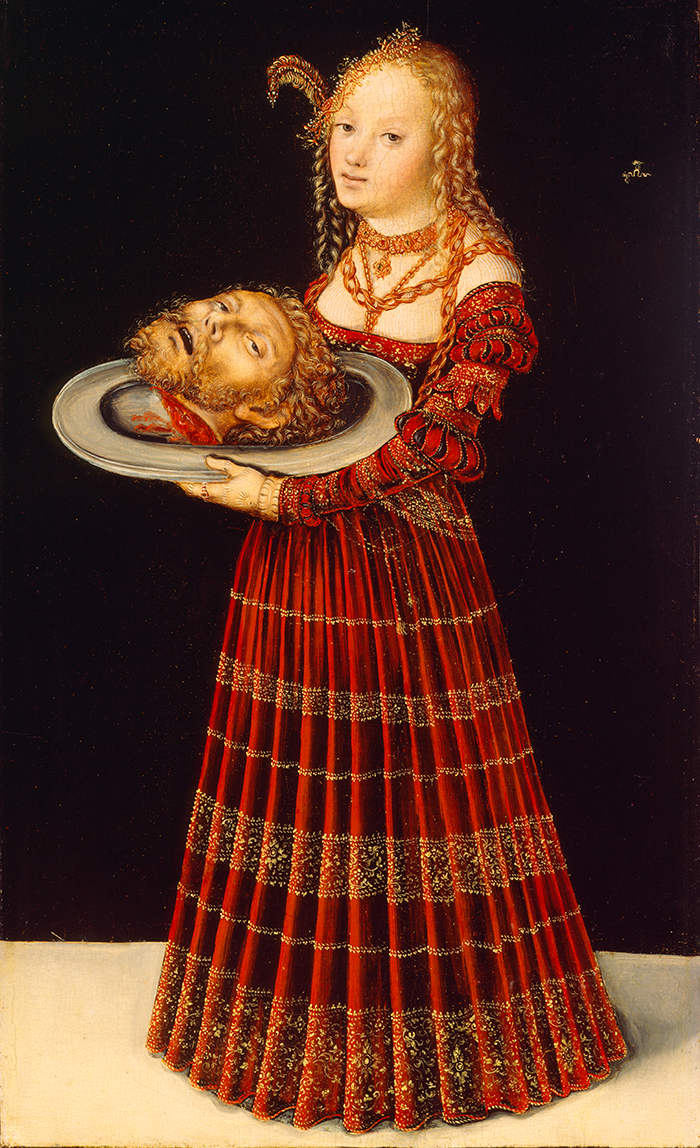
Salome with the Head of St. John the Baptist

Oil on panel, Signed: winged dragon symbol (upper right)

Lucas Cranach, the Elder

German, 1472–1553


Click on the links throughout the article to view additional artists’ works and reference material.

A young girl in a lavish red dress with gold trimming stands against a stark black background. Ornate gold necklaces hang from her neck, and on her left index finger, a ring peeks through intricate slashed gloves. Her face has a smug expression as she holds a platter on which rests a man’s severed head.

This painting, by Lucas Cranach the Elder is a sixteenth-century portrayal of Salome with the Head of St. John the Baptist and is based on the Biblical story recorded in Mark 6:14-29. While the image appears morbid to many, one author has pointed out that beheadings like this are frequently seen in Cranach’s oeuvre.

As is often the case with the Old Masters, Cranach did not paint Salome in traditional Middle Eastern clothing, with which he would have been unfamiliar. Instead, he painted her as a contemporary German noblewoman, giving us a glimpse of the beautiful clothing of the time period. It is interesting to note that Cranach’s paintings have proven invaluable to fashion historians and costumers studying and recreating Renaissance dress. One New York designer even created a special exhibition focusing on the slashed gloves that Cranach’s models are often shown wearing!

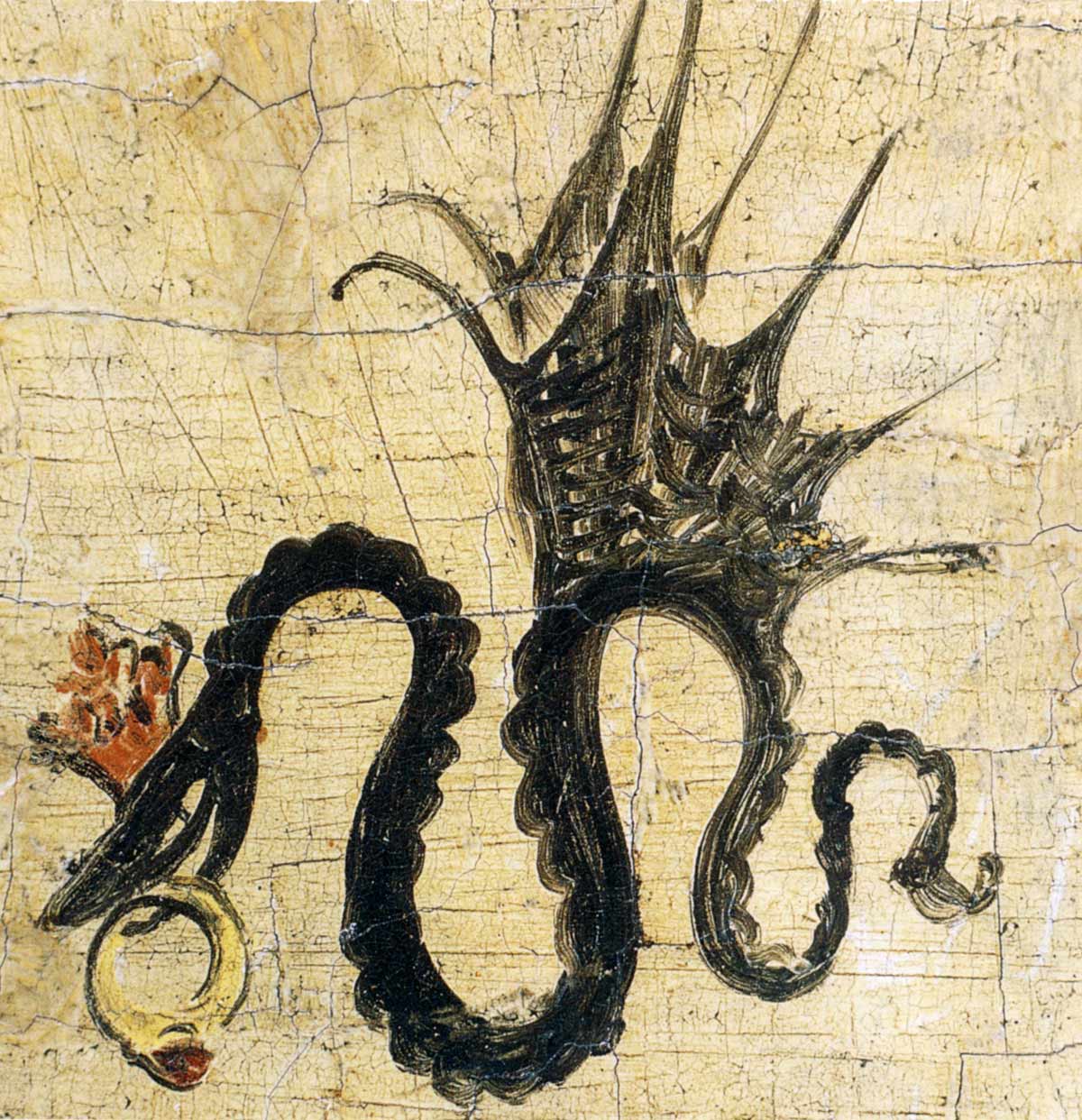
Perhaps the painting’s most fascinating detail, however, is distinct from the subject matter.  In the upper right hand corner is the kleinod, which served as his signature stamp. This symbol of a winged serpent biting down on a ruby was given to Cranach by Frederick the Wise of Saxony.  Since Cranach painted at a time when many artists were not even signing their works, this unique signature is particularly striking.

Cranach’s kleinod does at times pose a conundrum for art connoisseurs. Like many well-known and established artists of that time period, Cranach had a large workshop with many craftsmen working with him. Oftentimes these craftsmen worked on details and even produced entire pieces so similar to those of the master that scholars are sometimes left to wonder whether a painting with the kleinod symbol was actually produced by him or simply received his stamp of approval.

In addition to his many Biblical scenes, Cranach was a renowned portraitist. In fact, we owe him a debt of gratitude for providing us with more than one picture of Martin Luther, a personal friend of his. Cranach’s workshop was located in Wittenberg, Germany, the birthplace of the Protestant Reformation. It was here on October 31, 1517 that Martin Luther nailed his ninety-five theses to the church door. Eyre Crowe, an artist for London’s Royal Academy, captured the event over three hundred years later with drama and historical accuracy.  Cranach is the bearded man seen looking out at the viewer.

Cranach, who adopted Protestant theology, went on to become the key Reformation artist. As 2017 will mark the 500th anniversary of Luther’s world-changing actions, many museums, including M&G, are paying tribute to his artistic friend, Lucas Cranach the Elder.

Katie Neal, Docent and Customer Service Assistant


Published in 2016

Object of the Month: June 2016

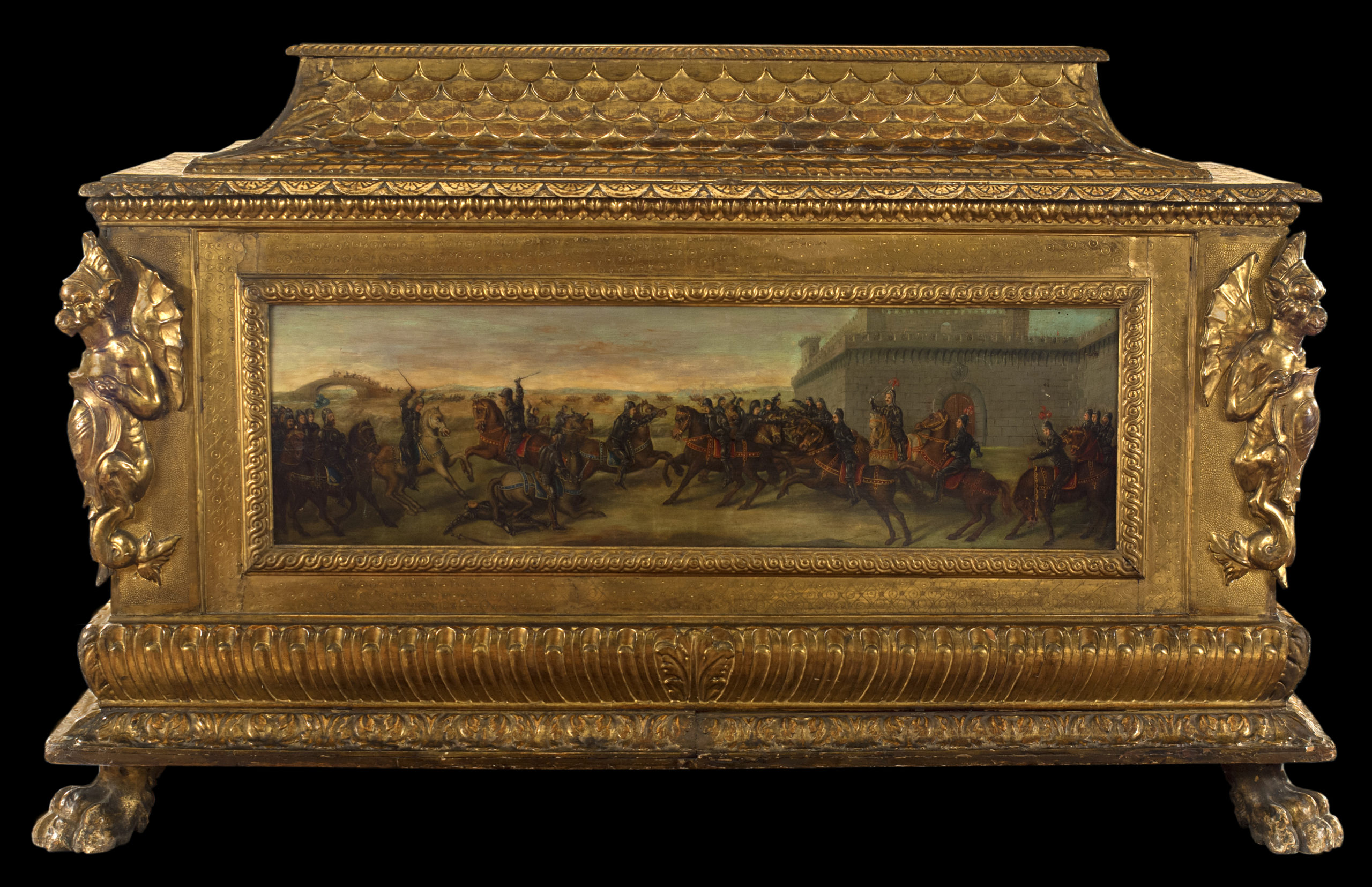
Cassone

Polychrome and giltwood

Italian, 16th century

Click on the links throughout the article to view additional artists’ works and reference material.

In the not-too-distant-past, young women acquired hope chests to hold clothing, linens, and other items needed to set up housekeeping after marriage. In medieval and Renaissance Italy, similar chests, called cassoni (singular, cassone) served the same purpose. The ornate chests reflected the wealth and status of the families; even the size and grandeur of the cassoni conveyed the importance of the bride’s family, which in this case must have been substantial. Part of the wedding celebrations included the parading of cassoni through the streets from the bride’s home to her new home.

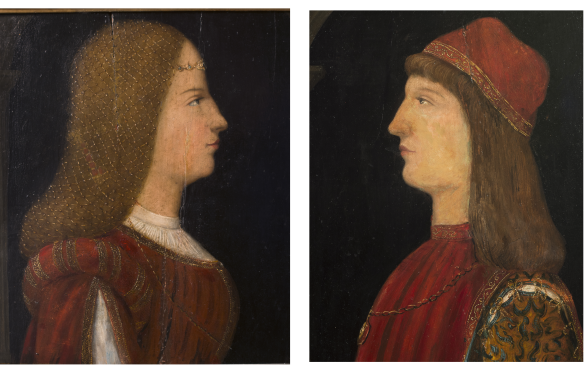
Portraits of the bride and groom are painted at each end of the Cassone.

To complete a cassone, the project required a variety of artisans—woodworkers, ironworkers, artists working in gesso for the ornate pastiglia  and gilding, and painters for the inlaid painted panels. It is probable that this cassone once had a decorative back called a spalliera, which is now missing. All of these components combined to make the cassone more impressive and expensive. The portraits of the bride and groom on each end of the cassone provide a beautiful, personal touch.

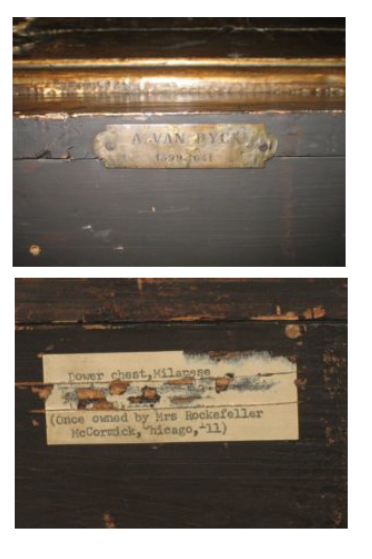
Sometimes an object of art contains clues on the back as to the history of its ownership, known as provenance. For example, a brass plate on the back of this cassone gives the information of “A. van Dyke 1599-1641.” Obviously added at a later date, there must have been some evidence to support the claim. It is known that Anthony van Dyke lived in Italy for six years (1621–1627). It seems especially appropriate that he would have owned this object which beautifully exhibits Renaissance portraiture since he became one of the best known portraitists who ever lived.

Another clue bears the name “Mrs. Rockefeller McCormick.” Edith Rockefeller McCormick was at one time one of the wealthiest women in America. She built an Italian-inspired villa on Lake Michigan and filled it with antiques. A chest such as this one would have fit in perfectly with the décor of the villa.

Anne Short, Volunteer Collection Researcher & Retired Docent

Published in 2016

Object of the Month: January 2016

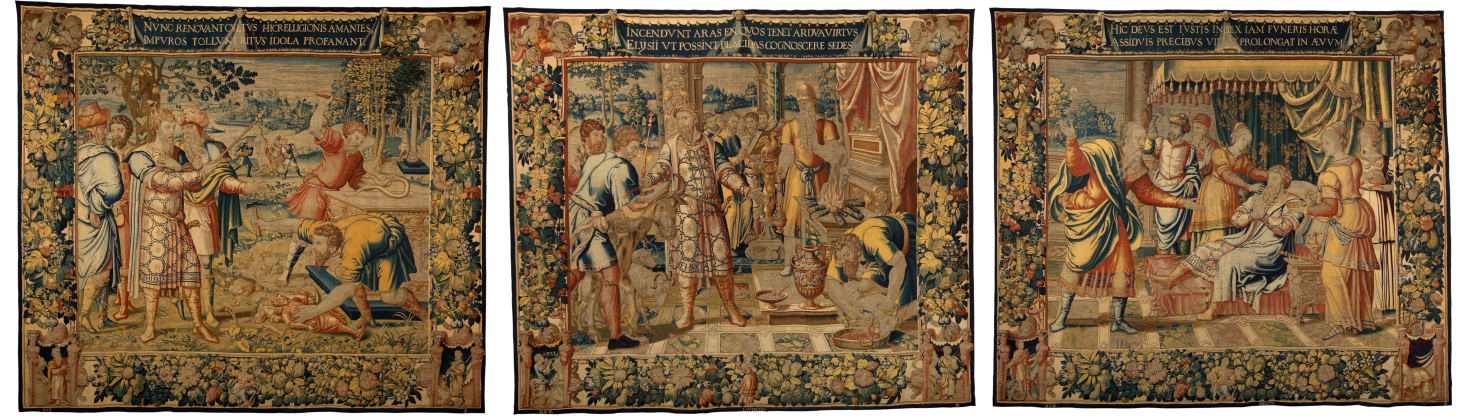
Tapestries on the Life of King Hezekiah: The Destruction of the Idols by Hezekiah, The Sacrifice of Hezekiah,  and Hezekiah’s Life Prolonged

Signed: unknown weaver’s mark (bottom right)

Woven wool  and silk tapestry

Designed by Jan Cornelisz. Vermeyen

Flanders, active 16th century

Woven by the Weaver of the Hezekiah Series (of the Royal Swedish Collection in Stockholm), also known as the Weaver of the Book of the Kings Series (of the Royal Collection in Vienna)

Brussels, c. 1530

Click on the links throughout the article to view additional artists’ works and reference material.
During these winter months, we turn up the thermostat, put on a sweater, or throw an extra blanket on the bed when the temperatures drop. Insulation, thermal-pane windows, and caulking keep our houses snug from winter’s chill.  But what if your home was a drafty castle with no warmth except near the fireplace? If you were wealthy enough, tapestries would provide some insulation to keep the winter winds out and the meager warmth in. The tapestry’s portability was an added bonus. When one residence got particularly smelly or otherwise unsuitable, the artistic insulation could be rolled up and transported to the next home. Of course, we view tapestries today primarily as works of art, without much thought as to their original practical purposes.

When you step into the Lobby at the Museum & Gallery at Bob Jones University, some of the first works of art you encounter are three tapestries, each measuring 13 feet x 11.5 feet. They depict three scenes from the life of King Hezekiah, ruler of Judah in the 8th and early 7th centuries BC. The tapestries were produced in Brussels, Brabant (before Belgium existed as a country) in the early 16th century, and by the early 17th century they graced the walls of Somerset House in London, residence of Queen Henrietta Maria, wife of King Charles I. Since tapestries were considered the most valuable objects of their time, only royalty or the very wealthy would have owned them. With the beheading of Charles I, the tapestries became possessions of Cromwell’s Commonwealth. Later sales trace them to Spain and then New York. M&G acquired them in 1965.

The Bible records details of Hezekiah’s life in 2 Kings 18–20, Isaiah 36–39, and 2 Chronicles 29–32. As one of Israel’s moral, godly rulers, Hezekiah is depicted in the first two tapestries destroying idols and restoring temple sacrifices to draw his countrymen back to serving and worshiping the one true God genuinely, purely, and wholeheartedly. The third tapestry shows an incident where Hezekiah was gravely ill and requested a longer life from the Lord; God answered his prayer and miraculously healed him. The Latin phrases at the top of each tapestry describe the events of each pictured scene.

Anne Short, Volunteer Collection Researcher & Retired Docent

Published in 2016

Object of the Month: December 2015

The Adoration of the Shepherds

Oil on canvas

Pier Francesco Sacchi

Lombardian, c. 1485–1528

Click on the links throughout the article to view additional artists’ works and reference material.

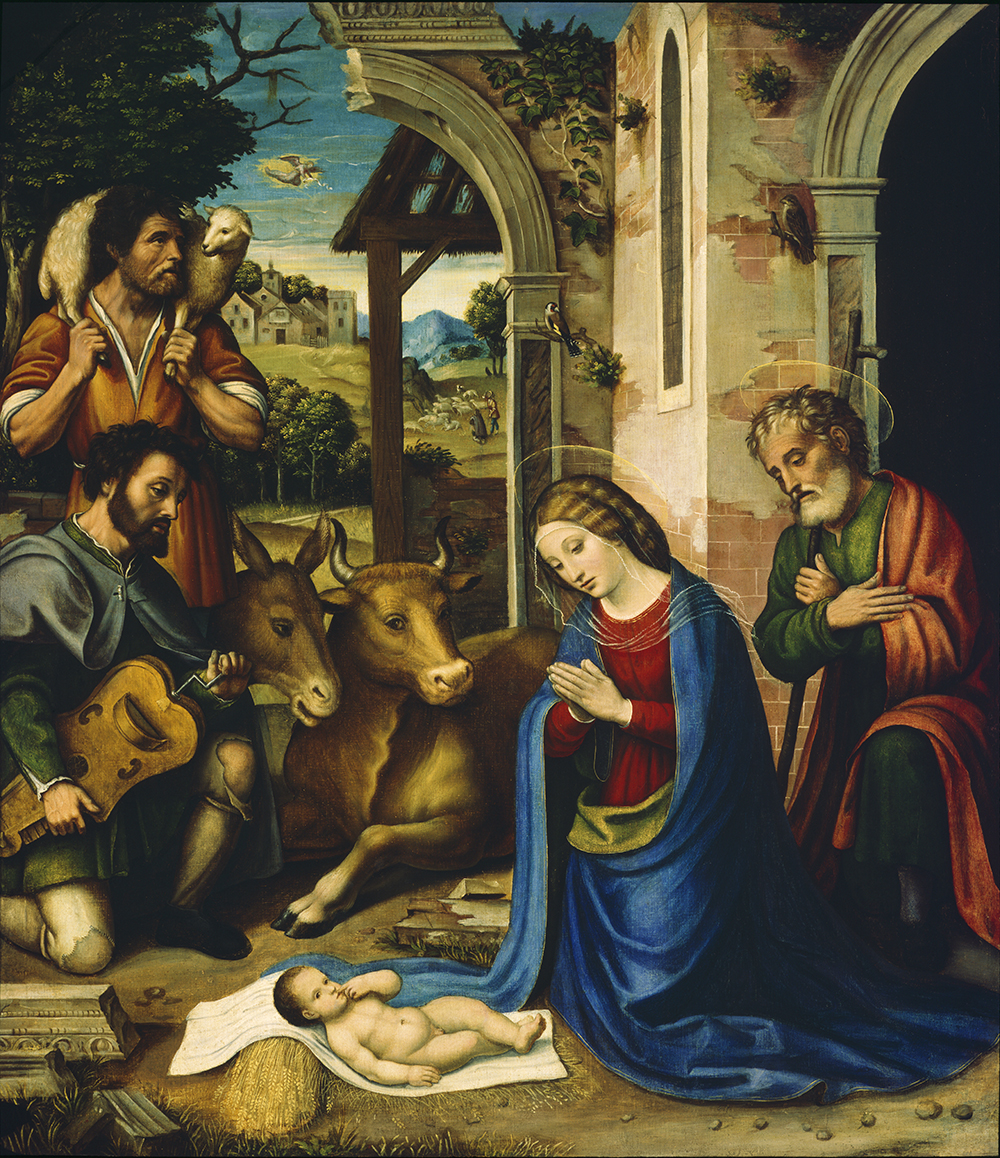
The Adoration of the Shepherds by Pier Francesco Sacchi, in the Museum & Gallery Collection, can best be understood when one is familiar with the historical context in which the work was composed and is knowledgeable about various aspects of the composition itself.

This interesting work was composed during the Renaissance—a “rebirth” of individualism, natural science, and classical education during the fifteenth and sixteenth centuries, which ended the medieval era.  Renaissance art reflects this “rebirth” which finally reached its zenith in the early 1490s centering on three central figures: da Vinci, Michelangelo, and Raphael.  This apex lasted about 35 years up until Rome became a Papal State in 1527.

High Renaissance painter Pier Francesco Sacchi was from a Lombard (northern Italian) village called Pavia as indicated by his signature on several of his works.  Later, he moved slightly south to the coastal city of Genoa where he apprenticed under Pantaleo Berengerio and became a member of the guild of painters in 1520.  The few paintings that can be credited to him are all religious subjects.

Sacchi’s The Adoration of the Shepherd, painted in quattrocento-style (meaning a style in the 1400s, which transitioned between the medieval period and the Renaissance), was originally oil painted on a wooden panel.  However, this work is one of two paintings in M&G’s collection that was transferred from its original wood panel to canvas due to decay.

Old Master painters followed a centuries-old, church tradition of painting specific symbols and attributes along with individual saints for the illiterate masses to identify visually the people and related life stories.  This use of symbolism is prevalent in Sacchi’s work.

For example, the classical ruins as the backdrop for the scene are not a stable for animals.  Rather, they reference Antiquity, and the broken arch represents both a bankrupt past and the necessity of the new covenant with Christ. The goldfinch, said to have eaten thorns, foreshadows Christ’s crucifixion; and the lamb the shepherd holds signifies that Christ, the Lamb of God, will offer up Himself as a living sacrifice for mankind.  The worn out knees of the man holding a Renaissance instrument (called a hurdy-gurdy) represent a life of kneeling in prayer.  The bundle of wheat used for Christ’s headrest prefigures His reference to Himself as the Bread of Life.  Christ lying on the ground and the sparrow, considered the lowliest of birds, references Christ’s humility in coming to earth; and, finally, the tree full of leaves in the background symbolizes life, and the bare branches symbolize death.

In order to “read” a work of art, understanding the historical context in which the work was composed and the various aspects of the composition itself are necessary.  M&G’s The Adoration of the Shepherds by Pier Francesco Sacchi affords the perfect opportunity for deeper knowledge about historical culture in light of Scripture.

Heather Osborne, Former M&G Graduate Assistant


Published in 2015

Object of the Month: November 2015

The Last Judgment 

Oil on panel

Giovanni Filippo Criscuolo (attr. to)

Neapolitan, c. 1495–1584

Click on the links throughout the article to view additional artists’ works and reference material.

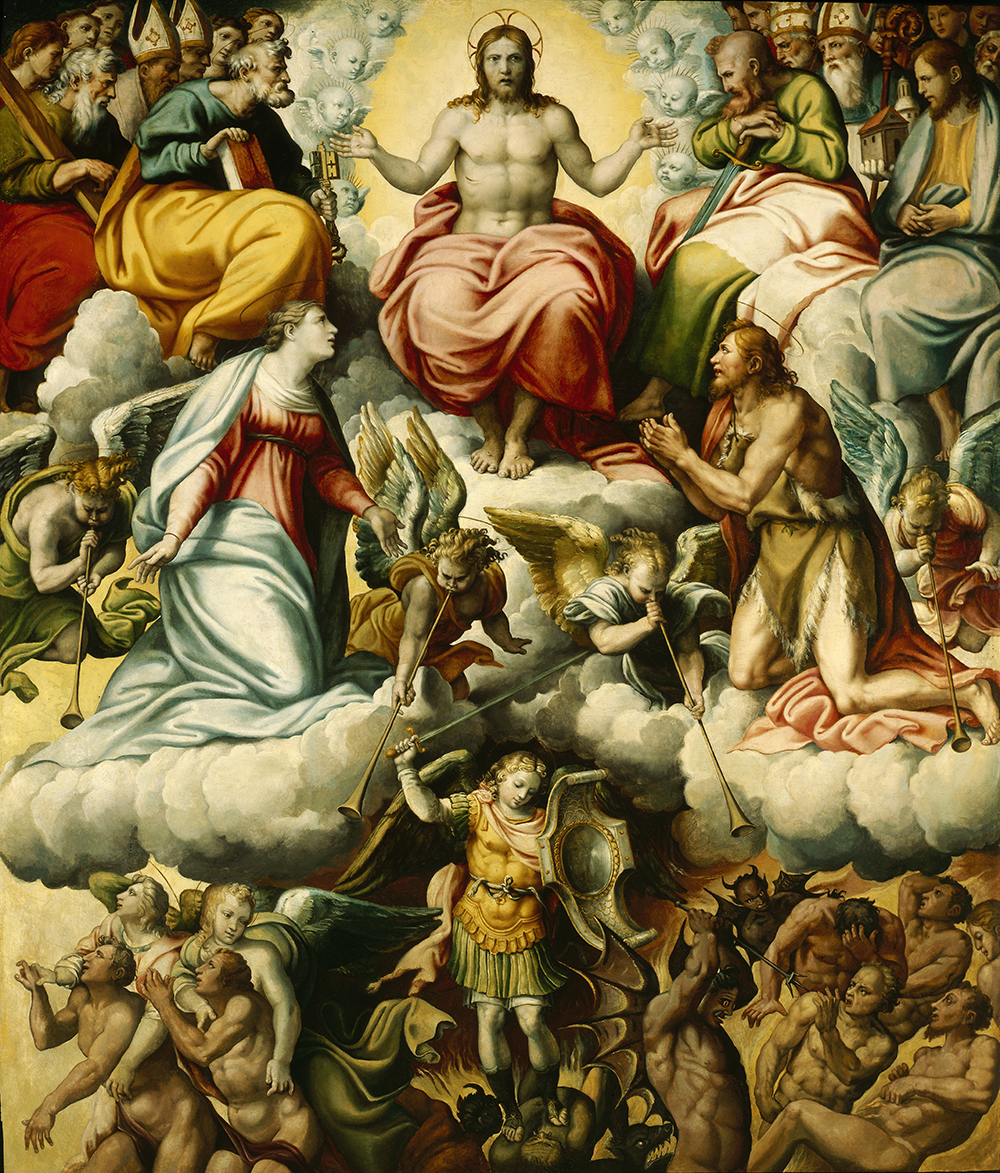
This theatrical scene of the last judgment attributed to the sixteenth-century painter Giovanni Filippo Criscuolo beautifully illustrates the era’s emerging artistic trends. Although his hometown of Naples would remain artistically provincial well into the seventeenth century, Criscuolo’s travels to Rome broadened his perspective. Inspired by the art of Michelangelo and Raphael, Criscuolo’s work reflects a more progressive style.  For example, the colors, poses, and compositional technique are similar to Michelangelo’s Sistine Chapel frescos.

Criscuolo’s interpretation of the spirit world is also intriguing. Two Medieval literary works influencing renderings like this one were Thomas Aquinas’ Summa Theologica and Dante’s Divine Comedy.

In Summa Theologica, Aquinas organizes the spirit world into specific ranks (or choirs). Those in the first rank (solely dedicated to face-to-face worship of God) are often pictured as disembodied spirits, “pure thought,” like those surrounding Christ’s throne in Criscuolo’s painting. The second rank dedicated to knowing God through contemplation of the universe are here pictured beside Mary and John the Baptist in the midpoint of his canvas. The third rank comprised of angelic messengers who interact in human affairs, are represented in the lower register by the archangel Michael and Satan and their minions. In addition, the wings of the satanic beings are much like those described by Dante: No feathers did they bear but as of a bat/ Their fashion was . . . (Inferno, Canto 34).

As Renaissance artists became increasingly dedicated to bringing the heavens down to earth, angels become more recognizably human; their wings, faces, and bodies sculpted in beautiful detail. By the nineteenth century, such differentiations between the earthly and the heavenly had all but disappeared.

Donnalynn Hess, Director of Education


Published in 2015

Object of the Month: October 2015

Procession to Calvary 

Oil on panel

Master of the Holy Blood (Maître du Saint-Sang)

Flemish, active c. 1500


Click on the links throughout the article to view additional artists’ works and reference material.

The identity of the anonymous artist called the Master of the Holy Blood has remained a mystery since the first serious study on the artist by Georges Hulin de Loo in association with the 1902 Exposition de Tableau Flamands des XIVe, XVe et XVIe Siecles in Bruges. De Loo decided to name this anonymous artist after the location of the Lamentation Triptych in the Chapel of the Holy Blood in Bruges, where it has resided since its commission by the Brotherhood of the Holy Blood around 1530.

The general composition of the present Procession to Calvary relates to paintings of the same theme produced in the late fifteenth century, which likely derive from a lost original attributed to Jan van Eyck (best known for the Ghent Altarpiece).

In the upper middle portion of the painting, a Flemish city in the guise of Jerusalem recedes into space through the artist’s use of atmospheric perspective in gray-blue tones. A fantastical building meant to represent the Dome of the Rock rests in the foreground of the city scene while a smaller dome for the Church of the Holy Sepulcher rises on the right side.

Moving from the distant city are progressively closer views of medieval Flemish houses forming a backdrop to the large grouping of figures in the right middle-ground.

Three men on horseback and two soldiers standing behind them form the first figural group of the procession. Each horseman is dressed in oriental garb—a tradition stemming back to the Limbourg Brothers (learn more here) connecting eastern headgear with Jews. The pointed hat on the horseman at the far left is traditionally Jewish in type, whereas the second horseman’s turban has a large jewel on the front associated with Muslim caliphs. The man on the white horse also has a Muslim turban. Northern Renaissance painters used these costuming stereotypes to depict non-Christian characters such as Jews or Arabs. Artists such as the Master of the Holy Blood were not yet exposed to the documented cultures of the Greeks and Romans since such information had not reached the Netherlands in any significant way. Since Islamic culture was also foreign to these artists, any pagan (non-Christian) characters set in Biblical narratives were naively costumed as Muslim.

In the right foreground is a ruggedly dressed soldier armed with both a sword on his hip and a cane for beating Christ. Next to him an elderly man, representing Simon of Cyrene, helps take the weight of the cross from Christ as he falls. His gentle, caring look and effort to support the cross contrast sharply with the tormentors surrounding Christ. The next tormentor, dressed in a white tunic, pulls tight on a rope tied around Christ’s waist to increase His suffering and to prevent Him from resting from the grueling task. The opposite end of the rope falls to Christ’s side and terminates in an unusual object of torture—the spikeblock or stumbling block. Made of a thick plank of wood with nails pierced through, the spikeblock is shown upside down with the nails facing Christ. This unusual object, a Netherlandish invention, maintained a relatively popular appearance (in a variety of forms and types) in northern European art for about 150 years. The concept was intended to visualize the intensity and torture of Christ’s suffering: as Christ made His way to Calvary, the swinging block would wound His heels from behind and His shins from the front, and it would also trip Christ while carrying the cross, thus becoming a “stumbling block.”

The Procession to Calvary is undoubtedly one of the Master of the Holy Blood’s most accomplished works, revealing the trends, motifs, and stylistic hallmarks of an artist who is at once distinctive and also reflective of the influences around him in early sixteenth-century Antwerp and Bruges.

John M. Nolan, Curator


Published in 2015