Give Now


Tag Archives: Roman

Object of the Month: August 2016

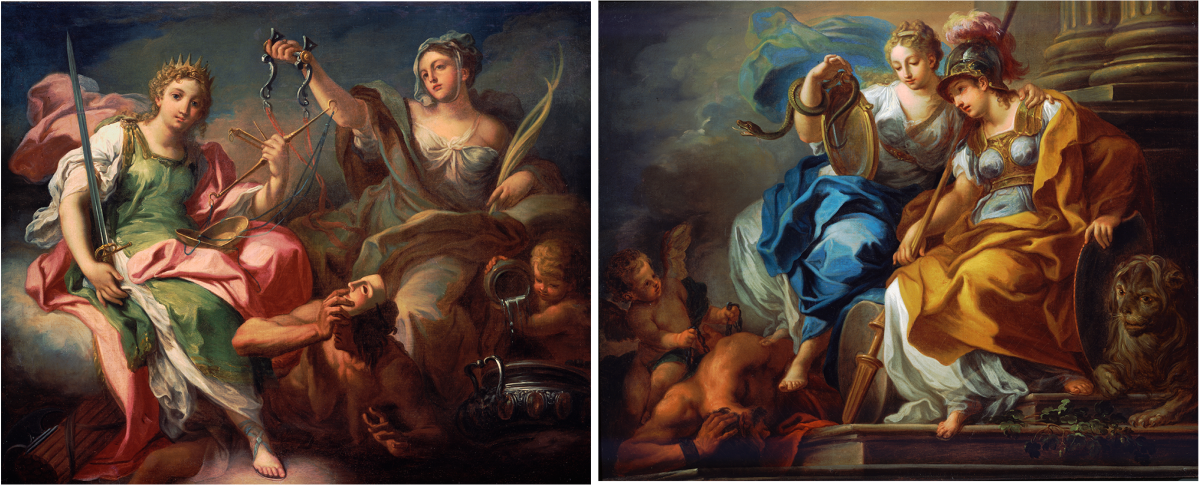
Justice and Temperance Overcoming Vice

Prudence and Fortitude Overcoming Evil

Oil on canvas

Sebastiano Conca

Roman, 1680–1764
Click on the links throughout the article to view additional artists’ works and reference material.

Although born in Gaeta, Italy in 1680, Sebastiano Conca received his early training in Naples as a student of Francesco Solimena. Conca’s teacher followed the style of his great Neapolitan predecessor, Luca Giordano as well as Giovanni Lanfranco and Mattia Preti, all of whom are represented in M&G’s collection.

Sebastiano eventually moved to Rome (along with his brother Giovanni) in 1706 to begin his own practice. He remained in Rome for about 45 years rising in popularity and becoming one of the most sought after artists of his day. Some of his most notable patrons included Cardinal Pietro Ottoboni, various members of the royal families of Spain, Portugal, and Poland, and even Pope Clement XI himself. He returned to Naples, his artistic roots, around 1752 where he remained the rest of his career. Considered his best work, the Coronation of St. Cecilia adorns the ceiling of the nave of the Basilica of St. Cecilia in Rome.

His style evolved from the Giordanesque influence of his early teacher, Solimena, to Baroque classicism and eventually the Rococo for his smaller works. He was not only an artist, but he was also twice the director of the Accademia di San Luca, a teacher (one of his most notable students being Pompeo Batoni), and a published author.

This pair of small, cabinet paintings appear to derive from four, large wall paintings Conca created for the Palazzo Lomellini-Balbi-Lamba-Doria in Genoa. While the four large works each feature an individual Virtue, these smaller pendants present them in pairs. Richard P. Townsend notes, “the painter’s combinations are particularly appropriate: prudence should always inform fortitude and justice should be dispensed with temperance.”

The four Cardinal Virtues are the foundation on which all others rest: Justice, Temperance, Prudence, and Fortitude. Artists and authors alike portray these virtues as women. Conca’s personification of the four Cardinal Virtues appears to be loosely based on Cesare Ripa’s Iconologia, which was the primary resource for many artists active in the seventeenth and eighteenth centuries looking to personify virtue and vice.

Here Conca draws symbols from three different types of justice described in Ripa’s book. Justice sits on the left with her symbolic scales used to weigh and measure the two sides of a court case. The crown on her head and sword in her hand show her power and authority to execute the verdict.  Resting beneath her lies the fasces (a group of wooden rods bundled together with an axe-blade protruding), the emblem of authority for magistrates in ancient Rome.

To the right, Temperance reclines holding a bridle by which she reigns in affections and passions with moderation and self-control. Clutched in the opposite hand, she holds a palm frond, a sign of victory in Roman culture. She is often portrayed tempering wine with water a task carried out by an angel in this work.

Crushed between them lies Vice, an immoral behavior or negative character trait. Together Justice and Temperance overcome Vice, depicted here by hiding her true face with a mask of deceit.


Aristotle describes prudence as “right reason applied to practice.” Conca’s Prudence features two characteristic attributes: a mirror and serpent. A mirror allows for self-examination from multiple angles. It reveals the truth about oneself. The serpent alludes to Matthew 10:16 where Christ tells the disciples to be “wise as serpents, and harmless as doves.”

Fortitude, “strength of mind which enables one to bear adversity with courage,” sits beside Prudence, clothed in armor and holding a shield by which she is prepared to battle Evil. Fortitude is often portrayed near or leaning on a column which lends her support (in reference to the Biblical Samson). Her spear shows her “superiority gained by strength,” and the lion resting by her side expresses strength and courage.

An angel holds Evil bound with a chain at their feet showing the triumph of Prudence and Fortitude over Evil.


Rebekah Cobb, Guest Relations Manager


Published in 2016

Object of the Month: March 2014

St. Cecilia

Oil on canvas

Giovanni Lanfranco

Roman, 1582-1647


Generally, a painter’s style refers to the way an artist executes a painting. Style can also be described as a general trend in painting usually initiated by an artist seeking to paint in an innovative or previously unexplored way.  However, a specific artist’s style can often be revealed in his individual expression—idiosyncrasies that help experts identify his work. For example, an artist may paint faces with certain characteristics (i.e. chubby cheeks, almond-shaped eyes, or small ears), use backgrounds in a similar way, or mark out his composition with heavy drawings before painting.

The technique an artist uses to apply paint is also characteristic of style. Every painter employs certain techniques that become distinctive to them—Botticelli outlined his figures; Rembrandt used very thick paint in highlights; Degas used hatching marks in his pastels; Van Gogh used thick paint for each individual brushstroke, etc… So, the actual stroke and method an artist uses to apply paint becomes an integral part of his personal style. Connoisseurs and scholars thoroughly inspect, discern, and memorize both the artist’s characteristic techniques and the general style or trend the artist follows—these are subjective considerations in determining a painting’s attribution.

To illustrate the concepts of style and technique, consider the context of Lanfranco’s painting of St. Cecilia from c.1620. At the turn of the 17th century, Italian artist Caravaggio initiated a style of painting viewed as revolutionary for his time. Artists all around him were painting in the “mannerist” style of the time—an eclectic blend of ideal forms with asymmetrical compositions, uneven or overall lighting effects, and garish colors. However, Caravaggio broke from these conventions to explore the dramatic possibilities of lighting combined with a candid, straightforward realism.

Caravaggio’s innovative style flourished rapidly within Rome’s fertile artistic environment, and Giovanni Lanfranco was one of the artists influenced by Caravaggio’s radical style, as evidenced in M&G’s painting. The half-length figures emerge from a dark background, bathed in a heavenly light streaming in from the upper left. The effect is intensified by deep shadows covering nearly half of each figure. This manipulation of light mixed with a strong sense of realism meet the criteria for the style that Caravaggio inspired called tenebrism.

Lanfranco worked in the tenebrist style intermittently throughout his career, with this St. Cecilia being one of his best representative works. However, M&G’s work is not his only treatment of this subject. The National Gallery’s St. Cecilia and an Angel in Washington D.C. provides unique insight into identifying Lanfranco’s particular style and technique; the National Gallery painting has been confirmed as a collaboration of two artists—Giovanni Lanfranco and Orazio Gentileschi. In 1990, Erich Schleier, the foremost scholar on Giovanni Lanfranco, expressed the opinion that the sleeves and hands of St. Cecilia reflect the style of Lanfranco (for centuries before, the painting bore a firm attribution to Orazio Gentileschi, one of Caravaggio’s principal Roman followers). Following Schleier’s input, further research was made into the old Rondanini inventories from which the National Gallery (and M&G’s) painting once belonged. Alessandro Rondanini’s painting inventory compiled on January 19, 1741 described two St. Cecilia paintings: one (M&G’s) by Lanfranco says, “St. Cecilia playing the cembalo with two angels,” and the other St. Cecilia (National Gallery) “with the heads by the hand of Gentileschi and the rest by Giovanni Lanfranco.”

Not only did the 1741 inventory confirm the attribution of the National Gallery’s painting to Gentileschi and Lanfranco, but analysis of x-radiographs, pigments, and x-ray fluorescence by National Gallery conservators have also supported this conclusion. This remarkable example reveals how expert (subjective) opinion by Erich Schleier led to objective proof for the collaborative attribution found in an old inventory and supported by scientific tests.

Studying the sleeves of M&G’s St. Cecilia furnishes insight into Schleier’s stylistic and technical analysis of comparing Lanfranco’s hands and sleeves in the Washington painting. Cecilia’s hands in both works are formed in a curved manner, almost as if no bone structure supported the flesh. Since artists tend to paint similar figural forms in paintings from a particular phase of their career, the stylistic detail of the hands in the Washington and Greenville paintings reflect the way Lanfranco uniquely handled this element of his composition. The flowing sleeves have highlights painted with rapid, bold brushstrokes, which is another stylistic trait carried over in each work.

In 1620, Lanfranco turned from the influence of other artists and was the first to develop an inventive style of ceiling fresco that presents an atmospheric illusion of figures rising into the heavens by using dramatic foreshortening and figure recession as seen in the fresco of the dome of S. Andrea della Valle in Rome; this Lanfranco innovation created a sensation inspiring many artists after him to use and develop this style.

John M. Nolan, Curator


Published in 2014