Give Now


Tag Archives: Spanish sculpture

Object of the Month: September 2026

St. Dominic and St. Thomas Aquinas

Bas-relief polychrome and gilt wood

Unknown Spanish

Late 16th – Early 17th century

Why a pair of 400-year-old wood panels depicting Saints Dominic and Aquinas dressed in lavish habits—garments they likely never wore—with books and enormous quill pens? To answer this, we need to understand a bit of medieval church history.

In the 12th century, Catharism (or Albigensian heresy) was spreading in southern France. Catharism taught a radical dualism: two opposing principals governed existence. The good principal created the spiritual world, while an evil principal created the material world. Therefore, physical matter, including the human body, was evil. According to this belief, Christ only appeared to be human, and the sacraments, such as communion and baptism were rejected because physical bread, wine, and water could not convey spiritual grace. Catharism denied doctrines involving the physical world, such as bodily resurrection and the goodness of marriage. Its followers lived simply and devoted themselves to spiritual pursuits like prayer, fasting, and preaching.

St. Dominic

Around 1170, Domingo de Guzmán was born into a noble family in Castile, Spain. He received his early education from his uncle, a Roman Catholic priest. Later he went to the prestigious University of Palencia, studied the liberal arts and completed advanced studies in theology. By his mid-20s he was ordained a priest and joined the clergy of Osma Cathedral. He lived communally and in poverty as dictated by the Rule of St. Augustine, and he became known for his learning and godliness.

Dominic encountered Catharism about 1210. The movement appealed to many because its leaders preached persuasively and lived simply, in a manner resembling the apostles. In contrast, many orthodox clergy lacked the theological knowledge to respond to it effectively, and they also preached in elaborate church vestments and ornate churches. The common people found orthodox positions unpersuasive and distant.

Dominic’s solution was to form a new kind of religious community. His Order of Preachers would be a clergy well educated in theology, logic, and persuasion, living under the Rule of St. Augustine, and engaging people directly. Dressed in simple black and white habits, Dominican friars defended Catholic doctrine often preaching in non-church settings. In 1216, Pope Honorius III formally recognized the Dominican Order.

St. Thomas Aquinas

In 1224-5, Thomas was born into an aristocratic family in Aquino, Italy. At age 5, Thomas de Aquino began studies at the Abbey of Monte Cassino. He completed studies at the University of Naples in his teens. His family expected their gifted son to become a high-ranking church official with prestige and power. Thomas, however, was drawn to intellectual and spiritual pursuits. When he chose to join the scholarly Dominican Order his family opposed the plan, largely because of the vow of poverty. According to tradition, his brothers kidnapped him for a year to convince him to change his mind. It did not work. He became a Dominican friar around age 20. Eventually his surname became Aquinas, the Latinized city of his birth.

Aquinas became a renowned theologian, teacher, preacher, and author. His writings used medieval scholasticism, a structured method of reasoning that begins with a question, presents opposing arguments, offers a succinct answer, supports the answer and then systematically refutes the contrary positions.

Aquinas believed that all truth comes from God, and since both reason and Scripture come from God, ultimately true philosophy cannot contradict true theology. His major works, Summa Theologiae and Summa contra Gentiles, are still recognized as foundational theological texts.

Dominic died in 1221, and Aquinas was born about 4 years later. Dominic established a powerful model for orthodox preaching while Aquinas provided the intellectual framework for that preaching. Together, yet separately, they built the foundation of the Dominican Order.

M&G’s Dominic and Aquinas Panels

The figures on M&G’s bas-relief panels each stand on corbels. Dominic’s corbel bears the Latin words, O Lumen Ecclesia, “O Light of the Church,” an honorific title often applied to the saint. At Dominic’s feet is a dog with a flaming torch in its mouth. Before Dominic’s birth, his mother dreamed that a dog with a burning torch leapt from her womb and set the world on fire. Her vision supposedly foreshadowed Dominic’s illuminating the church. On M&G’s panel Dominic holds an enlarged quill, the tip of which appears to be ignited by the torch’s flame. This suggests Dominic’s writings were the means of spreading orthodox illumination. The closed book in Dominic’s other hand is wrapped in the friar’s cloak, possibly indicating that the book contains Dominic’s writings or representing the Bible and his defense of Scripture from heresy.

The corbel on the companion panel identifies the friar as Thomas Aquinas. He stands behind a slender golden pedestal supporting an open book. He holds an enlarged quill as if preparing to write. His left-hand points to a passage in the book. (figure 1) Aquinas the scholar, appears to be pointing to a sacred text he is interpreting, explaining, or using to support a theological position he is considering composing.

Creating polychrome and gilt wooden sculptures of the quality seen in M&G’s panels required skilled artisans following multiple steps in a process. Originally an artist would draw the figure on wood, and carvers would sculpt the piece. Various colors of paint and gilding would be completed by other artists. In the final stages two areas received special attention: clothing and skin.

The saints’ garments received estofado, a process recently perfected by Spanish 17th-century craftsmenLayers of gesso, adhesive, gold leaf, and finally a coat of paint were applied. Then detailed scribing would remove areas of the paint to reveal the gold layer beneath. On the tunics and scapula, the paint on M&G’s panels is a dull golden color. Inscribing delicate repeating patterns in the paint reveals the luminous gold. These areas appear as a supple, damask material. The cloak’s black paint was inscribed with larger patterns and appears as a heavy, rich brocade. (figures 2a and 2b)

The face and hands of the saints were painted using another new technique, encarnación. Multiple layers of paints and glazes were used to create lifelike flesh and the shadowy stubble on the saints’ faces and heads. (figure 3)

M&G’s panels were most likely a part of a Spanish altarpiece, known as a retable or retablo. Similar to Italian altarpieces, a typical 14th to 17th-century Spanish retable included a banco or predella. Bancos were often a horizontal series of storytelling scenes at the base of the altarpiece. M&G’s Descent from the Cross may likely be a portion of a Spanish banco.

On the banco rested the cuerpos (layers of multiple images). It is likely that M&G’s panels were side panels in a cuerpo. Between them would have been a larger image of a biblical scene or an incident in the life of a saint. Many retablos also had an atico, the crowning piece, which may have been purely decorative or featured a culminating image.

In Spanish cathedrals monumental retables would have multiple cuerpos with scores of painted scenes and sculpted pieces framed by lavishly gilded architectural elements. Based on their size, subject, and quality, M&G’s panels were probably part of an elaborate mid-sized retable for an unknown Dominican convent or chapel. The downward gaze of the saints indicates they may have been looking at an image in a cuerpo beneath them.

At some point—perhaps due to chapel remodeling, sale of the property, or ecclesiastical confiscation by the state (desamortización)the retable containing M&G’s panels was dismantled and the sections dispersed. M&G acquired these panels in 1959 through art dealer Julius Weitzner, and they were donated to the collection by American art collectors, Mr. and Mrs. Jack Linsey.

In life, Aquinas and Dominic would not have worn the elaborate habits portrayed on M&G’s panels. Four centuries after their deaths, the patrons and artists who created the panels wanted to honor the saints and emphasize their importance. What better way than to depict them in elaborate garments using the latest artistic techniques with no care for historical accuracy? After all, the message was more important! Even now, 400 years after the panels were created, the saints are still impressive in their gold embellished habits.


William Pinkston, retired educator and M&G volunteer


Published 2026


Object of the Month: April 2025

Descent from the Cross

Polychrome and giltwood, c. 1570

Unknown Spanish, 16th century

Renaissance artists employed various media and techniques to communicate their subject matter with power and beauty. This mid- to late-16th-century giltwood and polychrome relief by an unnamed artist (likely Spanish) demonstrates both artistic mastery and devotional power. It was once part of a larger altarpiece yet communicates clearly on its own.

A relief sculpture is normally attached to a background of the same material, and the degree of projection from that surface determines the terms used. Low relief, or bas-relief, project only a little. High relief denotes significant freedom from the background and can look like the figures are about to burst free from their surrounds. Finally, in sunken relief (or intaglio), subjects are carved below the level of their surroundings.

Gilding, the decorative technique of applying a thin layer of gold on a solid surface, dates back to Egypt. Herodotus mentions the Egyptians’ skill in gilding wood and metal, and many examples of their work remain to this day. The Sumerians (with objects dating back to 2600-2400 B.C.), Ancient Chinese, Old Testament Israelites, Ancient Greeks and Romans also utilized very thin sheets of hammered gold to overlay important objects of wood, stone and metal.

To produce fine furniture or sculpture, artists first carved plain woods like pine, beech or limewood. They then added numerous layers of gesso (a type of plaster made by mixing fine chalk or gypsum with animal glue and water). Initial applications of the gesso filled imperfections in the wood, and subsequent layers built up a smooth surface that could be carved with greater detail than wood and rendered a top layer that could be gilt, painted, or otherwise decorated. The depth and crispness of this final surface indicates the craftsman’s skill.

The quality of M&G’s relief sculpture shows gilding expertise, but its polychromy adds to its power.  Polychrome (literally, “many colored”)—pigmented wood, stone or terracotta—also dates to Egypt and the process refined over time. Over the millennia artists employed a wide range of pigments, painting media, and surface applications to embellish their work, and specialization occurred.

In Spain, the production of religious sculptures was governed by designated guilds. The Guild of Carpenters carved the wood and gesso, and the Guild of Painters was responsible for all decoration. Specific terminology came to describe specific skills. After the pieces were carved, painters used flesh tones for hands, faces, and feet (a process called Encarnacion). Estofado, which means “quilted silk,” was the skill of simulating rich fabrics through the layering of gold or silver leaf.

M&G’s sculpture demonstrates mastery of all these skills in an emotionally intense representation of Jesus’ followers lowering Him from the cross. Christ is the central figure—emphasized both by His placement on a diagonal in the center and by the fact that He is the only figure painted entirely in flesh tones. Around Him gather His mother, Mary (on the right), Mary Magdalene (immediate left, her hair cascading over her shoulder), Mary’s sister, and Mary the wife of Clopas. Behind Jesus, the Apostle John (at Christ’s right shoulder) and Nicodemus (left shoulder) bear the weight of His body. To the far right, two men pry open a sarcophagus.  On the far left, stands Joseph of Arimathea, who had asked Pilate for Jesus’ body and donated both his new grave and linen to wrap Christ’s body. His headwear denotes Joseph’s status as a member of the Sanhedrin, and the striped pattern etched on its gilding matches that on the long swath of linen he is showing to the two women beside him. Taut carving of the trees, leaves, and clothing bring the scene to life and gilt patterns play across the various fabrics, the tomb, and the background plants and clouds. All of these techniques coalesce to convey the grief and dedication of Christ’s followers.

At the devotional center, as in history, is Jesus Christ—His redemptive work done, His burial imminent, and His victory over death yet to come.


Dr. Stephen B. Jones, M&G Volunteer


Bibliography

Metmuseum.org

Nationalgallery.org.uk

Hall’s Dictionary of Subjects and Symbols in Art, James Hall

Understanding Paintings: Themes in Art Explored and Explained, Alexander Sturgis and Hollis Clayson


Published 2025

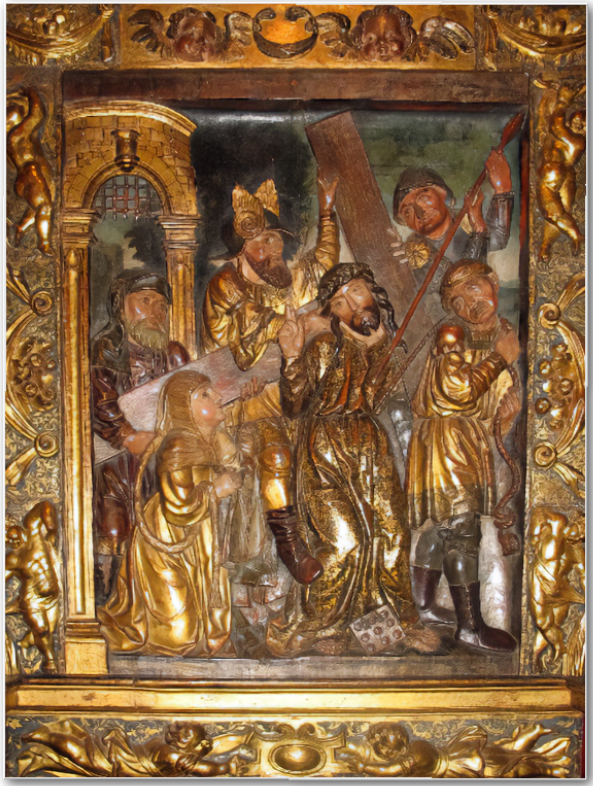
Procession to Calvary

Procession to Calvary

Polychrome Spanish, 1500s

Below the image, click play to listen.
John the Baptist: Polychromed Sculpture

Not everyone who can hew a block of wood is able to carve an image; nor is everyone who can carve it able to outline and polish it; nor is he that can polish it able to paint it. (St. John of the Cross). This 18th-century figure highlights one unknown sculptor’s mastery of all three skills.