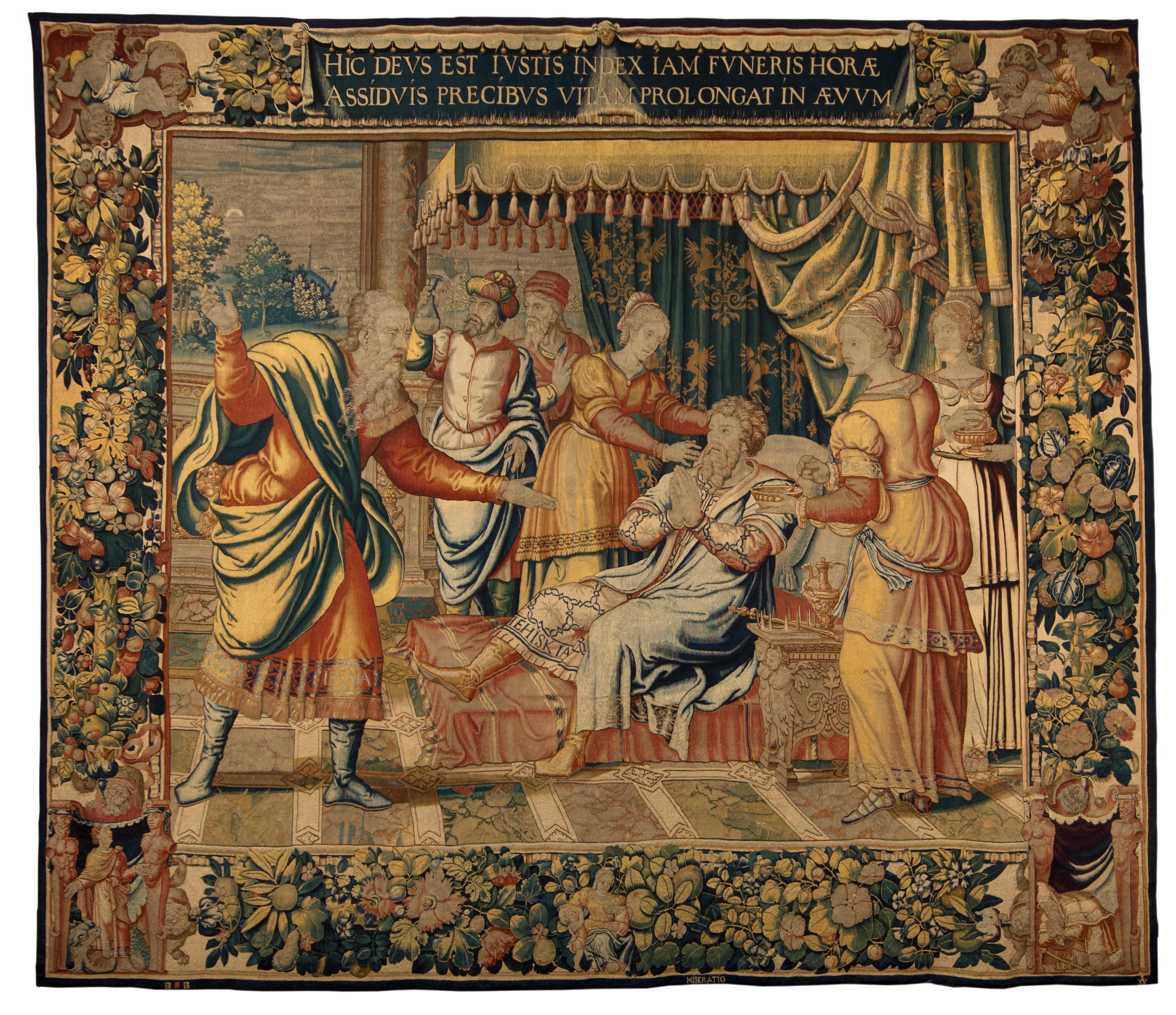
The Life of Hezekiah Is Prolonged Fifteen Years
Weaver of the Hezekiah Series
Brussels, c. 1530
Below the image, click play to listen.
Weaver of the Hezekiah Series
Brussels, c. 1530
Below the image, click play to listen.
Polychrome and giltwood
17th century
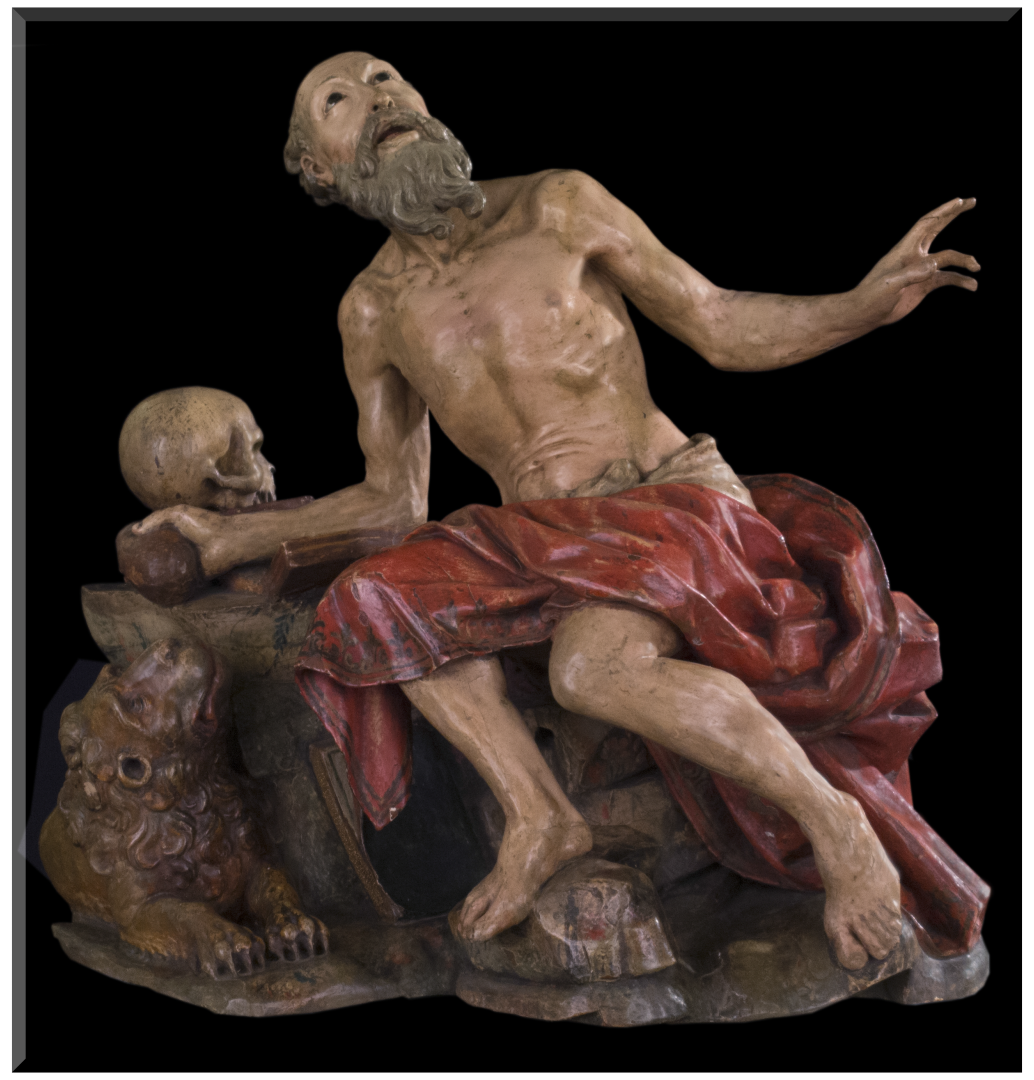
The obsessive attention to realistic detail and heightened emotion that characterized many 17th-century paintings is also evident in this dramatic polychrome sculpture. The adjective polychrome (meaning “many colored”) refers to the color on the wood which enhances the figure’s lifelikeness. Although this technique can be traced back to the Greeks and Romans, it became particularly popular during the Renaissance. Spanish sculptors who preferred wood to stone became especially adept at using the technique, often adding “gilding and brilliantly imaginative lusters.”
Jerome, the subject of this work, was born in the fourth century in the small town of Stridon (located in the Balkans today). Initially schooled by his father, he later traveled to Rome where he became proficient in Latin and Greek and excelled in oratory. His later biographical writings lament that this early success encouraged in him an overweening pride and ambition. He continued his education in Trier, a German city on the banks of the Moselle river. It was here that his Christian conscience was reawakened, and as one source notes, “his heart was entirely converted to God.” However, by his own admission his competitive nature and “rambling imagination” continued to trouble him throughout life. He lived in the desert of Chalcis for several years but eventually returned to Rome in 382 to become special secretary to Pope Damasus I. It was Damasus who assigned him the task of creating a revised Latin version of the Bible. The Vulgate, as it is known, was completed in 405. Jerome eventually retired to a monastery in Bethlehem where he died in 420.
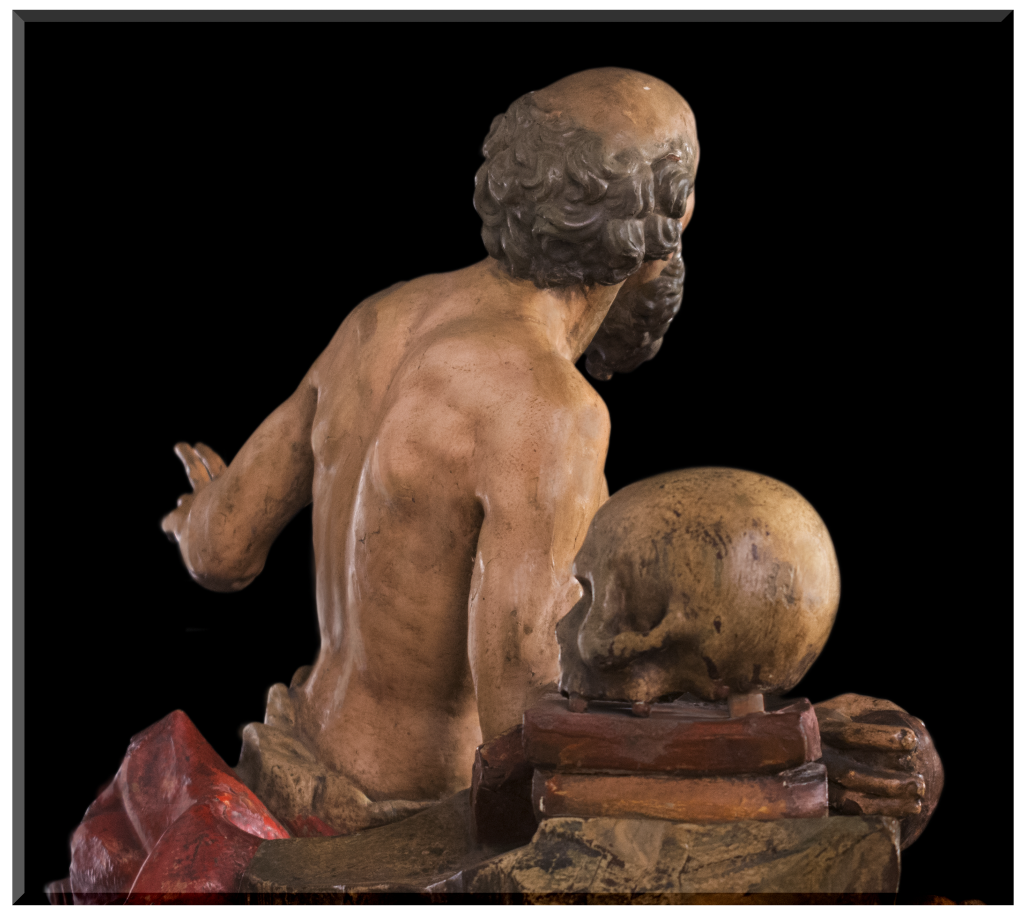 As is typical of the era the creator of this work uses numerous attributes to identify the figure and to illustrate his story. For example, the books stacked on the rock and supporting the aged Jerome represent his writings (most notably the Vulgate but also his other letters and theological treatises). The skull resting atop two of the books signifies the transience of life or natural death; notice however, that Jerome is turning away from “death” to gaze heavenward–the source of new, eternal life. The brilliant red cloak “embroidered” with fleur de lis seems rather out of place in the wilderness setting. However, in this context it represents Jerome’s office as a cardinal. Although, the position of cardinal did not exist in the early centuries of the church, ecclesiastics of Rome, like Jerome, held the duties that later fell to cardinals.
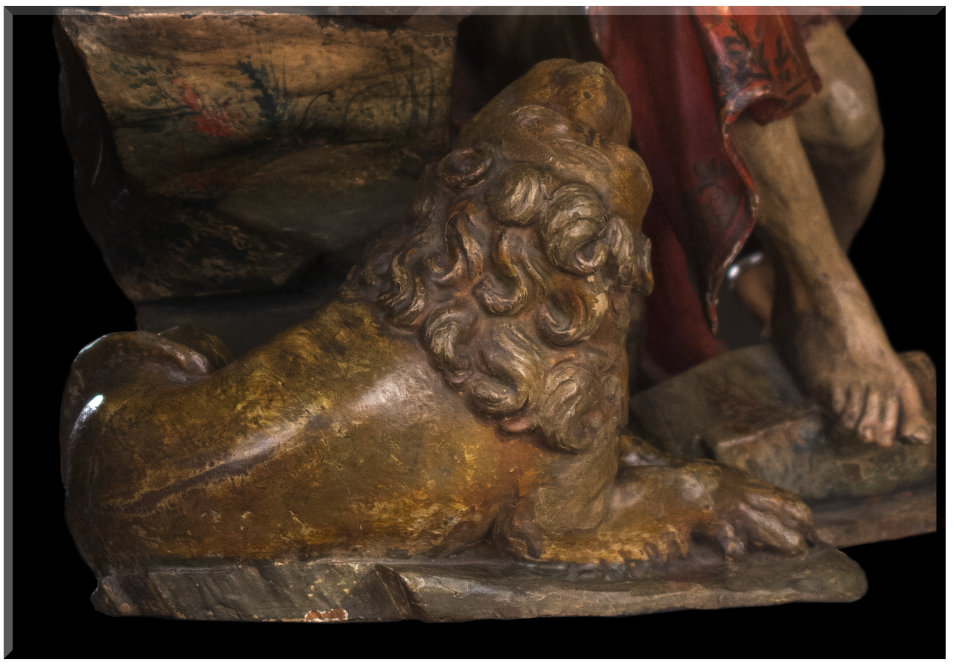 One other imaginative story connected to Jerome and recorded in The Golden Legend occurs during his retirement in Bethlehem. According to this story, as the monks were going about their daily routine, a wounded lion suddenly appeared. All fled but Jerome. Examining the beast, he discovered and removed a thorn that was deeply embedded in its paw. In gratitude the lion became Jerome’s constant companion and protector of the monastery. This beautifully carved attribute “rounds out” the base of the sculpture.
Donnalynn Hess, M&G Director of Education
Published in 2020
Master of the Borghese Tondo
Below the image, click play to listen.
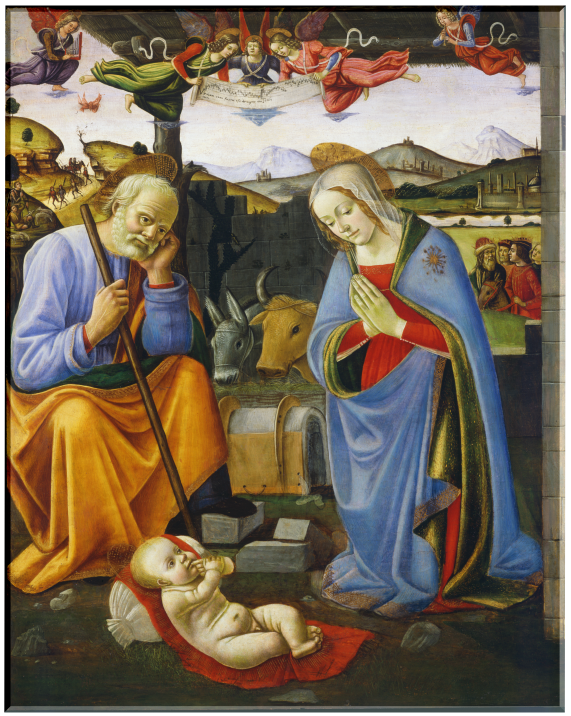
Oil on panel
Flemish, c 1500-1560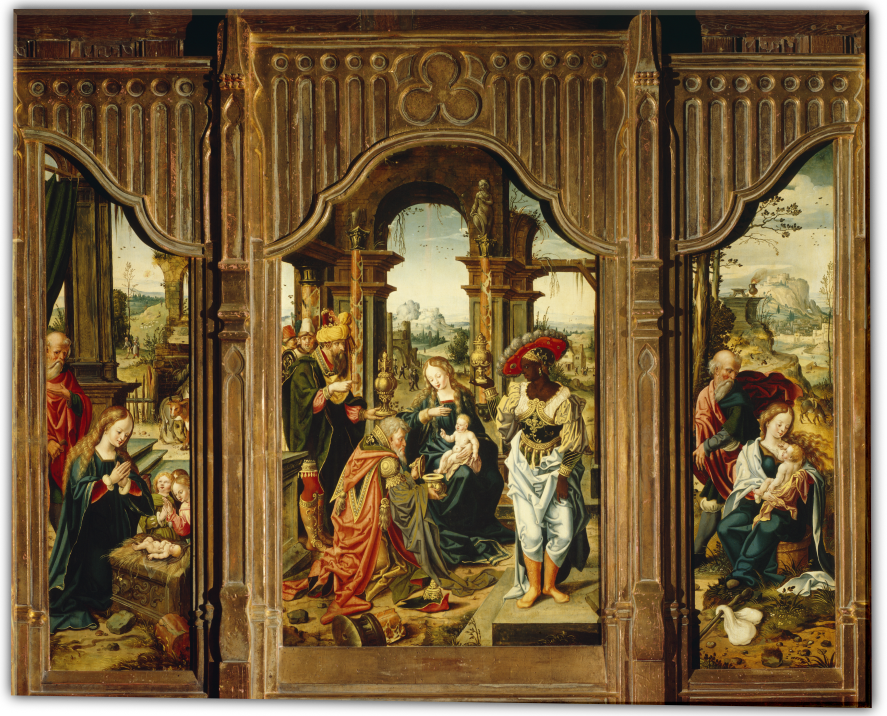
As his name states, Jan Swart came from the town of Groningen in the Netherlands. No documents tell of his training, but this painting depicts his fondness for showing people in unusual headgear. It also reveals his other work as a book illustrator. Here Swart pictures the central truth of Christ’s coming into the world, placed within the context of His early life.
M&G’s Triptych (three panels) illustrates three events in Christ’s early life: the Nativity, Adoration of the Magi, and the Flight into Egypt. The birth of Christ signified the coming of a new covenant—a covenant that forever removed the necessary demand of the Old Testament Law requiring atonement for sin before the joy of reunification and fellowship with God.
Swart unifies the three stories of the triptych through a key motif: broken architectural elements. The left panel (clearly the stable with a curious cow in the background) has the Christ-child lying on a manger of ornate stone, possibly the base of a larger pillar. But the broken pillar at the base of the marble manger (right foreground) catches the viewer’s attention because its decoration is too fine to be part of a stable and because it matches all the other pillars, especially the broken one in the foreground of the Adoration. In the Flight, the Madonna and Child are resting on a pillar’s base by the side of the road. In each panel then, Swart uses the broken columns to point to Christ’s reason for coming to earth.
However, Swart develops his illustration of the Scriptures even more, specifically within the large, middle panel. The Adoration is central to an understanding of that New Covenant that Christ came to establish. To appreciate his storytelling, one must carefully consider the motif of the number 3.

Three in Composition
Swart adorns the frame of the middle panel with a trefoil centered over the Madonna and Child. This iconography tells the viewer that the scenes are the story of the One God in Three Persons, the Trinity of which Christ is the second Person. Swart then emphasizes this truth through more tripling in the work. There are three openings in the room, which is clearly not a stable. In doing so he follows the same Scriptural distinction that the Magi came to “the house where the young child was.” Interestingly, each opening emphasizes a key character in the story:
Three Gifts
Swart does not include Joseph in this panel, though Christ’s earthly father is often part of this family scene. The reason is that the focus is on the heavenly family of the Christ. The three gifts of the magi emphasize a different family than that of Joseph’s.
Christ’s lineage through Joseph is that of the kings of Israel, perhaps another reason that he is not present: Christ’s royal claim to these kingly gifts relies on His eternal lineage, not that of His earthly father’s.
Three Magi
The three holders of the gifts are also interesting to note. Those held by the two Magi on the side are urn shape, commensurate with their gifts of oil. Logically then, the wide-mouthed lidded bowl offered by the central magus is the gold: the kneeling pose and the type of gift indicate the submissiveness of a subject to a king. Christ’s pose and gesture indicate His position as both king and priest in extending a blessing to His subjects.
Three Columns
The three ornate pillars within the middle panel are interesting as they are in differing conditions. The pillar in the foreground matches the one in the stable. But the other two frame the Christ and His mother. Perhaps Swart is showing the progressive nature of the New Covenant’s institution. One column is broken, another is empty, and the third fulfills its purpose. Christ must be born, die, and resurrect in order to complete the New Covenant. Swart again uses the number three to tell the story of Christ, even as an infant, has set in motion the redemption of the world.
Dr. Karen Rowe, M&G Board Member
Published in 2019
This documentary, titled “The Life and Legacy of Dr Bob Jones Jr.,” recounts the life of Bob Jones Univerisity’s second president, a unique, multi-faceted man with a variety of interests and skills.
The film opens in Dr. Bob Jr.’s office, which was left intact for several years after his death. The ornate art and décor of his office is a reflection of his love for the cultural arts, something he transferred to the University as a whole. Today, the University has a cinema program, a spring opera production and the world-renowned Museum & Gallery because of his artistic vision.
Dr. Bob Jr. became president in 1947. He designed the layout of the present campus and was involved in the academic restructuring to transition Bob Jones College into a university. Most importantly, Dr. Bob continued in the footsteps of his father as a preacher of the Gospel. Although today’s University student body will never have the chance to meet him on this earth, they are reaping the benefits of his many contributions to the school.
John Koch
Below the image, click play to listen.

Walnut and pine
German, 17th century
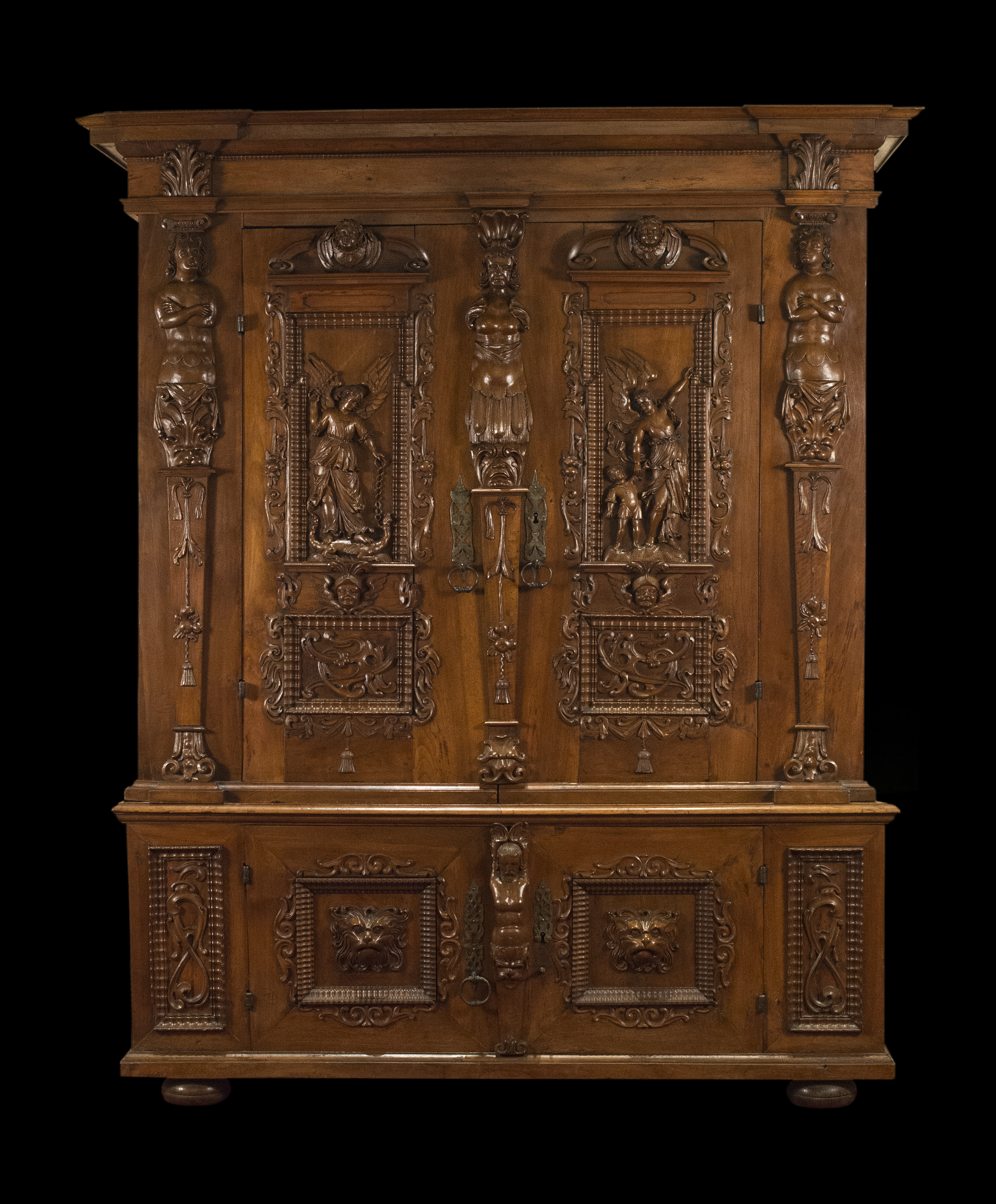
Storage has been one of humanity’s challenges through the ages. “Where do I put this?” is a question many of us may ask numerous times a day. In the digital world it can be more challenging: “Which folder do I store this in?”
The schrank is an evolution of the storage chests from the Middle Ages. When it was discovered that chests placed on top of each other with front-opening doors were more useful, the schrank in miniature was introduced. At that time, it was called a cupboard. Later modifications of enlarging them gave us what is commonly called an armoire, which normally contained more compartments in the top section than a schrank.
For practical purposes, both the schrank and armoire are used for storage, and the word is used interchangeably by many people. However, the difference between the two is more technical and geographical. Initially used to store armor, the French named the cabinet an armoire. The schrank was so named by the Germans. The term is still part of several words used to describe a storage item, most notably a kuhlschrank or what is known to us Americans as a refrigerator.
M&G’s Schrank joined the collection in 1964. It may have originated in southern Germany and was constructed in the 17th century or later. The last owner prior to M&G was A. S. W. Rosenbach, an antique book collector and dealer living in Philadelphia during the last half of the 19th century into the mid-20th century. His aggressive skill and vast knowledge of books made him “The Terror of the Auction Room.”
The Schrank’s upper carcass is constructed with a single pine board for each side, top, and bottom. The lower carcass uses a single pine board for each side as well as the back and bottom—the lower portion doesn’t need a top since the upper section rests on it. Finely detailed, hand-sawn dovetail joints can be seen on the top of the upper carcass. Carved walnut is used for the decorative ornamentation for the front.
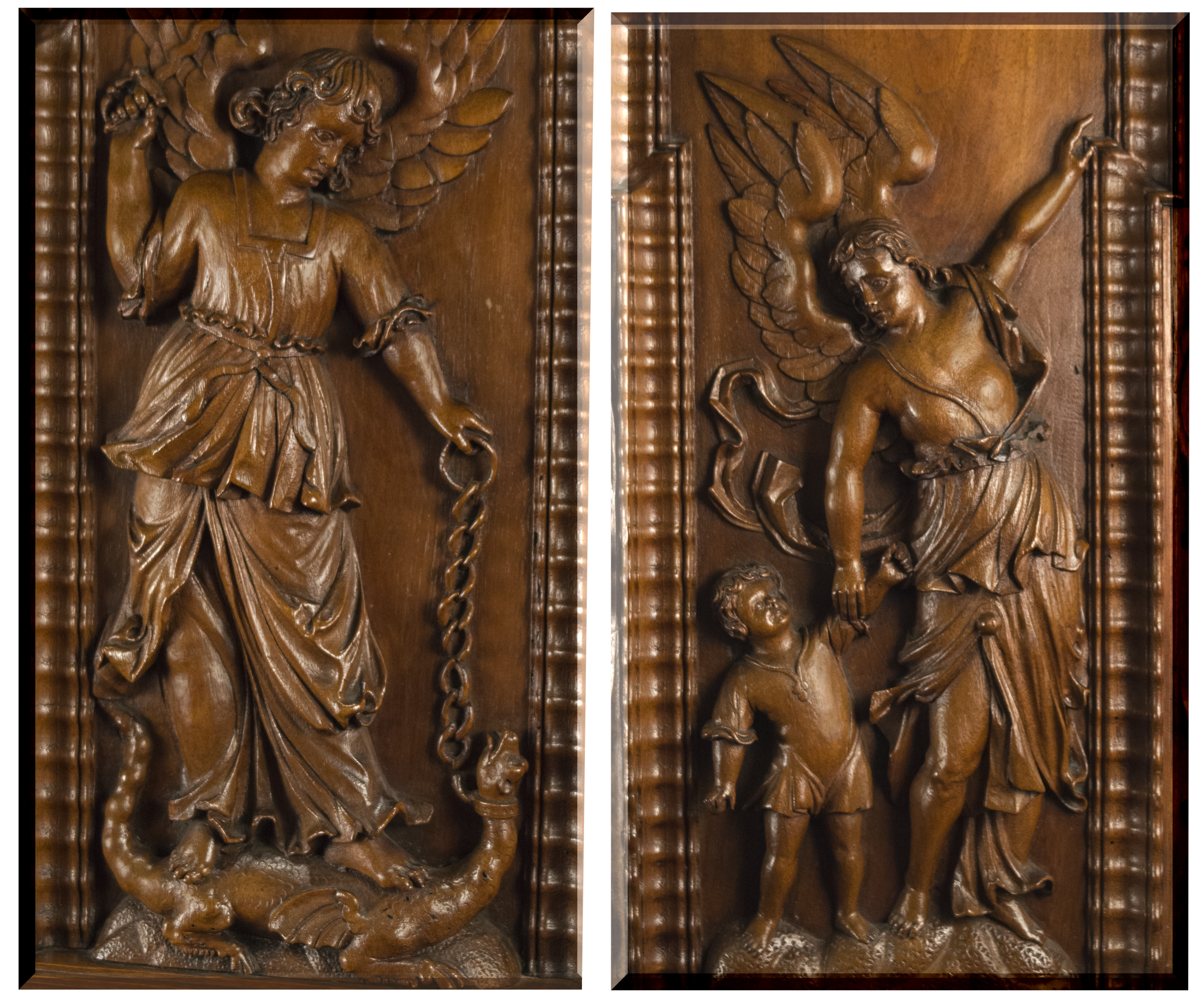 The left door panel displays a common 17th-century scene of Michael the Archangel overcoming Satan, in the form of a dragon. The other door depicts the apocryphal characters of the archangel Raphael with Tobias. The Book of Tobit from the Apocrypha gives detail to the legend presented. Other aspects of the ornamentation have been described in technical terms by Joseph Aronson in his catalog Furniture in the Bob Jones Collection. “The base cupboard features low doors paneled with wave-mouldings framing lion-heads, and its corners are embellished with panels framing scrolls. The astragal is a caryatid figure like the upper. The base mold, like the other horizontals, is quiet and rests on bun feet.”
Though the original craftsman is unknown, this piece of furniture represents well the skilled carving and furniture making from an era that no longer exists. Considering this Schrank was also part of a well-known bibliophile’s furnishings adds intrigue as to what treasures it may have stored more than a century ago.
John Good, Security Manager
Published in 2019
Unknown Flemish, 15th century
Below the image, click play to listen.
Oak
Flemish, 16th century

Churches and cathedrals throughout time have something architecturally in common: a location for the choir. Where the choir is placed differs in the various places of worship, yet the choir accentuates the central focus of the church: the altar. In many early European monasteries and later collegiate churches, the choir was positioned along the chancel which separates the nave (where the laity would sit) from the altar. The chancel is lined with rows of seating for the choir members. Every detail within Medieval and Renaissance places of worship were handcrafted, including the choir’s seating or choir stalls.
Choir stalls consist of carved, individual seats divided by armrests; these seats are attached to a long, carved dorsal panel (a short or high backrest board) and sometimes a canopy. M&G’s pair of sturdy oak Choir Stalls date to the 16th century and were designed by Gothic Flemish artist Jan Terwen Aertsz.
Little is known about Jan Terwen Aertzs. who lived a long life of 78 years. Born in 1511 and later educated at the Dordrecht School, Jan was considered a master woodcarver in Dort, also known as Dordrecht. While the exact church in the Netherlands from which M&G’s Choir Stalls originate remains a mystery, the location of Jan’s greatest work is on view in the Grote Kerk in Dordrecht. The church’s choir stalls, made between 1538-1542, demonstrate Jan’s skill and eye for detail, and are pristine examples of Flemish woodworking in the 16th century.
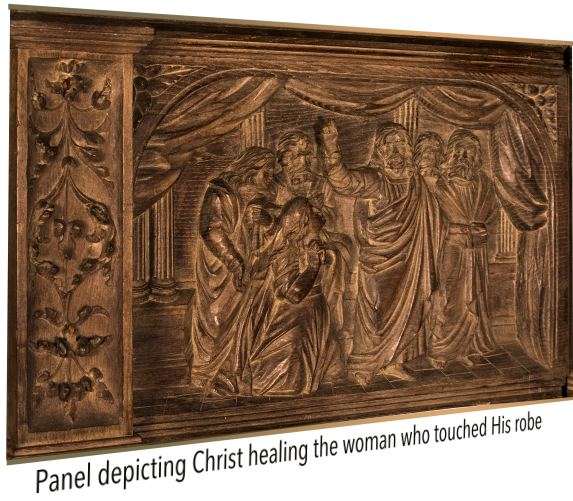 M&G’s Choir Stalls provide two sets of four seats each and are covered in finely detailed carvings. For example, the fins under the armrest are devised to look like eagles with every feather individually carved into the hard oak. The dorsal and end panels of the stalls contain images from various Biblical stories, including King Solomon displaying his God-given wisdom with the two mothers, and the believing woman healed by just a touch of Christ’s robe. Every minute design is accounted for—from the patterned hem of a character’s tunic, and the hair on Jesus’ head and beard, to the scenes’ distant mountains in the background, and the patterns in the tile underfoot. Surrounding these narratives are decorated spindles and more reliefs consisting of fruit and flowers flanked by winged, mythological creatures.
 One of the most fascinating details of the Choir Stalls are the misericords. Misericords (from the Latin word for pity and heart, literally pity of the heart or compassion of the heart) are molded brackets on the underside of a seat. Choirs or monks would stand for hours singing and participating in the worship ceremony; to provide them with a modicum of comfort and stability, these misericords or “mercy seats” were added. When the choir members would stand to sing, they could lift the seat up and surreptitiously rest against this small structure while still appearing to be standing.
The ownership history, or provenance, of these beautiful seats is long, mysterious, and fascinating. The choir stalls survived the iconoclasm that followed the Protestant Reformation sweeping through the Netherlands as staunch Catholic Philip II of Spain fought to retain Flanders, where they remained undamaged until the early 20th century. As America entered the Gilded Age with its booming economy, many American business and factory owners became millionaires; they wished to display their newly-earned wealth and position by designing grand homes decorated in the Old-World style. Men like architect Stanford White were sent to Europe to purchase whole rooms of traditional Medieval or Renaissance décor and ship the furnishings back to America. White chose the Choir Stalls to adorn Hearst Castle built by William Randolph Hearst, the newspaper magnate. The choir stalls decorated Hearst’s home until his bankruptcy during the Great Depression. In 1941, Hammer Galleries acquired the choir stalls at auction. A later owner gifted the Choir Stalls to the Collection in 1968, where they found a home among objects and paintings of the same age. While they are not being used for their original purpose, the Choir Stalls allow M&G’s guests a glimpse into 16th-century cathedrals.
Ashley Ellis, M&G History Intern
Published in 2019
Rutilio di Lorenzo Manetti (attr. to)
Below the image, click play to listen.
M&G at BOB JONES UNIVERSITY; 1700 Wade Hampton Blvd - Greenville, SC 29614
