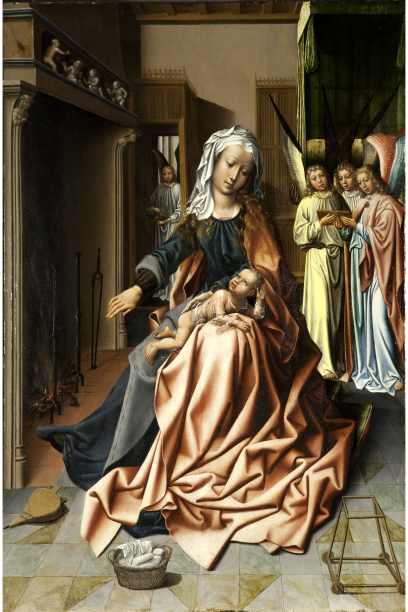
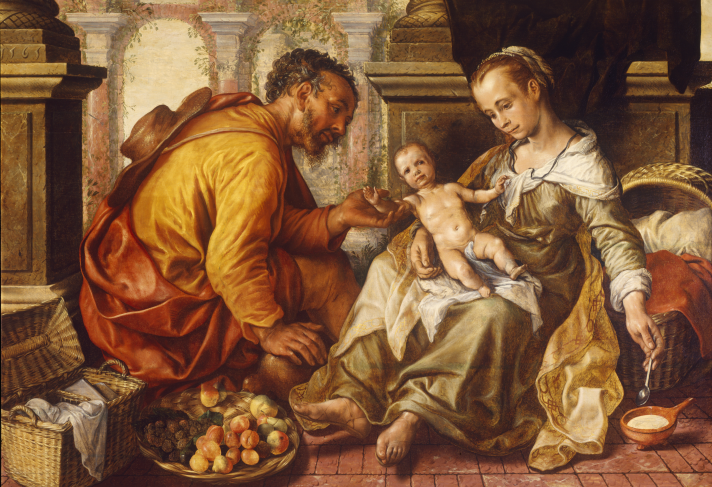
The Holy Family
Oil on panel
Joachim Bueckelaer
Monogrammed and dated: JB (top middle column) 1565 (top left column)
Flemish, c.1534–d.1574
Joachim Bueckelaer received his training in Antwerp from his uncle, Pieter Aertsen, who originated a type of genre painting with peasants or biblical characters set amidst a kitchen or market scene. As an innovator in a new approach to narrative painting, Aertsen enjoyed considerable success with patrons, though not a large following from other artists. Bueckelaer emulated Aertsen’s style closely when he became an independent master in 1560 and remained inspired by his teacher-uncle’s style for the rest of his career.
The painting came to the collection in 1963, three years after it was purchased at a Sotheby’s auction by dealer Julius Weitzner. Weitzner relates in a letter to Dr. Bob Jones Jr. (founder of the Museum & Gallery at Bob Jones University that the under-bidder for the sale was Phillip Pouncy (then Deputy Keeper of the Drawings Department at the British Museum) on behalf of Dr. Julius Held—representative for the Ferre Foundation and assembling works for the new Museo de Arte de Ponce in Puerto Rico.
Dr. Held later wrote to Dr. Jones about the painting saying, “Congratulations on the acquisition of the Bueckelaer; I know the picture very well and have always liked it very much. You did well to buy it.” Dr. Alfred Stange also commented that “The Holy Family by Bueckelaer is an outstanding picture; and signed and dated pictures by this master are, besides that, extremely rare.” Thieme-Becker listed the painting first among the artist’s most important works. The same year it was acquired by the museum it traveled to the Musées Royaux des Beaux-Arts de Belgique in Brussels for the important Le Siècle de Bruegel: La peinture en Belgique au XVIe siecle exhibit.
In the present work, the artist places the biblical scene front and center, forming a pleasing figural arrangement with limbs at active diagonals and a triangular focal point between the three main character’s faces. The large-scale figures of Joseph and Mary fill the immediate foreground, giving a monumentality and nobility to the peasant-looking characters. Bueckelaer’s other market scenes with biblical narratives often had a moralizing purpose, contrasting secular and spiritual values and/or illustrating the frivolity of pleasing the flesh. Here the spiritual tone is elevated throughout the scene, and the beautiful basket of fruits underscores the satisfaction and blessing that can be found only in Christ, the focus of the narrative.
Though Bueckelaer’s work influenced Northern Italians such as Bartolomeo Passarotti and Annibale Carracci, he had no close successors in the Netherlands. Nonetheless, his lifelong commitment to still life and genre painting proved an important on-going presence in Antwerp. Seventeenth-century painters such as Frans Snyders illustrate his continued influence into the Baroque era. His small, respectable output of about forty extant paintings and few followers can be explained perhaps by his early death at age forty.
Published in 2013