Give Now


Tag Archives: dismembered altarpiece

Object of the Month: July 2026

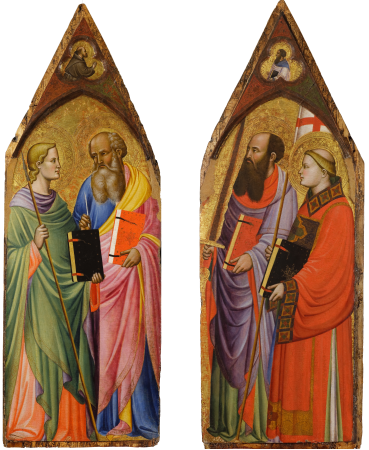
St. Paul and a Deacon

St. Jude Thaddeus and St. John the Evangelist

Tempera on panel, c. 1390-95

Tommaso del Mazza, called the Master of St. Verdiana

Florentine, active 1377-1392
Among the Museum & Gallery’s large collection, there are many altarpieces. Some are complete and some are sections of an altarpiece such as a predella or a removable wing. While considered “incomplete,” these panels stand alone as magnificent examples of art history.

One such is a pair of altarpiece wings titled St. Jude Thaddeus and St. John the Evangelist and St. Paul and a Deacon. Painted c. 1390-95 or the late Trecento, they show six figures from church history and link earthly worshippers with the divine. The details of the paintings—their rounded figures, the precise punchwork in gold, as well as the fluid and monumental fabrics—show a stylistic veneration of Giotto and the early Trecento. Compared to other paintings in the collection, they are not immediately eye-catching. However, their intricate details provide questions that are still being answered.

One resolved question surrounding the wings is the identity of the artist. The earliest collection records attributed them to the late-Trecento painter Giovanni del Biondo, then to the Master of St. Verdiana. The name comes from a rare depiction of Saint Verdiana in Atlanta’s The High Museum of Art, Madonna and Child with Six Saints. St. Verdiana is depicted with two snakes as her distinguishing attribute. Barbara Deimling was one of the first to connect the name Tommaso del Mazza to the Master of St. Verdiana in Tradition & Innovation in Florentine Trecento Painting: Corpus of Florentine Painting. Del Mazza (active 1377-1392) was trained in Florence and was influenced by the work of Agnolo Gaddi and Jacopo di Cione. Although del Mazza is considered a minor painter in the late-Italian Gothic style, he had a busy workshop in Florence, and his oeuvre consists of about fifty paintings.

One unanswered question continues to plague scholars: If these wings were part of a larger triptych and if so, where are the other panels? While there is speculation of other sections, Deimling and a few others believe the center panel to be The Annunciation from the J. Paul Getty Museum collection. It depicts the moment Gabriel appears to Mary and informs her that she will be the mother of Jesus.

M&G’s two wing panels were sent to the Getty where the conservation department examined and restored them. Up to that point, the union had been based on separate photographs and had never been seen together by modern historians. After extensive analysis, Yvonne Szafran, paintings conservator at the Getty at the time, concluded there is no way of being certain all the panels belong together. However, when the three works were brought together at M&G for an exhibition (and subsequent symposium) entitled Twilight of a Tradition, opinions were still divided about the panels originally being a united triptych.

More research will be needed to reach conclusive results on this particular altarpiece and more can be read about these two wings and the exhibition in the catalog Discovering a Pre-Renaissance Master: Tommaso del Mazza. Like the artwork, the catalog does an excellent job in conveying the technical skill of a moderately overlooked artist. Perhaps it is the small details and the small things which lead us to some of the largest discoveries.

KC Christmas Beach, artist and M&G volunteer


Published 2026

Master of Riofrio

Old Testament Characters: The Prophet Balaam; David, King and Prophet; Solomon, King and Prophet; The Prophet Zechariah

Master of Riofrio

Below the image, click play to listen.


Object of the Month: June 2025

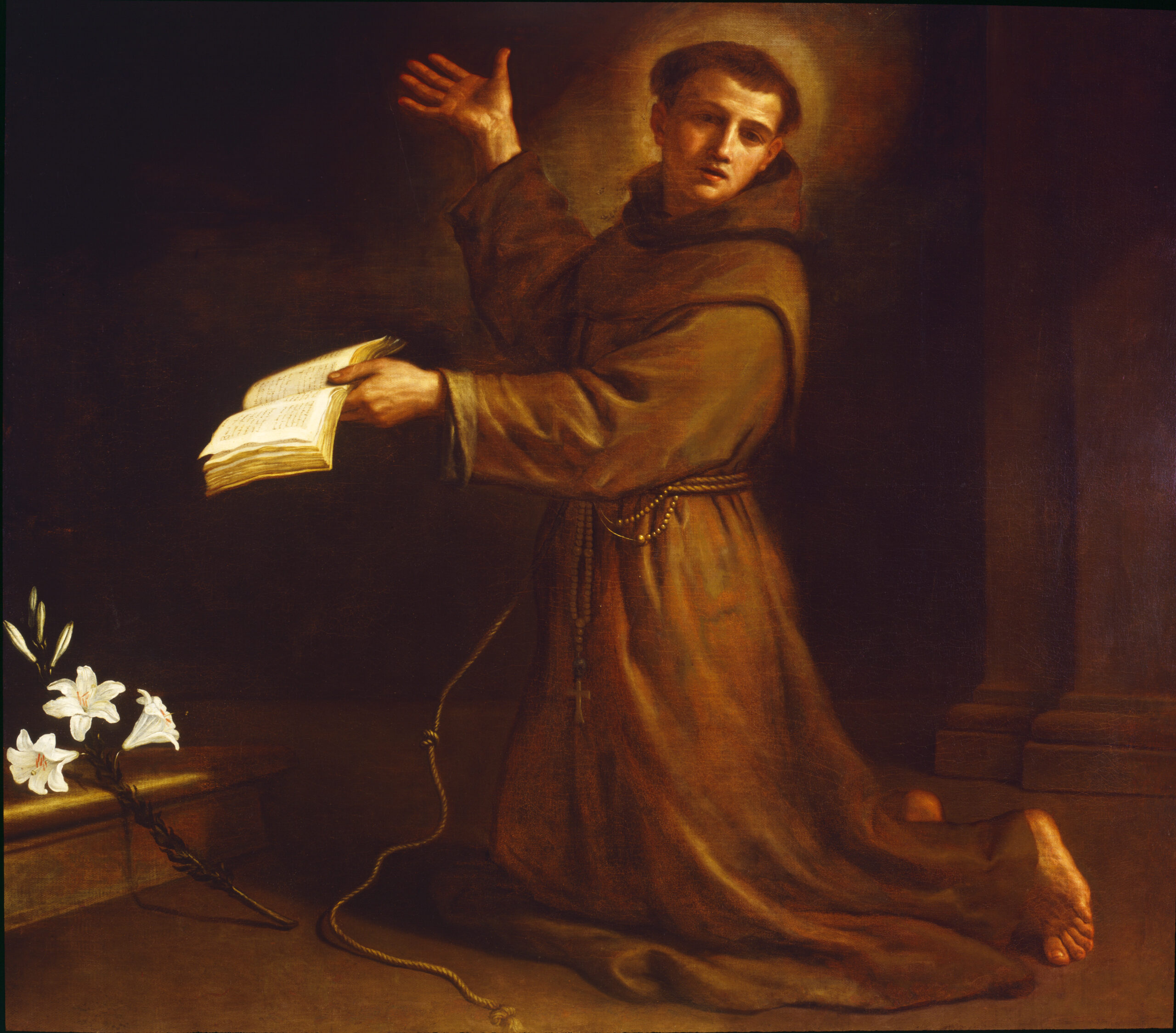
St. Anthony of Padua

Oil on Canvas, 1658

Giovanni Francesco Barbieri, called Il Guercino

Cento, 1591–1666

Long before social media, opinions were influential. And, in art history, opinions have affected perspectives toward artists and their work for entire generations. One example of this is the brilliant philosopher of the Victorian era, John Ruskin, who was an art critic that championed JMW Turner, Britain’s greatest landscape painter. Ruskin preferred and praised the contemporary artists of his day such as Turner and the Pre-Raphaelites, the art prior to Raphael, and the Gothic style.

In contrast, Ruskin’s opinion about the Italian Baroque period can essentially be summed up by his reaction to one painting in the Brera Gallery in Milan by Guercino, “partly despicable, partly disgusting, partly ridiculous” (Ruskin, p.203). He classified many of the great seventeenth-century painters within what he labeled “the School of Errors and Vices” (Ruskin, pp.144-45). Such strong views influenced the collecting habits of collectors and museums in Europe and America for several decades. Consequently, Baroque artists are still recovering from the stigma; their names are not as well-known as the Renaissance masters even though their skill is of equal quality.

Giovanni Francesco Barbieri, called Il Guercino was one of the most important and talented painters of the Italian Baroque period. He hails from the region of Emilia-Romagna, born in the small town of Cento, which is close in proximity to the artistic centers in Ferrara and Bologna. He was largely self-taught (influenced by works of Ludovico Carracci and Caravaggio), although he studied with local artists Paolo Zagnani and Benedetto Gennari.

Guercino’s nickname means squint-eyed or cross-eyed possibly due to an eye condition, yet this disability didn’t seem to affect his work. Ludovico Carracci praised him in Bologna, and his “genius was recognized by the Bolognese canon Padre Antonio Mirandola, who became his earliest protector and obtained the artist’s first Bolognese commission in 1613” which established his career. “He was then patronized by the papal legate to Ferrara, Cardinal Jacopo Serra,” Duke of Mantua Ferdinando Gonzaga, and the Bolognese cardinal Alessandro Ludovisi, who later become Pope Gregory XV— summoning Guercino to Rome in 1621 (de Grazia, p.157).

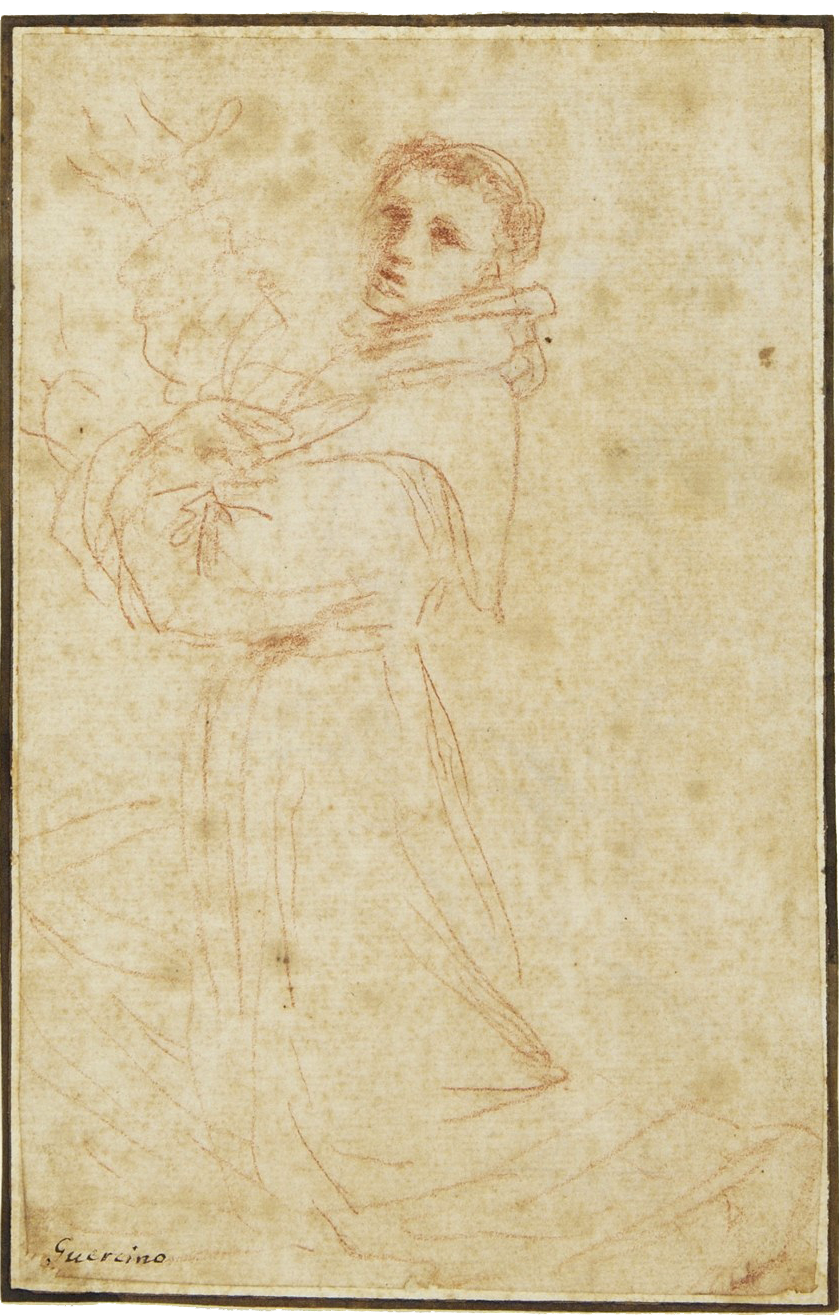
Guercino study of St. Anthony of Padua from Glasgow Museums

Following the pope’s death in 1623, Guercino returned home to Cento to work, painting a wide range of subjects and drawing countless distinctive studies in red chalk and ink. As an artist, he was truly inventive, a real creative. He would put his ideas to paper very quickly and spontaneously—something his biographer Malvasia described as guizzanti, meaning “dart with a flick of a tail, as fishes” (Brooks, p.12).

Among other requests, he was asked to become official painter to the courts of England (1626) and France (1629 and 1639). After the death of his archrival Guido Reni in 1642 he moved his studio to Bologna. By the 1650s, his European patronage had tapered to more local commissions, which is when M&G’s painting was made.

St. Anthony of Padua features the thirteenth-century Doctor of the Church, who was born in Lisbon. He joined the Franciscan Order (represented by the dark brown robe and tonsure haircut) and became a close friend and follower of Francis of Assisi. He had a vast knowledge of scripture and was a gifted preacher, serving in France and Italy including Bologna and Padua, where he died. After his death, he was made the patron saint of Padua.

In art, Anthony is depicted in various scenes describing events from his life. M&G’s subject is the vision of the Virgin and infant Christ—a common theme during the Counter Reformation. The vision came while Anthony was in his room, and he is portrayed with a book (which identifies his learning), lilies (representing his purity), and a crucifix (in the shadows above the lilies).

At the time of acquisition in 1973, M&G’s founder knew that this painting was referenced in the artist’s account books—it was one of two St. Anthony altarpieces recorded. The great Guercino and Baroque specialist, Sir Denis Mahon wrote Dr. Bob, “I have no doubt whatsoever from studying the painting itself that it is an authentic late work by Guercino…. It was the lower half of a picture which had been very much bigger…. It follows that the picture is likely to have originally been a full-size altarpiece” (M&G files).

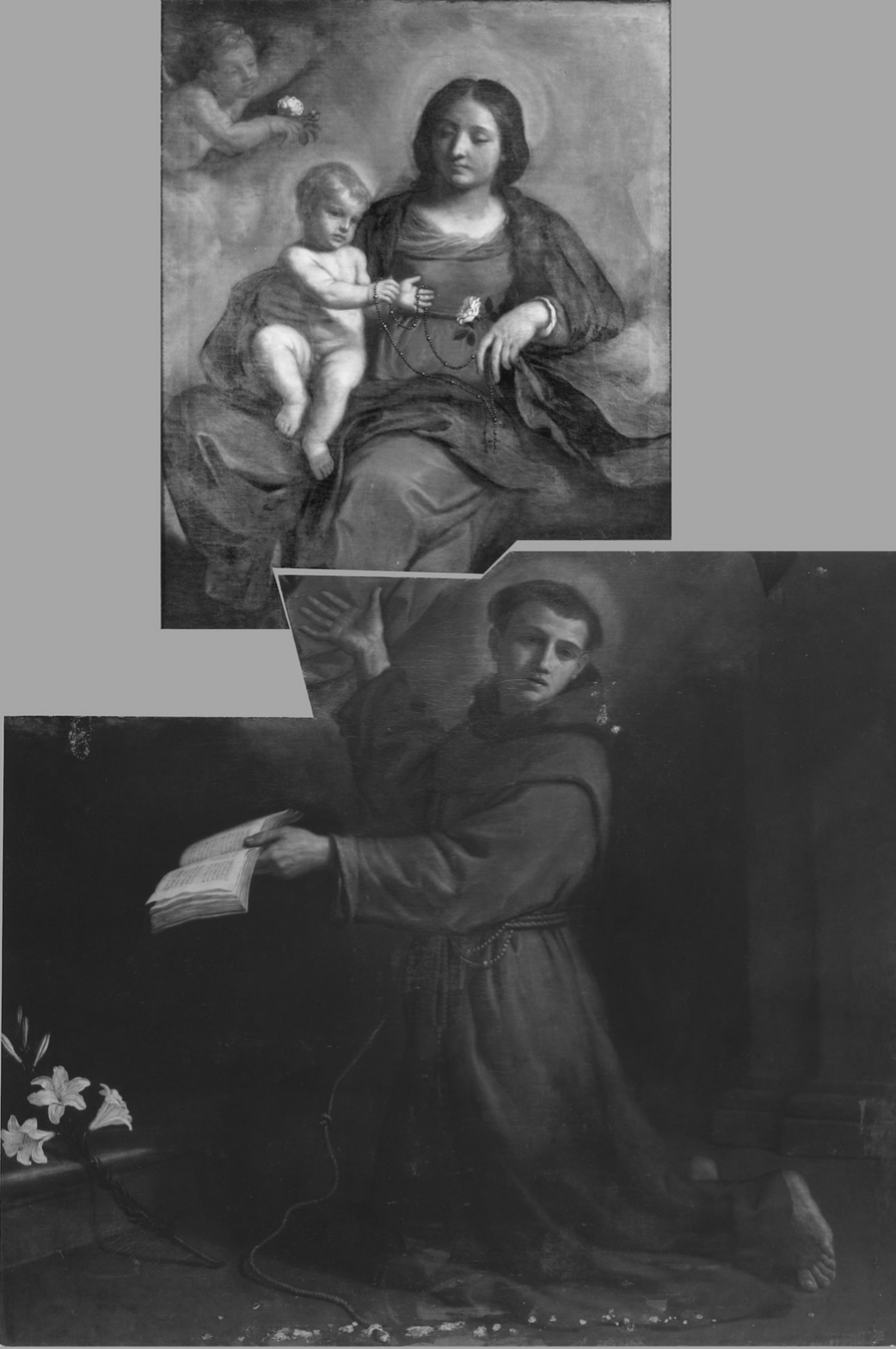
In the 1990s, Richard Townsend found that of the two St. Anthony altarpieces referenced in Guercino’s account books, one was still in Verona and the other cut in two and sold. This work remained a mystery, until recent years when Italian art historian Enrico Ghetti pieced together the history based on the confusing details in Guercino’s Book of Accounts and Malvasia’s biography. M&G’s painting was once called the Madonna and Child with Saint Anthony of Padua and paid for in 1658 by Pier Luigi Peccana (from Verona) most likely on behalf of the Marquis Gaspare Gherardini. The altarpiece used to hang in the Chapel of Saint Antony at the Capuchin church of Verona.

Ghetti Reconstruction

Ghetti suggested the painting, Madonna with Child, which was formerly in the Sgarbi collection in Italy is most likely the upper portion of our work; he has proposed a reconstruction of the dismembered altarpiece as seen here.

M&G’s painting reveals some of the standard matters art historians encounter regularly: the influence of art critics like John Ruskin, the connoisseurship of art specialists like Sir Denis Mahon, dismembered altarpieces, and confusing primary records for art scholars like Enrico Ghetti to ferret out. More importantly, this interesting work represents one of the most notable and innovative Italian painters of the seventeenth century.


Erin R. Jones, Executive Director


Bibliography

Brooks, Julian. “Characterizing Guercino’s Draftsmanship.” Guercino: Mind to Paper. Getty Publications: Los Angeles, 2006.

De Grazia, Diane. “Giovanni Francesco Barbieri, Called Il Guercino.” Italian Paintings of the Seventeenth and Eighteenth Centuries: The Collections of the National Gallery of Art Systematic Catalogue. National Gallery of Art, Washington: New York, 1996.

Ghetti, Enrico. 2020. “La ricostruzione di una pala del Guercino: la Madonna col Bambino e sant’Antonio d Padova per i Cappuccini di Verona,” Storia dell’ Arte 153, Nuova Serie 1.

Ruskin, John. Modern Painters (vol. ii), ed. Edward T. Cook and Alexander Wedderburn. George Allen: London, 1903.

Ruskin, John. Ruskin in Italy: Letters to His Parents, 1845, ed Harold I. Shapiro. Clarendon Press: Oxford, 1972.


Published 2025