Give Now


Tag Archives: Florence

Object of the Month: February 2026

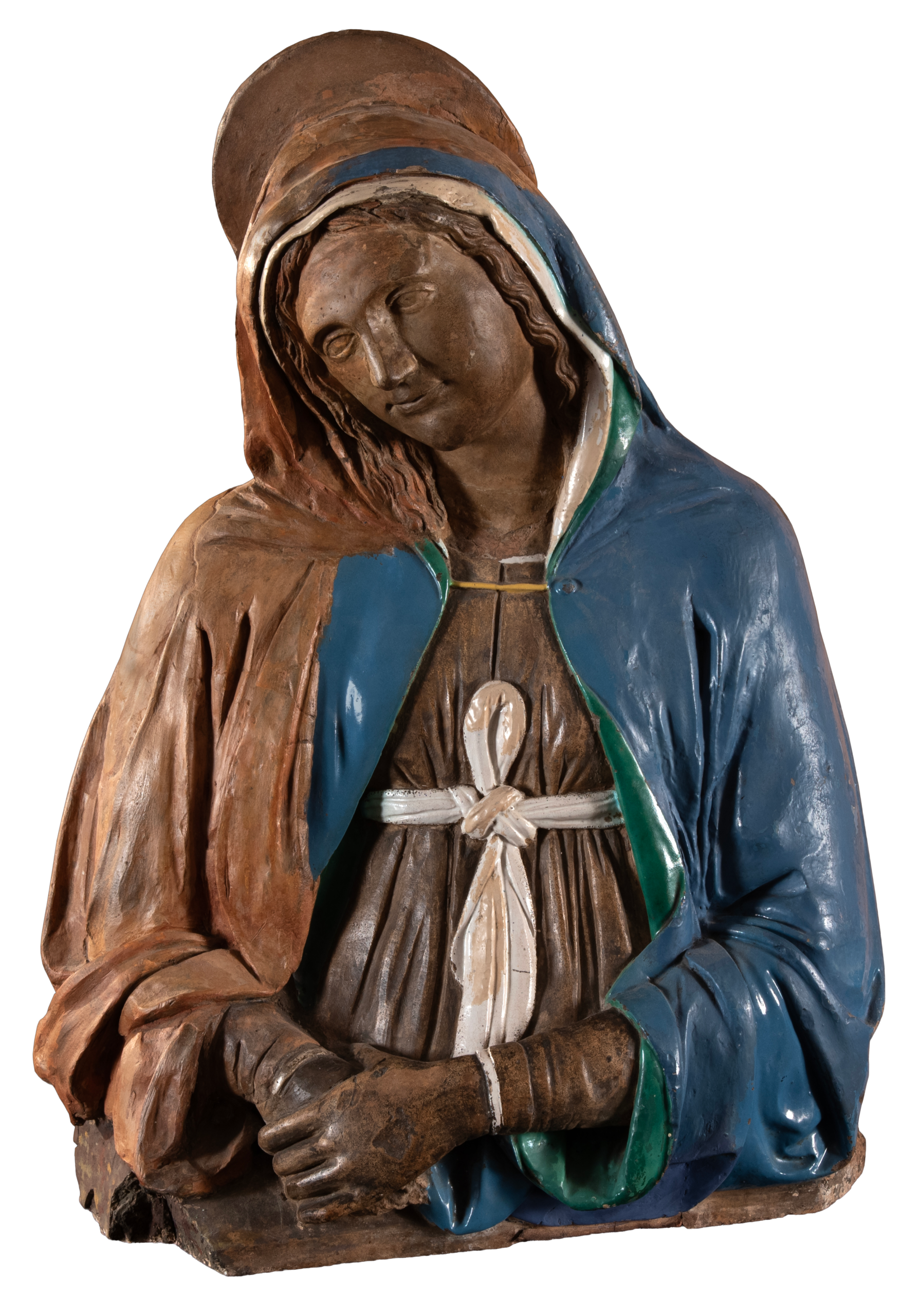
Sorrowing Virgin

Glazed Terracotta, c. 1500

Andrea della Robbia

Florence, 1435-1525
Andrea della Robbia was born into a family known for artistic innovation. His uncle, Luca della Robbia pioneered glazed terracotta as a durable and expressive sculptural medium. As Luca’s primary heir, Andrea learned not only sculptural principles of form and proportion from his uncle, but also the closely guarded technical procedures of glazed terracotta that made the family’s works exceptional in Renaissance Florence.

Throughout his long and prolific career, Andrea expanded and perfected the aesthetic, technical, and practical uses of tin-glazed clay sculpture. His terracotta works are recognizable for their highly refined modeling of serene faces and graceful drapery, their luminous surfaces, and their brilliant colors.

Although Luca and Andrea both carefully guarded their tin-glazing techniques, an early form of corporate espionage resulted in these methods being leaked, allowing competitors—such as Benedetto Buglioni, who crafted M&G’s Pair of Angels with Candlesticks—to share the profitability of glazed terracotta. Others, like Andrea’s son, Girolamo della Robbia, built on the families’ advances and developed firing processes needed for extremely large pieces, like M&G’s terracotta busts of French royalty.

Savonarola, a contemporary of Andrea, was a fiery preacher calling for reform within the Roman Catholic Church. He was not anti-art, but was critical of excessive ornamentation and sensuous beauty in religious art.  He fostered art that reflected humility, repentance, and Christian devotion. There is documented evidence that contemporary Florentine artists such as Botticelli, were followers of Savonarola. Their works show dramatic stylistic shifts as Savonarola rose to prominence, as illustrated by M&G’s Botticelli tondo.

Art historians, including Sir John Pope-Hennessy and Franco Gentilini, have noted that Andrea’s later works resonate with what Savonarola described as “semplicità devota” (devout simplicity). Andrea increasingly favored simpler compositions and less exuberant ornamentation. His later images of the Virgin portray a quiet gravity rather than the courtly sweetness seen in both Luca’s works and Andrea’s earlier productions. There is no documentary evidence of a personal or ideological connection between Andrea and Savonarola; however, Andrea’s later works reflect the tone and purpose of the religious reform Savonarola advocated. One expert noted that M&G’s Sorrowing Virgin aligns not with Andrea’s early works, created under his uncle’s tutelage, but with those from his later period, “when he, himself was in control” of the studio.

The Same Molds

Andrea della Robbia’s wall-mounted glazed terracotta reliefs of the Virgin and Child were highly popular. The graceful, serene expression of the Virgin and the strong, confident appearance of the infant Christ reflect a devotional mood suitable for chapels, hospitals, orphanages, and private homes. These works also embody the “devout simplicity” endorsed by Savonarola.
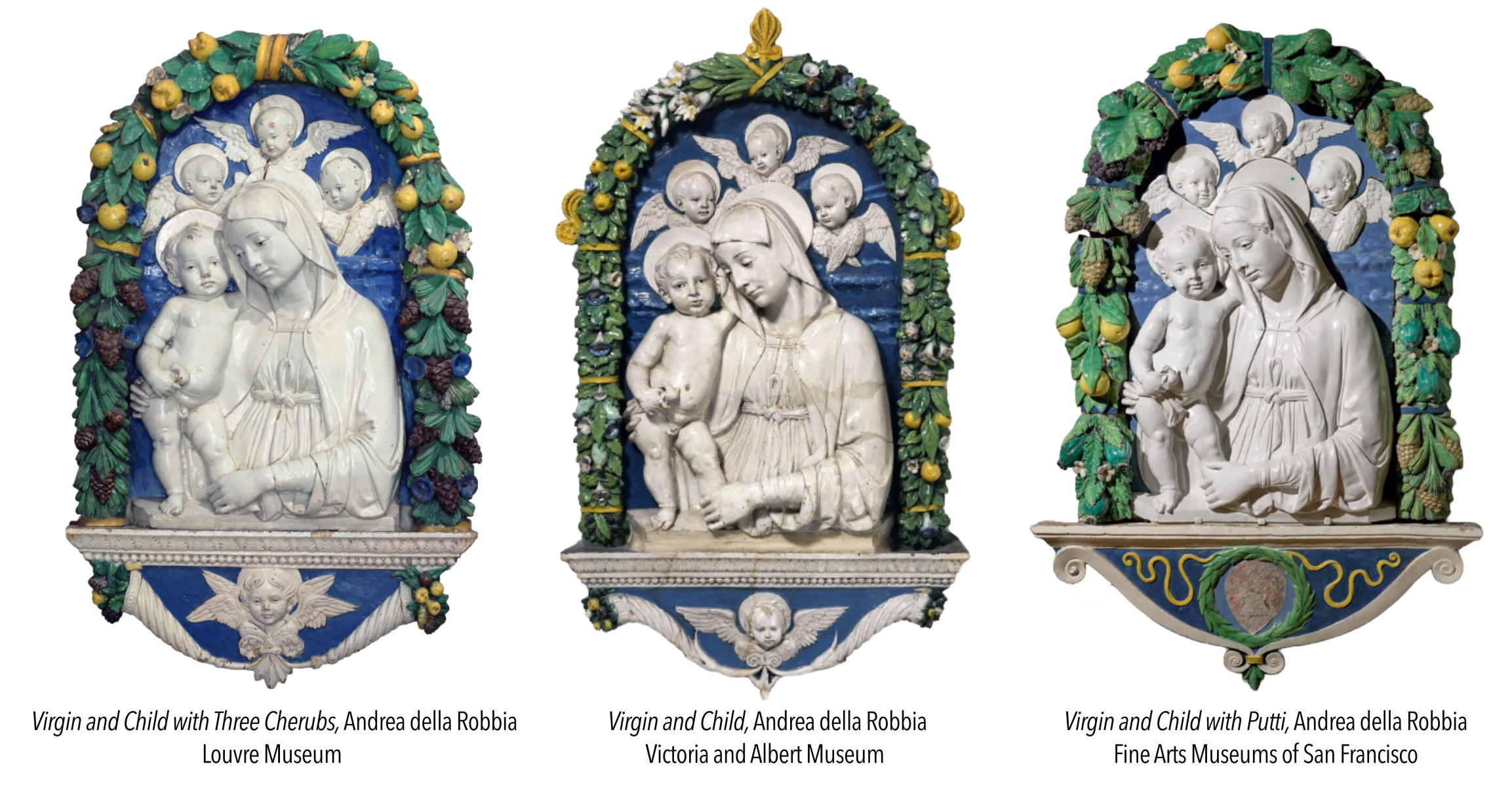
While the background and frames vary considerably, the figures themselves were likely produced from the same molds. Minor variations can be as seen in details such as the Virgin’s head covering or placement of her right hand. Occasionally more significant variations occur, such as a swaddled Christ seated on His mother’s lap. These and other works that appear to derive from the same molds, can be found in situ in Italy, and in museums and private collections worldwide. Some have direct provenance to Andrea and his studio. A repeated detail also seen in M&G’s piece, is the decorative, single slipped reef knot on Mary’s belt, an Italian Renaissance symbol for purity.

M&G’s Sorrowing Virgin is unsigned; few Italian Renaissance terracotta pieces are, but some of the molds used to make Andrea’s wall-mounted reliefs of the Virgin and Child, as well as other works from his studio, appear to have been used in forming M&G’s piece. Experts agree that these and other similarities justify attributing M&G’s Sorrowing Virgin to Andrea and his studio.

M&G’s Sorrowing Virgin

The first known reference to M&G’s piece is in Allan Marquand’s 1922 Andrea Della Robbia and His AtelierMarquand describes the sculpture, stating, “This much injured half figure of the Virgin is only partially glazed,” that in 1920 it was owned by the New York art dealership French & Co., and that it had received some conservation treatment.

It is possible that the piece experienced a kiln disaster during the firing to affix the glazes. Its extensive damage and conservation are in keeping with this scenario.

  • The right side of the sculpture is glazed in standard colors for Renaissance terracotta. However, during conservation, areas not usually damaged by normal wear, received in-painting.
  • The left side required extensive repair and was painted brown. It is unknown if any glazing survives beneath the paint.
  • During the Renaissance, a permanent red glaze was impossible; artists often glazed areas brown and painted them red after firing. The Virgin’s dress is finished in a brown glaze, but the color intended for it is unknown.
  • A firing problem could explain the very dark, unglazed terracotta of Mary’s face, neck, and hands.

The della Robbia studio developed skin-tone glazes, which Andrea used on works intended to be viewed from a distance. For more intimate sculptures, leaving the skin unglazed resulted in a pale brown, matte surface. Set against the high gloss of their glazed surroundings, these matte areas appeared as soft flesh. Unglazed clay also allowed for detailed modeling and subtle facial expressions, which would have been obscured by thick glaze. The expressions of the figures became the focal point of the sculpture. In keeping with Savonarola’s message, unglazed terracotta would convey the Virgin’s suffering more powerfully than a polished surface would.

The Virgin Mary knew her Son, Jesus Christ, was the Messiah, the God-sent Redeemer. Her sorrow at His crucifixion stemmed from His unjust treatment and excruciating suffering. That sorrow would have been tempered by what the angel Gabriel had told her as His miraculous birth was described. He, the Son of God, would not only be her Redeemer, but He would also be an Everlasting King. Believing God, she had both hope and peace with her sorrow. All of which can be seen in the face of Andrea della Robbia’s Sorrowing Virgin.


William Pinkston, retired educator and M&G volunteer


Suggested References

Cambareri, Marietta. Della Robbia: Sculpting with Color in Renaissance Florence (Boston: MFA Publications, Museum of Fine Arts. Boston, MA. 2016)

Marquand, Allan. Andrea Della Robbia and His Atelier (Princeton University Press. Princeton, NJ. 1922)


Published 2026
Object of the Month: November 2025

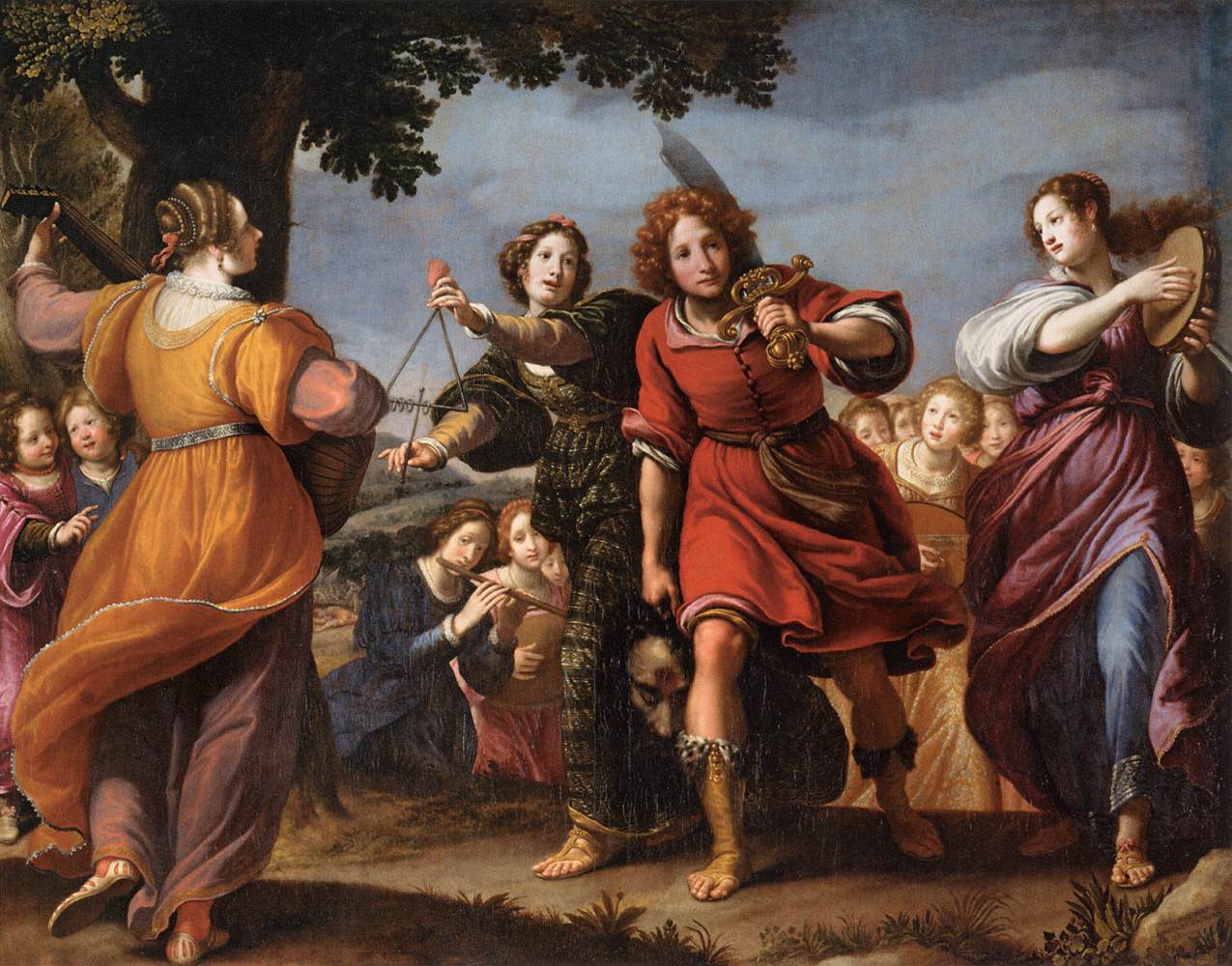
The Triumph of David

Oil on canvas, c. 1630s

Jacopo Vignali

Florentine, 1592-1664

Italian art scholar Howard Hibbard once observed, “Florentine seventeenth-century art has a fascination and beauty worthy of our attention: it is a sensuously colorful and romantic school of painting, sometimes even magical or mystical.” The Museum & Gallery’s Triumph of David by Jacopo Vignali is a case in point. Described as one the most “poetic and sensitive” of the Florentine painters, Vignali began his career at 13 under the tutelage of Matteo Rosselli. In his early twenties he joined several other noteworthy artists in the decoration of the Casa Buonarotti—the most important commission in Florence at that time. By his early thirties, he was not only a member of the Academy but also one of the leading artists in Florence.

Rosselli’s superb tutelage provided Vignali with the technical and artistic skills necessary for his later success. However, as Vignali’s style matured, he became more eclectic, incorporating Counter-Mannerism with the grandeur, drama, and emotional intensity of the emerging Baroque aesthetic. This diversity is clearly apparent in The Triumph of David.

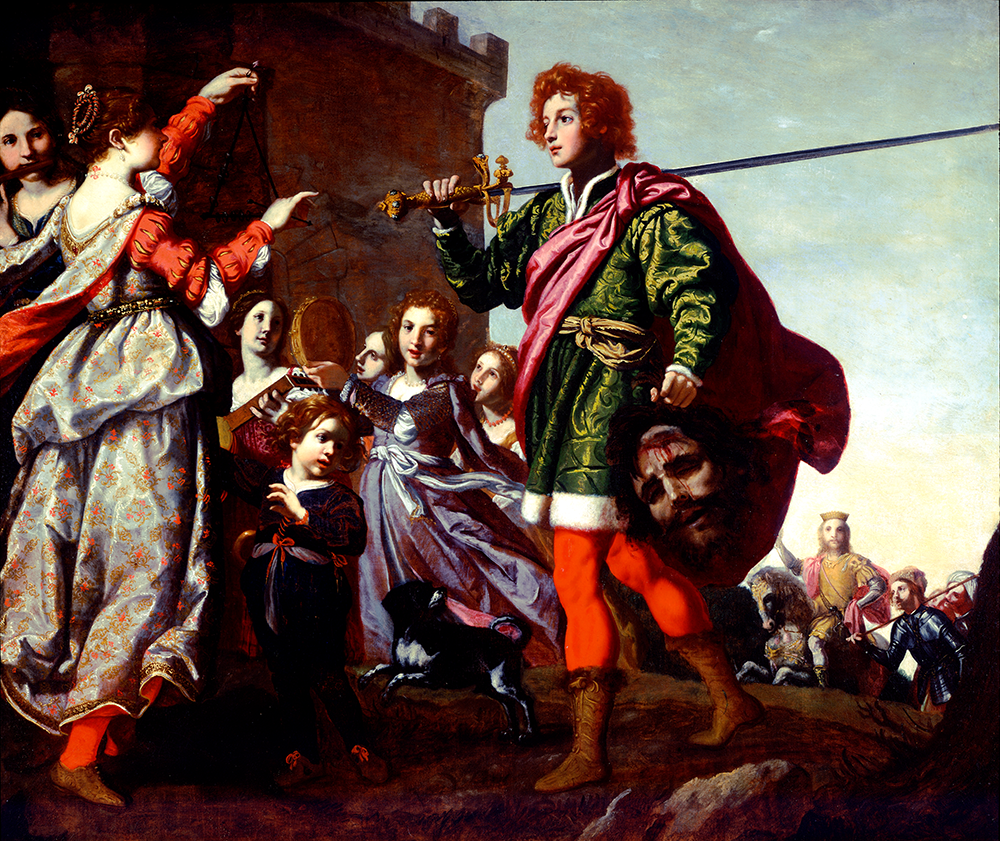
Seventeenth-century paintings on the life of David had been prevalent since the 15th century when the innovative, stunning sculptures of Donatello, Verrocchio, and later Michelangelo elevated this biblical figure into a civic symbol. Interestingly, our M&G painting was originally attributed to Vignali’s teacher Rosselli. Joan Nissman notes: “The answer to this problem of attribution, as Del Bravo suggests, seems to be that it is an early work painted while Vignali was still under the influence of his master. Vignali, in this painting, shares his master’s solid and smooth technique as well as his concern for details of costume.” However, a comparison of Rosselli’s treatment of the subject [fig. 1] with Vignali’s highlights why Carlo del Bravo’s attribution of the work to Vignali (rather than Rosselli) has now won general acceptance.

fig. 1 THE TRIUMPH OF DAVID, Matteo Rosselli

Notice that in Rosselli’s rendering we see the coloration, composition, and scale indicative of the classical Baroque style popularized by the Carracci. In contrast, Vignali’s more dynamic composition, vivid coloration, and careful use of scale reflect his mature style which favored the integration of Counter-Mannerist techniques with the dramatic realism of Baroque naturalism. For example, High Mannerist paintings were often characterized by strained poses, distortion of the human form, crowded compositions, garish coloration, and unusual (sometimes bizarre) elements of scale.

In this scene, however, Vignali manipulates these common characteristics to create a “restrained” but equally dramatic effect. For example, the composition is “crowded” but the poses elegant, the figures without distortion. The coloration is vivid but not garish, carefully integrated to create focus and highlight the triumphant mood of the scene (e.g., David’s bright red stockings draw the eye to Goliath’s head while the bright red sleeves of the woman’s costume create an implied horizontal line that guides the viewer’s eye back to the hero’s face).

Vignali also carefully manipulates scale. The extreme elongation of the sword and the enormous head of Goliath subtly serve to reinforce the power of the biblical narrative. Scripture notes that Goliath was about 9 feet tall, and although we are not told specifically how much his sword weighed, we do know that the head of his spear weighed about 15 pounds! In addition, the soft modeling of the faces, the contemporary dress, and the morbidly gruesome severed head highlight Baroque naturalism’s penchant not just for realism but also for the “bizarre and strident” (David Steel).

Although Vignali’s contributions to the early Baroque period are significant, he remains less well-known than either his teacher Matteo Rosselli or his most famous student Carlo Dolci. Joan Nissman attributes this lack of name recognition to the fact that, unlike Roselli and Dolci, the great seventeenth-century Florentine biographer, Filippo Baldinucci, did not write of Vignali’s life. Regardless, this work has long been praised as one of the finest treatments of The Triumph of David ever produced.


Donnalynn Hess, Director of Education


Works Cited:
Steel, David, Baroque Paintings from the Bob Jones University Collection. North Carolina Museum of Art.1984.
Hibbard, Howard and Nissman, Joan, Florentine Baroque Art from American Collections. The Metropolitan Museum of Art. 1969.


Published 2025

Object of the Month: February 2020

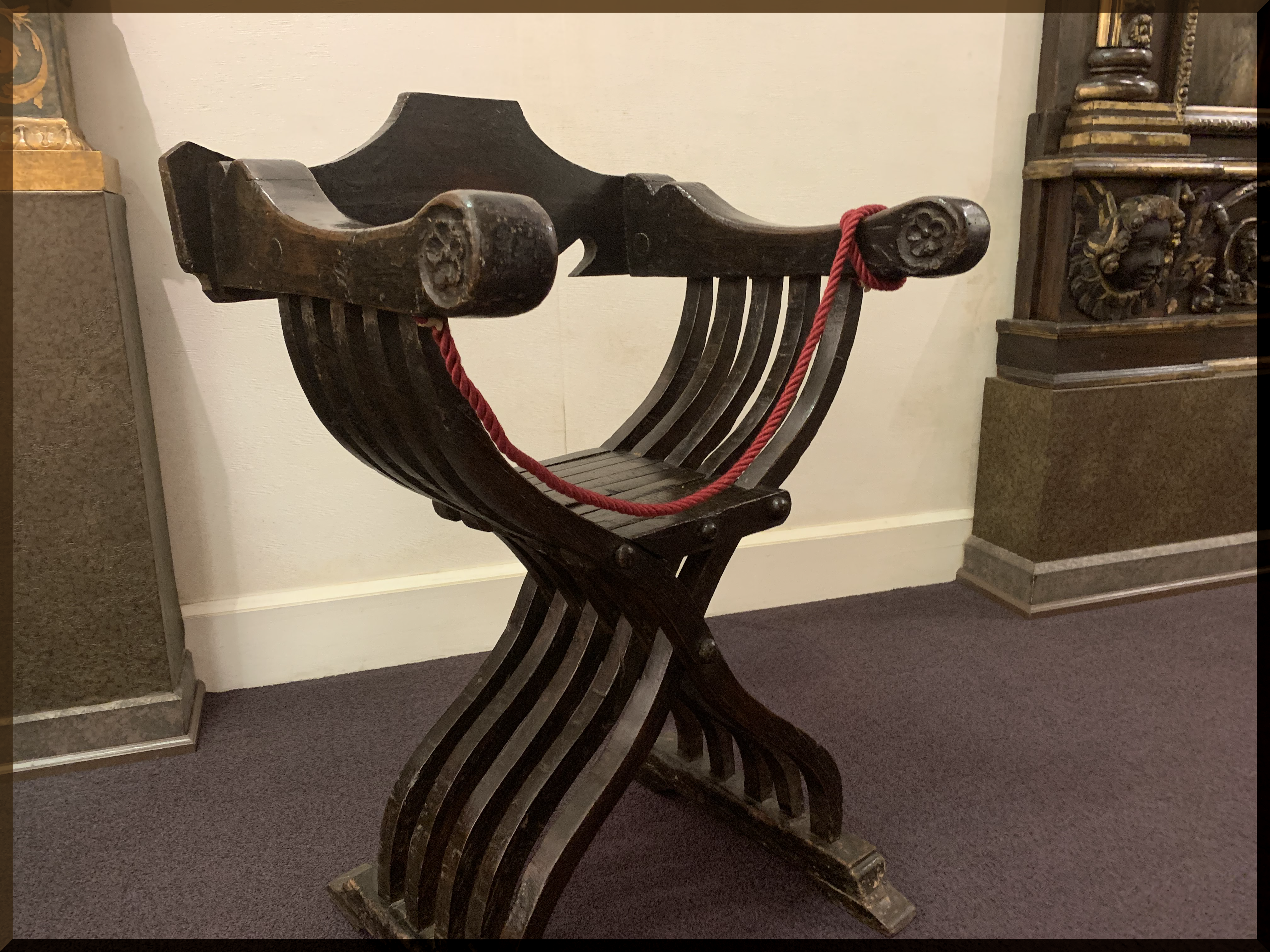
Savonarola Chair

Walnut

Florentine, early 16th century 


For a mundane piece of furniture with such a simplistic design as to be easily transportable, this folding chair bears the name of a big personality and has allowed countless VIPs to rest and rule simultaneously.

Girolamo Savonarola was a monk and religious reformer in Florence, Italy. He came to the Medici’s city in 1481 to serve at the Dominican monastery and church of San Marco (St. Mark).  He proved to be honest and sincere, and he studied and memorized Scripture, which he applied practically to everyday living for himself and in his teaching. His preaching was passionate and dramatic, and he spoke against corruption in the church and papacy. His influence for morality and reform held popular support for a while, even garnering respect from Lorenzo, the Magnificent. Eventually, however, Savonarola was bitterly opposed by Rome. The pope enforced excommunication, suspension of the sacraments from the faithful, and a ban of trade, which affected Florence’s prosperous economy. Ultimately, the Florentines turned on him too, and Savonarola was sentenced to death. He was hanged and his body burned in the town square in 1498—just seventeen years after his arrival.

Shaped in the frame of an X, this Italian Renaissance Savonarola Chair is one of a few in M&G’s collection. The chair is constructed of walnut and is considered “unusual” by furniture expert Joseph Aronson because it only has five pairs of the thick, pivoted S-shaped strips of wood to hold the hinged seat. Normally, a chair like this might have six, eight, or even twelve pairs. However, these five rung pairs are each held together at the floor with a trestle for sturdiness, and the pairs are joined at the top by heavy arms with carved rosettes. The back of the chair is a modest board, which is attached loosely—easily removed when the chair needs to be folded. 

The chair style has had many names through the centuries and geographical regions including the X-chair, curule, faldstool, scissors chair, Dante chair, and Luther chair. Because of its unique design, the chair traces its roots and practical service back to antiquity. A visual record exists of Egyptian Pharoah Tut’ankhamun sitting in the chair. Roman senators and consuls used a backless version of these portable seats, and in Romanesque and Gothic illuminations the kings of France are perched on it.  

With Italy’s interest in Greek and Roman culture and thought, the Renaissance also revived awareness in the architecture and design from antiquity including furniture. One writer explains the era as “an exhibition of emancipated modern genius fired and illuminated by the masterpieces of the past.” During the awakening, the chair’s status of power continues in the pictorial records of seated bishops, emperors, and popes. Artists also rendered respected religious individuals in the chair such as St. Ambrose and Christ’s mother Mary. 

The Museum of San Marco preserves and features the fifteenth-century Dominican monastery where Fra Angelico was Prior and who decorated many of the monk’s cells and interior spaces with beautiful frescoes. Girolamo Savonarola became the monastery’s Prior in 1491 and occupied three cells that today still display a few of his personal items, including a folding X-chair in his study and similar chairs in other parts of the museum.

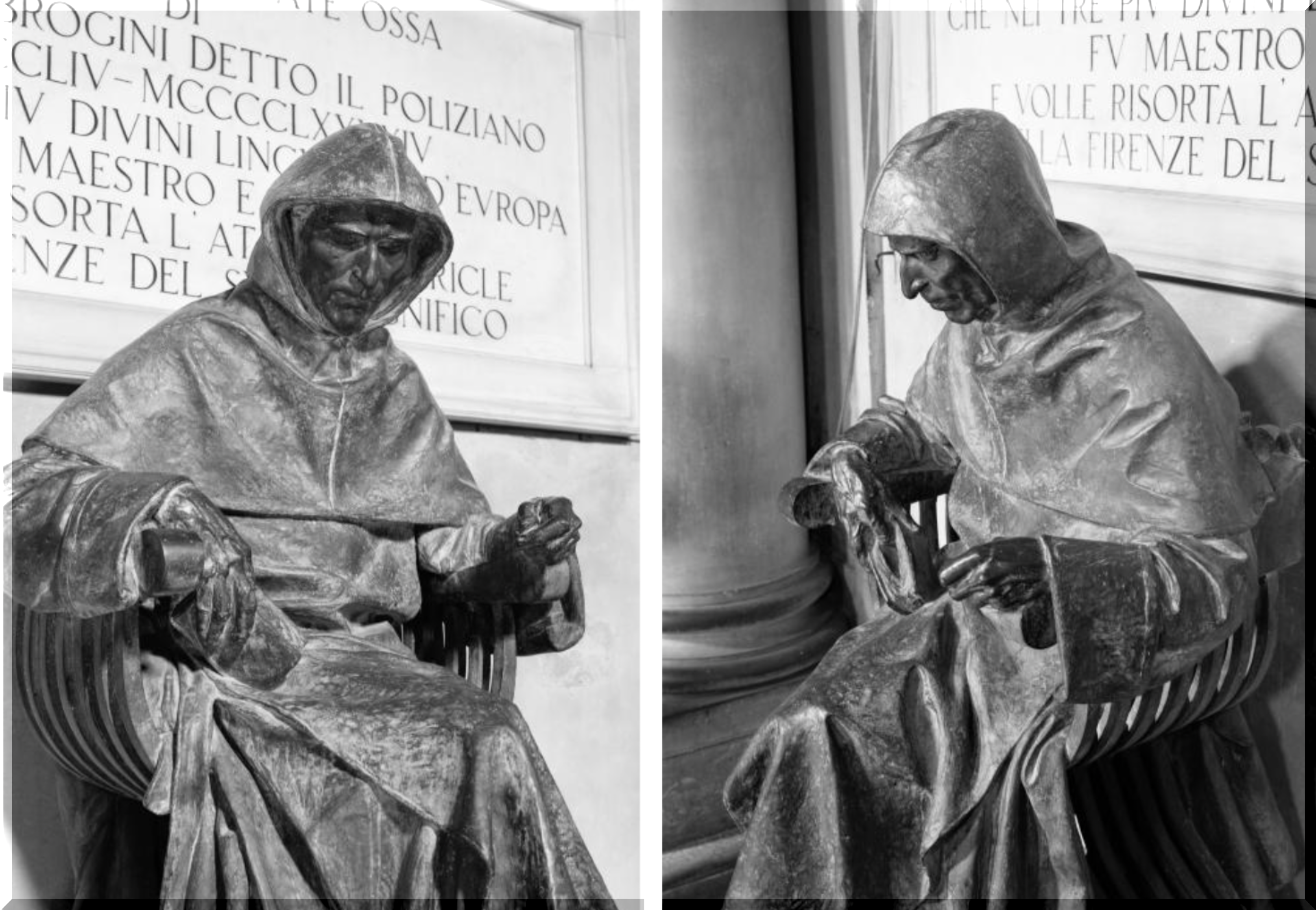
However, it wasn’t until nearly 400 years after his torturous death that the chair became associated with Savonarola specifically. In 1878, Florentine sculptor Giovanni Biggi created for the church at San Marco a bronze statue of the monk sitting pensively in an X-shaped chair.

Erin R. Jones, Executive Director


Additional Reading: 

Furniture of the Italian Renaissance, Walter A. Dyer

Michelangelo and Seats of Power, Eric Denker and William E. Wallace

Faith of Our Fathers: Scenes from Church History, edited by Mark Sidwell

Anatomy of A Design Classic: The Savonarola Chair


Published in 2020