
Although much is written about the Apostle Paul, little is known of the courageous prophet who, at the Lord’s command, restored Paul’s sight.
Visit HERE for the next video to ponder those things that are Honorable.
Although much is written about the Apostle Paul, little is known of the courageous prophet who, at the Lord’s command, restored Paul’s sight.
Visit HERE for the next video to ponder those things that are Honorable.
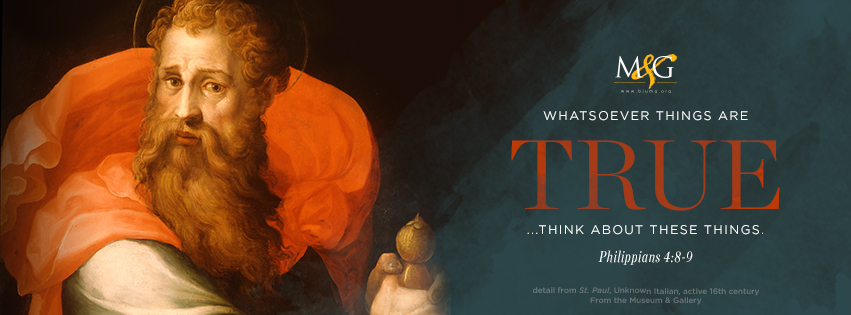
St. Paul, known as the Apostle to the Gentiles, was a passionate personality whose ardent zeal is well documented in Scripture. It is also beautifully captured in the nuances of this Mannerist work.
Visit HERE for the next video featuring Truthful things to consider.
This is the only signed picture by this early Italian master. It also includes 55 faces!
At the dawn of the 16th century Mannerism was gaining in popularity. Even noted Renaissance painters like Raphael began to mirror the style, but it was the Sienese painter Giovanni Antonio Bazzi who would push the mannerist vision even further.
Paris Bordone studied for a time under Titian, the greatest Venetian artist of the 16th century. Although forced to leave this great master’s studio, Bordone went on to excel in portraiture, large-scale architectural settings, and cabinet paintings.
This elegant tondo illustrates the interesting “detective” work that is sometimes involved in attributing a work of art to a particular artist.
The Della Robbia family is famous—for their secret artistic recipe. Watch to learn more about a pair of sculpture and this family of artists represented in M&G’s collection.
The European furniture in the Museum & Gallery collection has been called the finest in America by Joseph Aronson, author of The Encyclopedia of Furniture. This beautiful Italian cassone is a good example.
The refinement of High Renaissance art motivated mannerist painters like Francesco Cavazzoni to explore other avenues of expression. Legend of the Finding of the True Cross provides an intriguing example.
Giovanni Filippo Criscuolo’s The Last Judgment provides a fascinating study not only for its religious iconography but also for its theological and literary allusions.
M&G at BOB JONES UNIVERSITY; 1700 Wade Hampton Blvd - Greenville, SC 29614
