Give Now


Tag Archives: sculpture

Object of the Month: July 2018

Angel with Candlestick (pair)

Polychrome and parcel-gilt

Unknown

Florentine, c. late 15th century
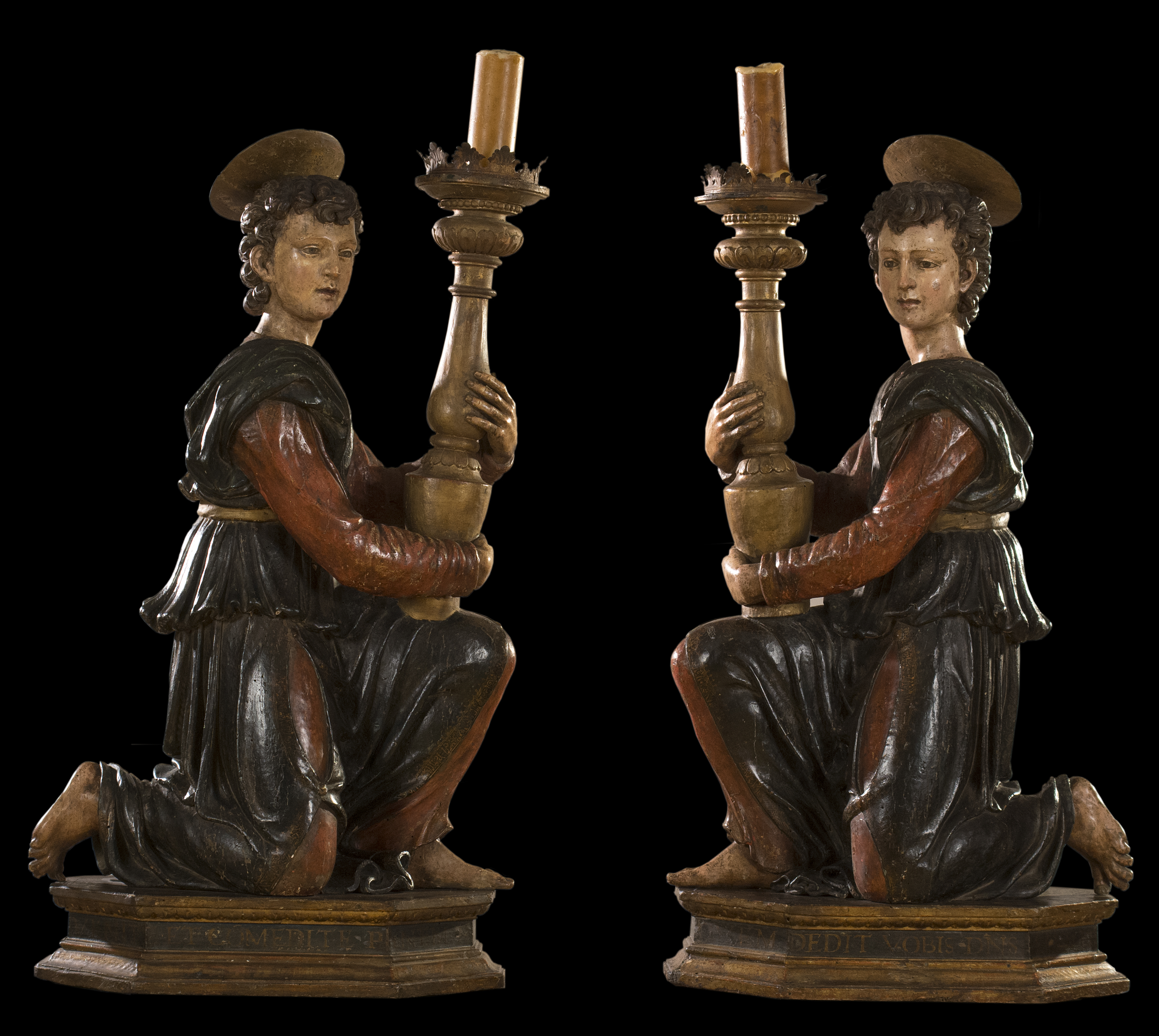
 

Since paintings in an exhibit often take “center stage,” ecclesiastical pieces like these Angels with Candlestick can be overlooked by museum viewers. During the Renaissance, however, a polychrome sculptural grouping would often be the centerpiece of an altar’s decorative scheme while the painted narrative scenes or figures functioned as the “wings” of the altar. Although by the end of the sixteenth century, paintings became the central focus of Italian altarpieces, while sculpture continued to be used extensively in other countries like Spain. 

The term polychrome (meaning “many colored”) refers to the application of colored materials to sculpture in order to present a more life-like quality. This technique dates back to the Greeks and Romans and was particularly popular during the Renaissance. Because these pigments fade over time such coloring is rarely discernable today.  The good condition of these statues is due to the porous wood used which retains color well. 

We know that the figures shown here were meant to be angels from the metal pins that remain on the back of each figure—a clear indication of the wings’ placement. Sadly, it is not uncommon for such appendages to be broken off or lost over centuries of movement from place to place. Fortunately, the carved wooden haloes have remained intact, as has the original base with its Latin inscriptions.

Since several of the words are Latin abbreviations, the precise translation of the inscriptions is unclear. However, a loose reading would be: 

OVEM DEDIT VOBIS DNS ADVES CENTVIM 

Dedicated to the Lord’s Advent

VENITE ET COMEDITE PANEM

Come and eat bread 

ANGE ORVM

Angels


Donnalynn Hess, Director of Education


Published in 2018

Object of the Month: June 2017

Reliquary

Giltwood

Spanish, 17th century


Reliquary Head of a Monk

Silver

French, 14th century

figure 1: Reliquary Head of a Monk

Click on links for additional reference information.

While the Museum & Gallery is best known for its large collection of European Old Master paintings, the museum also contains around 2,000 objects, ranging from medieval tapestries to Renaissance furniture to ancient Egyptian artifacts.  Among these diverse and unique items, two reliquaries provide an interesting look at sacred art in object form.

Reliquaries are containers that were designed to hold relics, the remains of a saint or an object closely associated with the honored individual.  In their day, these relics varied from supposed fragments of the cross to the finger bones of saints.  Beginning with the reign of Charlemagne, every medieval church owned some kind of a relic, and it was common practice for people to venerate relics deemed particularly significant.  Literature from the medieval era, such as Chaucer’s Canterbury Tales, whose characters are on a journey (a pilgrimage) to visit the shrine of St. Thomas Becket, reveals the integral role relics once filled in religious life.

figure 2: Reliquary

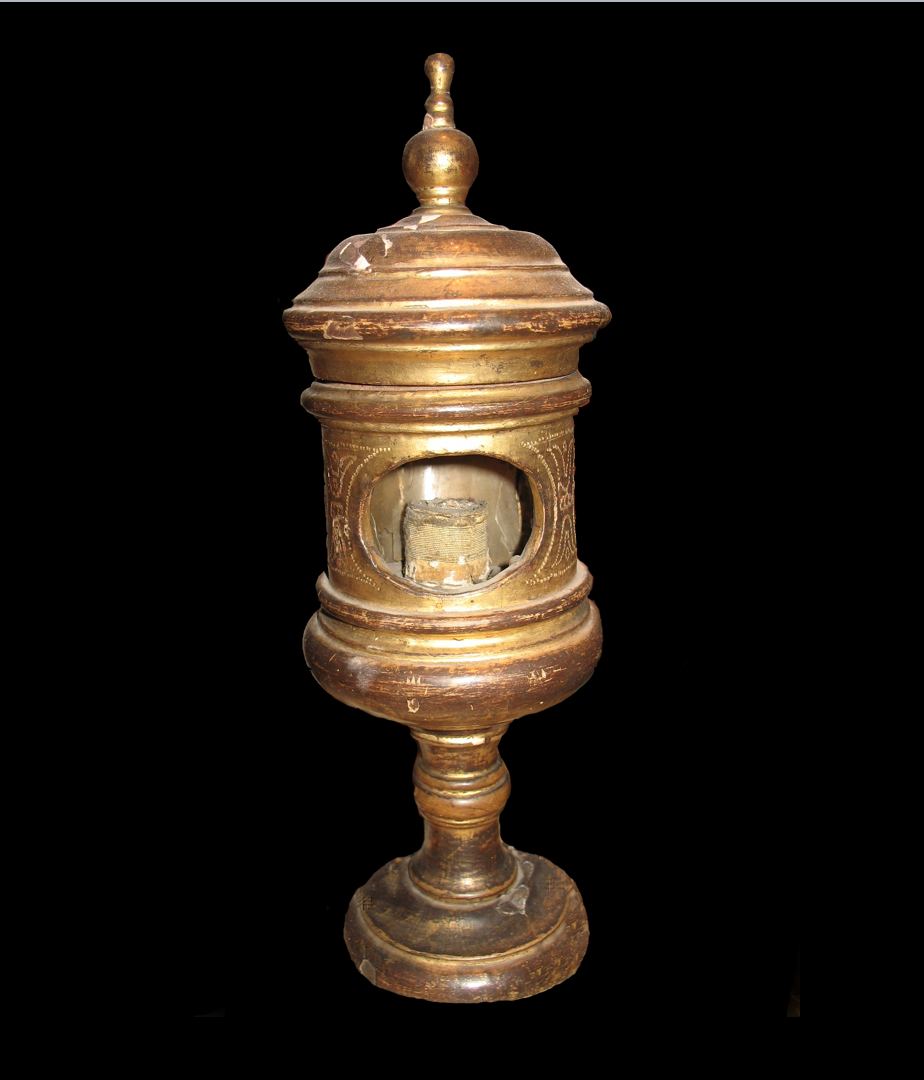
The first of M&G’s reliquaries is Spanish, dating from the seventeenth century (figure 2).  It is made of giltwood and has a small openings in the side of it, possibly designed to allow the worshipper to glimpse the relic within.  What that relic was, is unknown, and compared to M&G’s Reliquary Head of a Monk, (figure 1) this reliquary is simple in design and style.

On the subject of reliquaries, Barbara Drake Boehm, the senior curator of the Metropolitan Museum of Art’s Department of Medieval Art and The Cloisters, writes that “these complex containers in the form of parts of the body, usually mimicking the relics they enshrined, are one of the most remarkable art forms created in the Middle Ages for the precious remains of saints.” It is quite likely then, that M&G’s beautiful French reliquary designed to look like a face, once held the fragments of a skull—whose skull, remains a mystery.  Other reliquaries, more ornate but reminiscent in style, can be seen at the Aachen Cathedral in Germany.

As part of Roman Catholicism, the cult of relics had an interesting connection to the beginnings of the Protestant Reformation.  In 1517, Martin Luther nailed the 95 Theses on the church door of Wittenberg, Germany.  Frederick the Wise of Saxony, ruler of that region, had a collection of over 17,000 relics on display at the Church of Wittenberg.  M&G’s painting, Wittenberg, October 31, 1517, depicts a pilgrim, pictured towards the bottom far right with a shell on the outside of his cloak, coming into Wittenberg to venerate the relics at the church.

While M&G’s reliquaries no longer house the elements for which they were once designed, they provide a unique window into historical religious practices, serving as a lasting testament of the spiritual devotion of those who once venerated them.

Katie Neal, former M&G staff member and docent


Published in 2017