While this artist’s paintings are well represented in Spain, rarely is he found outside his native country. M&G’s Pentecost is considered the finest example of Juan de Juanes’ work in America.
Tag Archives: rare
Crucifix
Tempera and gold on panel, c. 1380
Francesco di Vannuccio
Sienese, active c. 1356-1389

Among the many treasures in M&G’s collection hangs a unique and exemplary example of late fourteenth-century Italian art. In 1374, the Black Death struck the city of Siena and its surrounding countryside for the third time in twenty-six years. The return of the plague devastated the city, which was already struggling from political and economic instability. Tragically, most of the victims of this wave of the Black Death were children. In the wake of this period of grief, an unknown patron commissioned Sienese artist Francesco di Vannuccio to paint a crucifix or croce dipinta (painted cross) for his or her church. During the fourteenth century, large painted crucifixes were a fixture in Italian churches. They depicted Christ dead on the cross flanked by Mary and John the Evangelist and were often highly decorated in gold. Positioned above the altar, these crucifixes provided a focal point for worshippers.
Francesco’s patron included an unusual request: the image of Mary Magdalene facing out toward the worshipper with her hands raised in the ancient orans pose of prayer. Of the 214 surviving Italian fourteenth-century crucifixes, only fourteen have Mary Magdalene present. Of those, only one intact crucifix, M&G’s, features this extremely rare imagery of Mary Magdalene. With its unique depiction of a ministering female saint, Francesco’s crucifix was born out of the need for spiritual solace in the aftermath of the Black Death.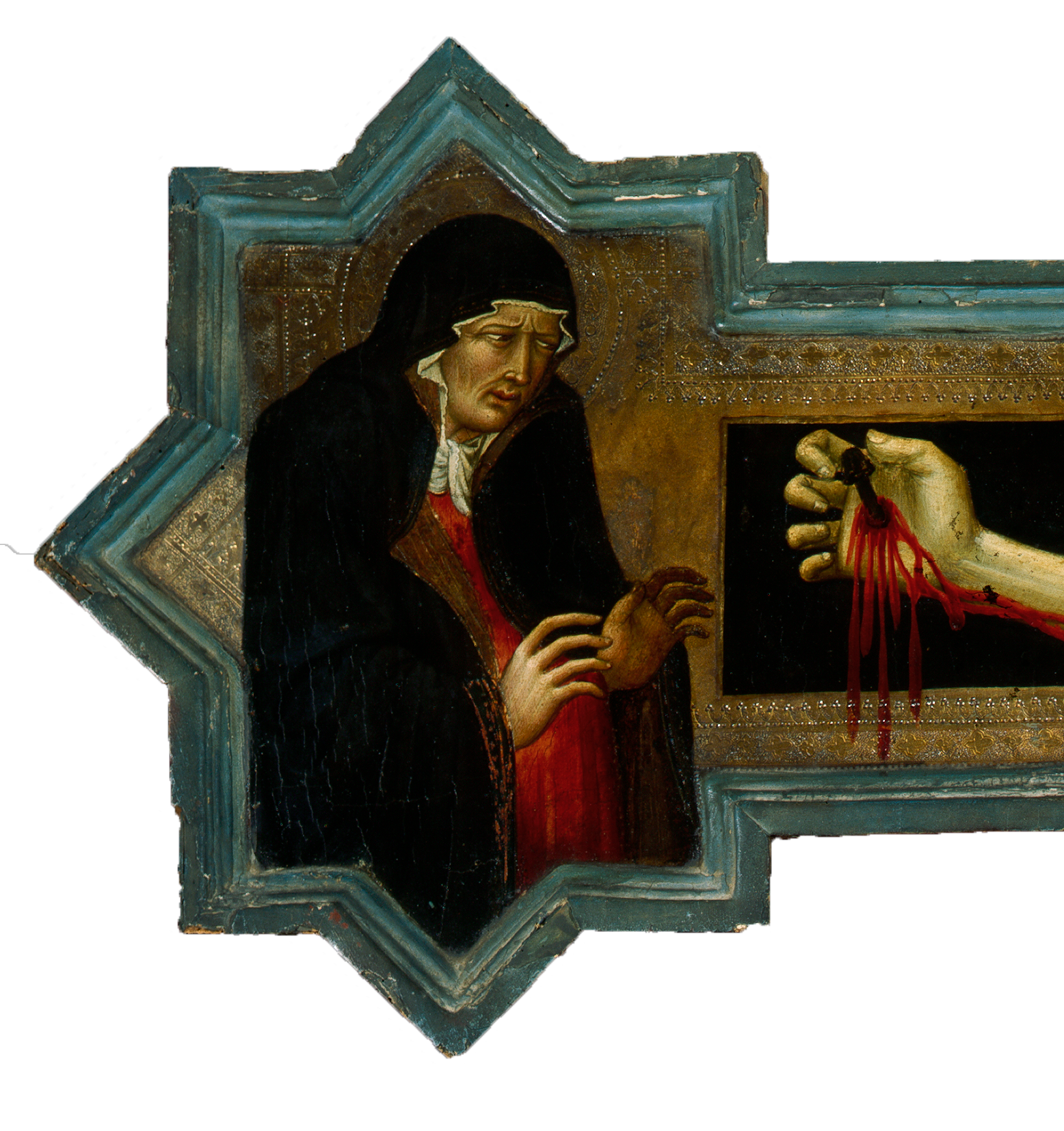
Little is known about Francesco di Vannuccio. Few of his paintings survive. He signed only one work, a double-sided panel now housed in Berlin’s Gemäldegalerie. Despite this small surviving body of work, all of Francesco’s paintings demonstrate that he possessed a keen eye for intricate decoration. He was also closely attuned to the religious concerns of his day. Francesco’s depictions of physical and emotional suffering made him stand out among his fellow artists. In his crucifix, Christ’s arms are pulled taut by the weight of His body. His fingers curl and His feet twist around the piercing nails. Blood spurts in a wide arc from the wound in His chest and drips from His head, hands, and feet. While other crucifixes show the mother of Christ serenely grieving, Francesco painted her face deeply lined in anguish. Poignantly, she reaches for her Son, something not seen in any other fourteenth-century crucifixes. Francesco’s Mary is a mother mourning the loss of her Child, a sight many worshippers would have personally related to following the third outbreak of the Black Death.
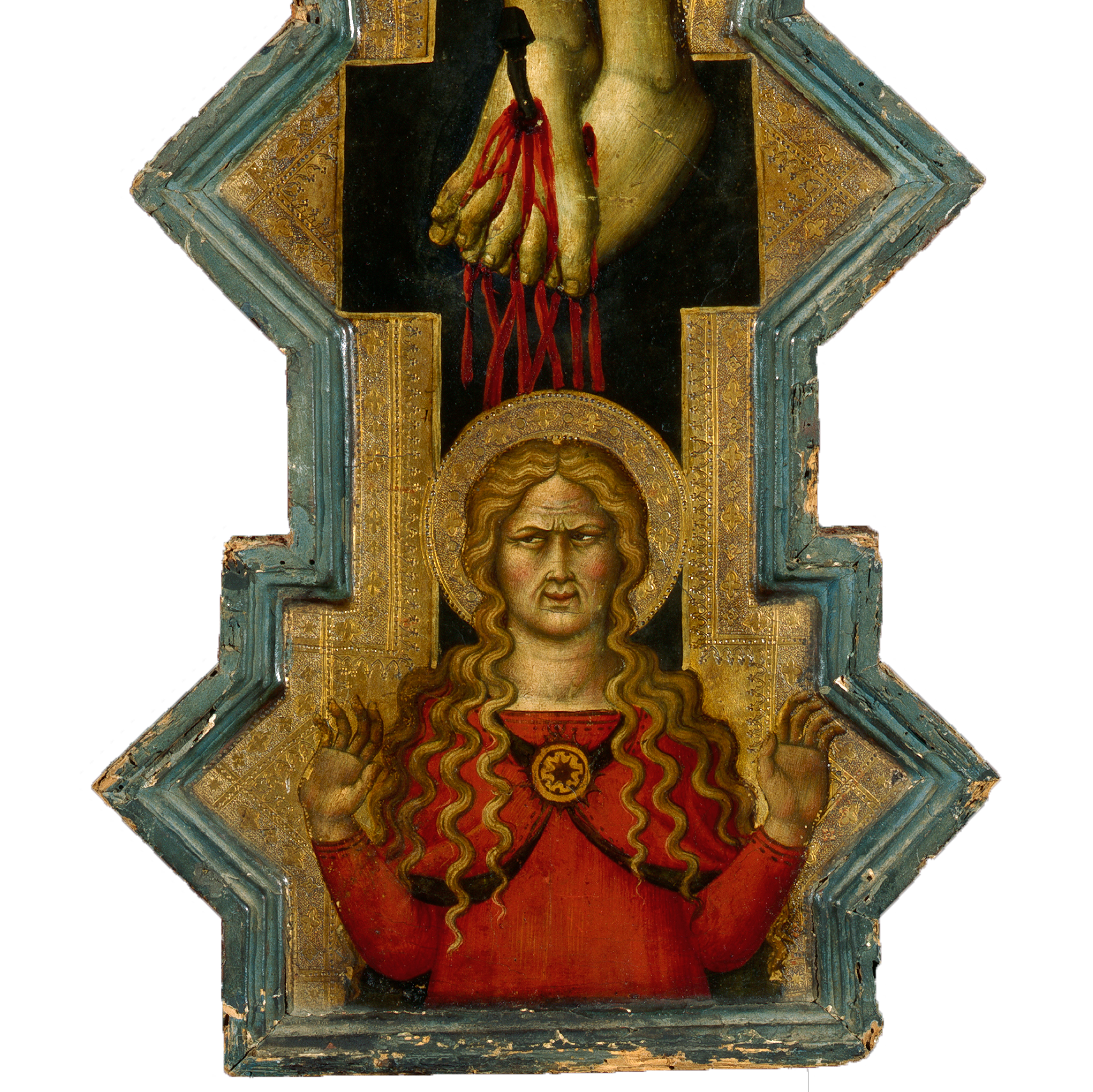 Beneath Christ’s feet, Mary Magdalene prays. Despite being one of the most popular female saints during the fourteenth century, Mary Magdalene’s presence in crucifixes is rare. Most depict her small in scale contemplating the cross. She does not directly engage with the worshipper as Francesco’s does. During the fourteenth century, Mary Magdalene was revered both as the “blessed sinner” (tradition combined her with the repentant sinful woman in Luke 7) and as the “apostle to the apostles” because of her encounter with the resurrected Christ and her role of spreading the news to His other followers. Painting the blood flowing down to her head and her bright red robes, Francesco depicted Mary Magdalene as being baptized in Christ’s blood. With her hands raised in the orans position and facing the worshipper, Francesco also depicted her as the “apostle to the apostles.” The ancient orans pose represented the worshipper’s openness to God’s grace and was a gestural expression of faith in Christ’s death and resurrection. By the fourteenth century, this prayer position was reserved solely for the clergy. Thus, Francesco’s Mary Magdalene is an apostle actively ministering to the worshippers.
Painting Mary Magdalene in this active role, Francesco and his patron were likely inspired by Catherine of Siena (1347-1380). Catherine was a writer and preacher who advocated spiritual reform. She was beloved for her piety and her healing the sick during the third wave of the Black Death. In her ministry, Catherine looked to Mary Magdalene as an example of religious devotion and service. Writing to her female followers, she urged them to “follow the Magdalen, that lovely woman in love, who never let go of the tree of the most holy cross. No, with perseverance she was bathed in the blood of God’s Son…she so filled her memory and heart and understanding with it that she became incapable of loving anything but Christ Jesus.” Mary Magdalene’s love for Christ drove her to brave the Roman soldiers guarding the tomb and proclaim the news of the Resurrection to anyone who would listen.
For worshippers living in the grief-filled years of the late fourteenth century, the sight of Mary Magdalene offered comfort both in the cleansing power of Christ’s sacrifice and His Resurrection. Almost six and a half centuries later, the message of Francesco di Vannuccio’s gleaming cross continues to resonate today.
Dr. Allison Wynne Raper, Adjunct Instructor at York Technical College
For further reading:
Ole J. Benedictow. The Complete History of the Black Death. Woodbridge, Suffolk: The Boydell Press, 2021.
Catherine of Siena. The Letters of Catherine of Siena. Translated by Suzanne Noffke, O.P. 4 Volumes. Tempe, AZ: Arizona Center for Medieval and Renaissance Studies, 2000-2008.
Katherine Ludwig Janson. The Making of the Magdalene: Preaching and Popular Devotion in Late Medieval Italy. Princeton: Princeton University Press, 2000.
Published 2024
Madonna and Child with St. John the Baptist and an Angel
Tempera on panel
Pseudo Pier Francesco Fiorentino
Florentine, active late 15th century
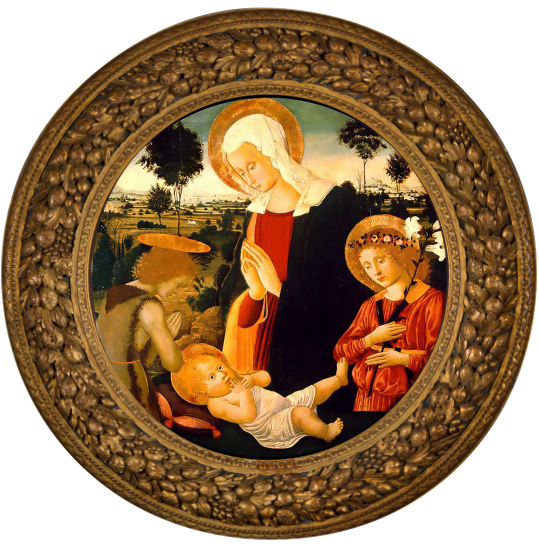
In the 15th century, Florence enjoyed a robust cultural and economic environment. One prominent idea of the era was the rediscovery of the circle and the variety of ways it was used. It may be somewhat humorous in our current culture to recognize that a simple shape could dominate life, but the circle did.
The Renaissance was about advancement—an era full of discoveries. Dias, da Gama, Columbus, and Vespucci found places previously unknown through geographical exploration of our planet, understood then to be round instead of flat. Rediscovery of Greek and Roman mathematical perfections included the circle. The shape was incorporated into architecture in a variety of public and private buildings in Florence. The circle became a symbol of God, the universe, and heaven. Between late 1430 to early 1450, artists began using the circle as part of their painting design in a format called tondo, the Italian word for round.
As a spiritual symbol, the circle became a means of representing the patron saint of Florence, John the Baptist. He was often depicted as a youth, an example to the young people of Florence. Before the Renaissance, paintings focused on individual depictions of saints and biblical characters; however, artist Fra Filippo Lippi is credited with being one of the first to paint John the Baptist together with Mary and the infant Christ in the 1450s. Additionally, Lippi was the first to paint the figures worshipping the Christ Child in adoration as seen in his work, the Annalena Adoration in the Uffizi, Florence. This new subject was the beginning of a popular focus in the late 1400s and well suited to the tondo format.
Filippo Lippi had a bustling workshop with many apprentices including Pesellino and Botticelli. As a favorite of the Medici, Lippi fulfilled numerous private and public commissions, including a Medici tondo now in the National Gallery. While Botticelli is credited with making the round format popular in the late 1400s, Lippi’s studio and apprentices created tondi and essentially mass-produced paintings depicting Mary and John the Baptist adoring the Christ Child to satisfy the public demand.
The Medici family was partly responsible for the popularity of tondi because these round paintings became not only a status symbol of wealth, but also were of spiritual significance in private, devotional settings. To have an object of art that the Medici possessed was a means of connection to them. Tondi existed in the homes of wealthy Florentines and public spaces and soon became popular in other Italian cities. They were not commonly used in churches since they were smaller.
The creator of M&G’s tondo, Madonna and Child with St. John the Baptist and an Angel, is enigmatic. Scholars have been unable to attribute a specific artist, but the work seemed influenced by Pier Francesco Fiorentino yet not painted by him. Hence, the designation of “Pseudo.” However, careful study of the work indicates that its construction predates the surge in popularity of tondi in the 1480s. M&G’s painting is one of the earliest surviving tondi produced after Fra Filippo Lippi’s initial exploration of the adoration subject—a strong representative of the Florentine tondo tradition.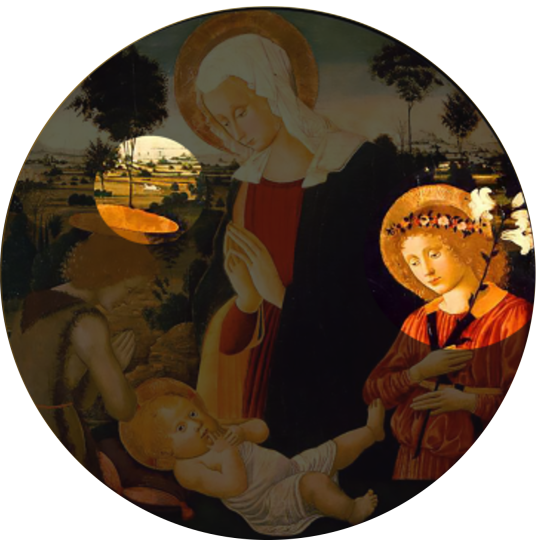
The painting’s details include a unicorn in the background, which is a symbol of Mary’s purity along with the white lily. Her adoring the Christ Child in a country landscape setting may be based on St. Bridget’s Revelations. The halos reveal the influence of naturalism prevalent in the Renaissance style. While the halos of Mary and the angel are typical of the flat Gothic style, the foreshortened, elliptical halo of John the Baptist is shown from a three-dimensional perspective.
As a “window into heaven,” M&G’s tondo has delighted viewers since entering the collection in 1951—the museum’s inaugural year.
John Good, M&G volunteer
Published 2022
Seat of State
Walnut
Italian, 16th century

A throne is usually a large, ornate chair designed to impress. The majesty and power of the one seated on the throne is visually communicated by the throne’s magnificence. Thrones are also designed to intimidate the one who stands, kneels or bows before the one seated upon it. Today the judge’s bench of a courtroom and the dais of an assemblies’ chairman are designed to have a similar effect.
Technically a high backed, multi-seat bench is a settle. Settles generally have arms, and elaborate ones often have canopies. They are generally stationary and may be an architectural feature built into a room. A settee is the settle’s smaller, movable cousin. Today’s couch, sofa or love seat can be called a settee.
In the 15th and 16th centuries various kinds of settles were used in Italian city-states for ceremonial purposes. In the Chamber of the Great Council of the Doge’s Palace in Venice, massive, built-in settles surround the room. Along the front wall is a raised seven-seat settle for officials of the Maggior Consiglio. The central, larger, higher seat was for the Doge.
The three seat Throne of Giuliano Dei Medici (son of Lorenzo the Magnificent) is very similar to M&G’s Seat of State. Although the provenance of Giuliano’s throne is not clear, most likely it originated in Florence. Another elaborate three-seat throne, attributed to Bartolomeo Baglioni, was probably made in the early 1500s for the Strozzi family of Venice (now currently in the Ringling Museum).
Other than the Seat of State being crafted in Italy in the 16th century, its origin is unknown. But similarity to these and other examples, give credence to it having served as the ceremonial seat of an Italian, high-ranking, three-person governmental body.
M&G’s Seat of State lacks features that would associate it with a particular city or individual. The rich profusion of intricate carvings reflects scrolling foliage, mythical beings, grotesque masks and geometric embellishments. There are small crests, but they appear to be stylized ornaments rather than official symbols. Also, they are not located in prominent places where identifying crests could be recognized and appreciated by those in front of the settle.
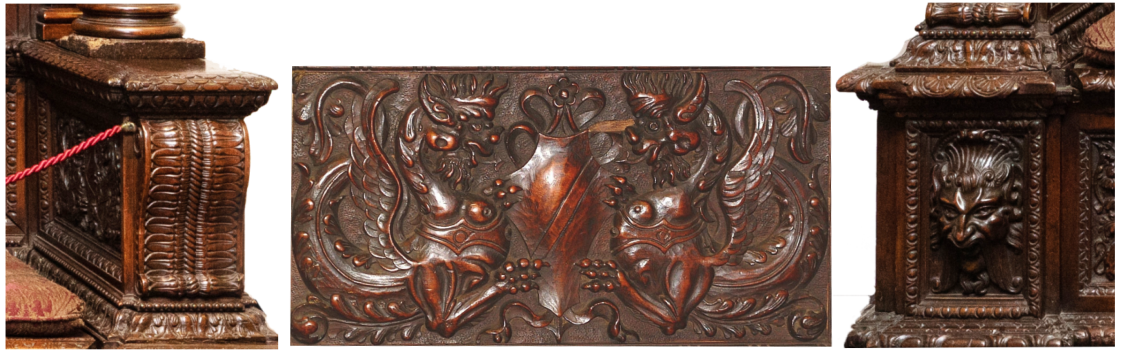
The stylized crests are not in the prominent places where one would expect to find official crests (center image). Highly skilled craftsmen embellished M&G’s massive settle with ornate details (left-right images).
The choir stall, also represented in M&G’s furniture collection, is similar to a settle. Choir stalls generally have uniform, narrow seats. Their high backs and canopies are more for acoustics and aesthetics of the room than aggrandizement of the individuals seated on them. Choir stall seats are often collapsible, permitting the choir to stand or kneel during religious services. The visible carvings of a choir stall generally have religious themes with geometric ornamentation.
The Seat of State is constructed of interlocking pieces of solid walnut fitted together with mortise and tenon joints. The seat is a chest, and each person sits on a hinged lid. Because of the height and depth of the seat, unless you have long legs, you must sit forward on the bench, which makes the back too far away to rest comfortably. The settle’s lack of comfort might have helped to keep ceremonies and meetings short.
Standing in front of M&G’s 10’ high, ornately carved, polished red-brown Seat of State one is impressed with its magnificence. Now, envision being led into that position while three officials in their elaborate ceremonial garb sat on those seats and stared down at you. Will they grant your petition? Will they decide in your favor? Whatever they do, you just know they have the power and authority to do it.
It worked. That is exactly what this settle was to settle in your mind.
William Pinkston, retired educator and M&G volunteer
Published in 2020
The Four Evangelists: Matthew, Mark, Luke, John
Oil on Canvas, 1630s
Guido Reni
Bolognese, 1575-1642
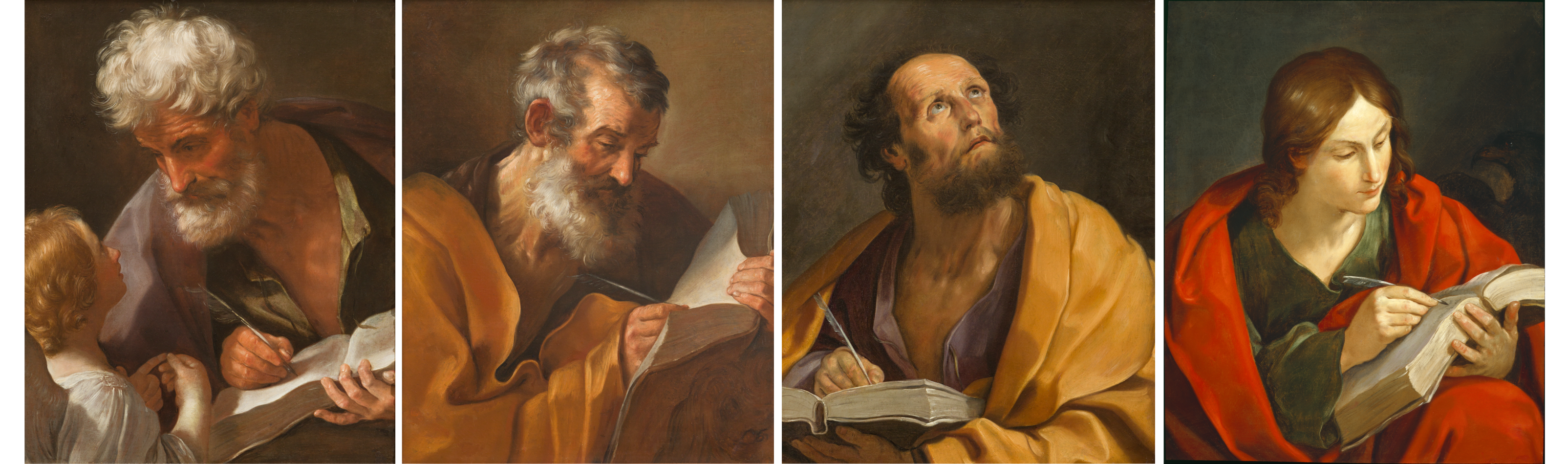
The painter of this elegant series of the Four Evangelists is Guido Reni. Reni is not only one of the most revered 17th-century painters but also one of the Baroque era’s most fascinating personalities. His friend Carlo Cesare Malvasia wrote an illuminating biography acknowledging the painter’s paradoxical character. Although deeply religious, Reni was plagued by an addiction to gambling; although renowned for his generosity, he was notoriously thin-skinned, and although labeled conventionally “prim,” he was one of the few artists of the time willing to mentor female painters (most notably Elisabetta Sirani). Regardless, throughout his life Reni is said to have “cut an impressive aristocratic figure, always fashionably and expensively dressed and usually attended by servants.”
Born in Bologna in 1575, Reni began his training in the studio of Denys Calvaert. In his late teens, he entered the Carracci Academy where he continued studying until 1598 when he embarked on an independent art career. Despite his initial success, he soon realized that to expand (and solidify) his reputation he would have to study in Rome. He left for the “eternal city” in 1601, and for the next thirteen years he immersed himself in Rome’s rich artistic heritage. He returned to Bologna in 1614 and remained there for the rest of his life. His thriving Bolognese studio received commissions from all over Europe, and Ian Chilvers notes, “Rubens was the only contemporary painter who had a more glittering international clientele.”
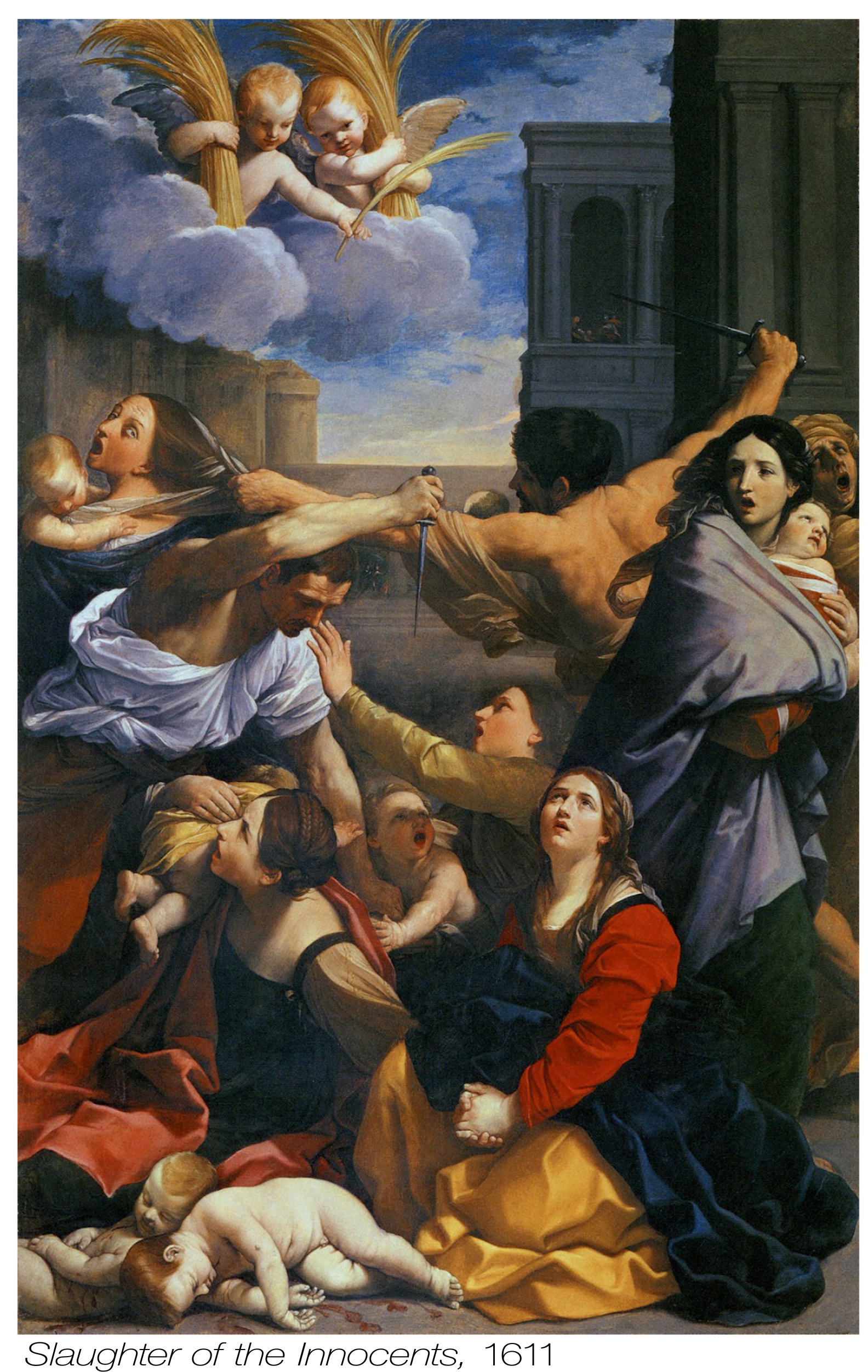
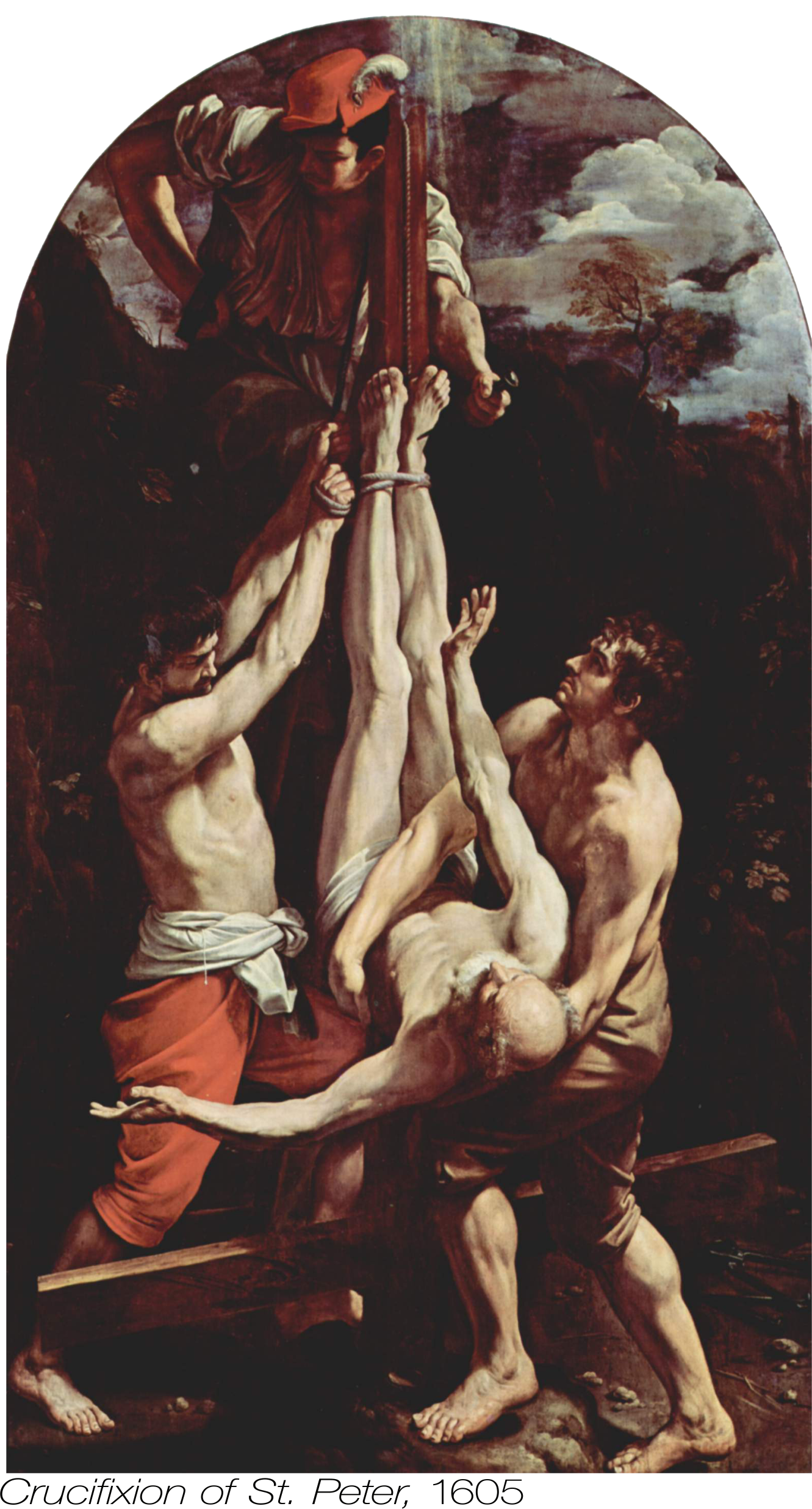
Reni’s 1611 Slaughter of the Innocents reflects the tight brushwork, pristine finishes, and rich coloration of his early work. While in Rome, he did flirt briefly with the popular Caravaggesque style (as seen in the Crucifixion of St. Peter). However, he soon returned to his classical roots. David Steele observes that as his style continued to mature, “his colors become progressively more silvery and his brushwork more free.”
We see evidence of this tonal shift and looser brushwork in M&G’s gospel writers—particularly in the renderings of Matthew, Mark, and Luke. The more vibrant coloration of the St. John figure relates to his iconography. This “beloved disciple” is often dressed in red and green garments (red symbolizing his love for Christ and green representing his faith in the resurrection.) Also apparent in the upper right of John’s canvas is an eagle; this identifier symbolizes the “soaring inspiration” mirrored in the artful imagery that opens his gospel and illuminates his book of revelation. This attribute is derived from the “four living creatures” surrounding God’s throne (referenced in both Ezekiel and Revelation). Each of the gospel writers has an identifier related to these tetramorphs as they are called: Matthew’s is the angel (clearly visible in his portrait), Mark’s is the lion (in the lower right of his canvas), and Luke’s the ox (faintly visible in the upper right of his portrait). Irenaeus of Lyon was the first to associate these mystical creatures with the four gospel writers, but it was the Church Father Jerome who assigned each their specific identifier.
By the end of his life, Reni had become the most famous Italian painter of his day. His style is still regarded as “perfectly poised between formal precision and expressive density” (Baroque Painting, p. 82) Although he briefly fell out of favor during the 19th century, his reputation as the “divine Guido” remains firmly intact.
Donnalynn Hess, Director of Education
Published in 2019
